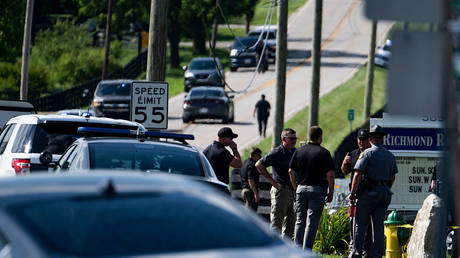
When multiple casualties occur in a public municipal zone, standard journalistic reporting routinely collapses into superficial chronology. Initial media accounts of the recent shooting at Charles Young Park in downtown Lexington, which left five individuals injured and one dead, typically reduce a complex systemic failure to a string of raw statistics and fragmented witness statements. Deconstructing urban kinetic incidents requires shifting from descriptive reporting to diagnostic structural analysis, examining municipal response architecture, public space vulnerability matrices, and the specific mechanics of emergency intervention efficacy.
The Spatial Vulnerability Matrix of Urban Parks
Public parks occupy a distinct topological category within municipal infrastructure. Designed for open access and community aggregation, they inherently lack the perimeter security controls characteristic of private commercial assets or government installations. Analyzing the Charles Young Park incident requires evaluating how open-access urban zones function under stress.
The security architecture of municipal spaces relies on three distinct layers:
- Ambient surveillance and natural line-of-sight visibility.
- Municipal patrol frequency and response time vectors.
- Social cohesion and crowd-density dynamics.
When a kinetic event unfolds in an unconstrained environment, the absence of physical hardening means that injury mitigation depends entirely on rapid neutralizing intervention by law enforcement or immediate trauma care execution by bystanders. In the Lexington incident, the presence of vulnerable populations—including minors, with a four-year-old and a fourteen-year-old among the injured—underscores how open-access spatial design multiplies the casualty surface area during active hostility.
Quantifying Emergency Response Vectors
The efficacy of emergency services following an urban shooting event is governed by a strict operational formula known as the response-to-stabilization timeline. This timeline breaks down into three sequential phases:
- The detection and notification interval, measuring the duration between the initial discharge and the dispatch of first responders through automated acoustic sensors, 911 aggregation, or direct observation.
- The transit and containment interval, defined by the physical movement of law enforcement units through urban traffic bottlenecks to secure the perimeter and neutralize ongoing threats.
- The triage and medical extraction interval, dictating how quickly victims with penetrating trauma receive advanced life support and surgical intervention.
In high-density municipal zones, response times fluctuate based on arterial road congestion and the precise positioning of precinct units. While local authorities established an immediate perimeter and deployed emergency medical services to transport victims, the variance between injury onset and trauma center admission remains the primary variable determining survival rates in mass-casualty incidents. Penetrating trauma involving multiple victims strains local emergency room capacities, creating secondary triage bottlenecks that test regional medical infrastructure resilience.
Systemic Precursors and Institutional Blind Spots
Municipal violence rarely occurs in a vacuum; it functions as the acute manifestation of chronic systemic failures within community safety networks. Conventional crime reporting isolates individual incidents, treating them as anomalies rather than predictable outputs of underlying socioeconomic and behavioral friction points.
Addressing urban firearm violence requires isolating structural risk factors:
- The availability and illicit circulation vectors of firearms within local municipal jurisdictions.
- The breakdown of local conflict resolution frameworks in public spaces.
- The operational gaps in predictive intelligence and intervention programs targeting high-risk individuals.
Public safety strategies that rely solely on reactive policing fail to alter the baseline probability of kinetic events. True municipal resilience demands predictive resource allocation, targeting hot-spot zones with intensified community intervention initiatives before behavioral escalation reaches the threshold of lethal violence.
Strategic Directives for Municipal Defense
To transition from post-incident crisis management to proactive threat mitigation, city administrators must deploy a multi-vector operational framework. Municipalities must audit urban park infrastructure to balance open community access with strategic sightlines, environmental design modifications, and targeted surveillance integration that preserves civil liberties while deterring targeted violence. Concurrently, emergency response protocols require continuous stress-testing to compress the triage and extraction intervals, ensuring that field medical interventions match the speed of kinetic threats. The metric of a secure city is not merely the speed of the police response after shots are fired, but the systemic dismantling of the precursors that make those shots possible in the first place.


