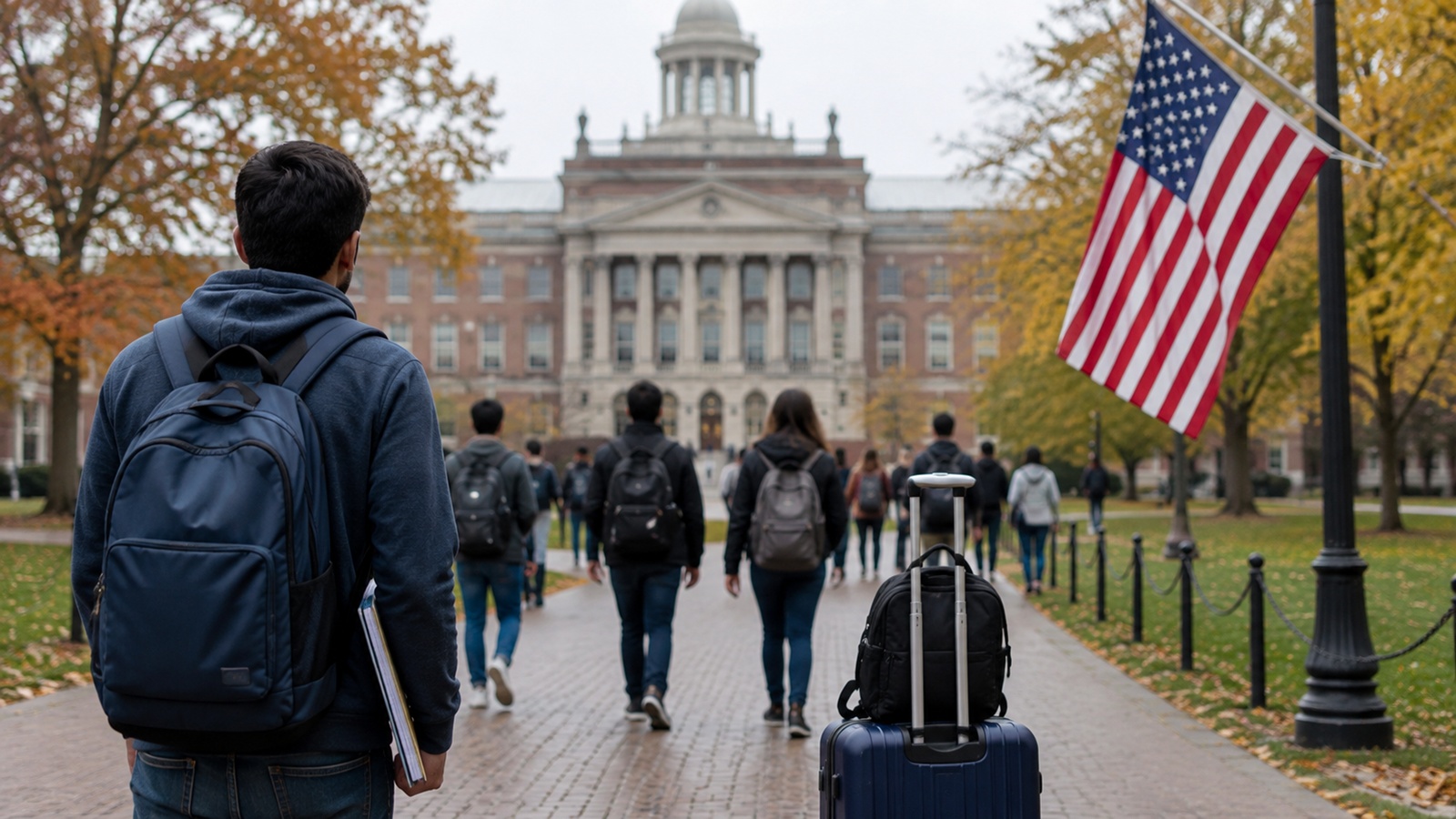
US student enrolment is projected to plummet by 9.5 percent, a demographic shockwave that alters the calculus for international scholars, particularly those from India. Domestic campus halls are emptying due to falling birth rates following the 2008 financial crisis, forcing universities to rethink their survival strategies. For years, institutions treated Indian applicants as tuition cash cows to plug domestic budget holes. Now, rising visa scrutiny, runaway living costs, and diminishing return on investment are convincing ambitious students in Mumbai and New Delhi to look elsewhere.
The Domestic Demographics Crisis Driving The Shift
American higher education faces a slow-motion demographic trainwreck. Birth rates plummeted nearly two decades ago, and the echo of that drop is finally hitting college admissions offices. Fewer teenagers mean empty freshman dorms, vanishing lecture sections, and severe budget deficits for regional universities that depend entirely on tuition revenue to keep the lights on. Recently making news in this space: Why Trump Tariffs on Chinese Drones Will Completely Backfire.
Administrators panicked. They looked across the Pacific Ocean for a lifeboat.
Indian students filled the vacuum. Applications surged as families liquidated assets, took out massive education loans, and pinned their hopes on the American dream. Campuses marketed themselves aggressively, promising world-class degrees and lucrative career pathways. Additional details regarding the matter are explored by Bloomberg.
Yet the math no longer adds up. When a regional American college loses twenty percent of its domestic base, it cannot simply recruit its way out of the deficit with foreign arrivals. The sheer volume required to offset domestic losses creates a dangerous dependency.
Why Indian Families Are Rethinking The US Option
The financial reality has turned hostile. Tuition inflation outpaces standard inflation by orders of magnitude. Add metropolitan rent inflation in cities like Boston, New York, or San Diego, and a master's degree easily crosses the six-figure debt threshold.
Employment pathways have grown jagged. The H-1B visa lottery remains a broken bottleneck of random selection, leaving graduates who spent small fortunes on tuition at the mercy of a computer algorithm. When lottery numbers fail, graduates face a frantic scramble for alternative statuses, day-one CPT traps, or sudden repatriation.
Consider a hypothetical case. An engineer from Pune borrows fifty thousand dollars against her family home to study data analytics in Ohio. She graduates into a tech sector undergoing massive corporate belt-tightening and hiring freezes. Her optional practical training clock ticks down while employers routinely reject applicants requiring visa sponsorship. She returns home owing debt denominated in dollars while earning a starting salary pegged to rupees.
That narrative travels fast back home. WhatsApp groups and alumni forums expose the gilded marketing brochures as expensive gambles.
The Changing Global Educational Menu
Alternative destinations smell blood in the water. Germany offers tuition-free or low-cost public university education paired with straightforward post-graduation work rights. Canada, despite recent immigration caps, still provides clear, points-based permanent residency pathways that America refuses to match. Ireland and the United Kingdom have streamlined their post-study work visas precisely to capture the talent fleeing the American administrative labyrinth.
Indian applicants are rational actors. They calculate risk, cost, and reward with cold precision. If an American degree requires clearing hurdle after bureaucratic hurdle only to end in deportation or chronic underemployment, the rational choice is to pivot toward London, Berlin, or Toronto.
Universities caught in the enrollment crunch are responding with mixed tactics. Elite institutions remain insulated by massive endowments and pristine brand equity, but middle-tier and lower-tier institutions are scrambling. Some are lowering admission standards to capture volume, which inadvertently degrades the perceived value of the credential itself. Others are establishing offshore branch campuses or partnering directly with Indian universities to deliver dual degrees locally, bypassing the visa crisis entirely.
The Structural Reckoning For American Campuses
The 9.5 percent drop is not a temporary dip. It is a permanent structural contraction. Campuses built for expansion must now learn to downsize. Academic departments that relied on international student fees to cross-subsidize non-revenue-generating programs face severe budget cuts.
Administrators who treated international recruitment as a magic wand failed to build sustainable institutional partnerships. They viewed students as financial transactions rather than academic investments. The chickens have come home to roost.
Indian students see the writing on the wall. They are no longer willing to finance the administrative bloat of struggling American colleges while carrying all the risk of a volatile immigration policy.
The era of effortless international recruitment is over. American higher education must either fix its structural flaws and offer genuine, secure career pathways or watch its international applicant pools dry up entirely.