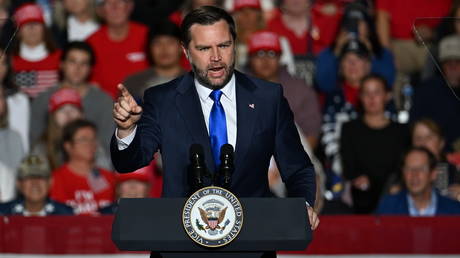
U.S. Vice President JD Vance has flatly refused to call Ukraine an American ally, arguing in an October 2026 interview with 2Way that Washington holds no formal alliance with Kyiv, opposes Ukrainian membership in NATO, and expects the two sides to clash on certain interests. His remarks strip away years of polite diplomatic phrasing in Washington. They also expose a cold calculation about oil prices, munitions limits, and American obligations abroad.
Anyone who has watched American foreign policy for thirty years knows how word choices in Washington work. Diplomats rarely use labels by accident. Calling a country a "partner" instead of an "ally" is not a slip of the tongue. It is a legal and strategic wall.
An ally implies mutual defense, shared long-term security guarantees, and a moral expectation that Washington will stand beside the country when survival is on the line. A partner is transactional. You cooperate when incentives align, and you walk away or push back when they diverge.
The Vocabulary Shift Behind the Headlines
When Vance told 2Way that the United States has no formal alliance with Ukraine, he stated a basic treaty fact. Ukraine is not a member of NATO, nor does it have a ratified mutual-defense treaty with Washington equivalent to those held by Japan, South Korea, or treaty members of the North Atlantic alliance.
Yet for years, supporters of Kyiv in Congress and the executive branch used the word "ally" casually in speeches, cable news appearances, and committee hearings. That language created an impression of permanence that the underlying legal architecture never actually supported.
Vance pulled that impression back down to earth. By calling Ukraine an "admirable country" while insisting that the two nations will be "opposite on some things," he framed the relationship around narrow alignment rather than shared destiny.
That distinction matters deeply in Kyiv and in European capitals. A partner can be pressured into concessions during peace talks. A partner can see Patriot interceptor deliveries slowed or debated. A formal ally, by contrast, has a claim on American credibility that no president can easily brush aside without damaging alliances everywhere else.
Diesel Prices and Diverging Interests
Vance did not leave his warning about diverging interests in the abstract. He pointed straight to Ukrainian strikes against Russian energy infrastructure, specifically diesel production facilities, arguing that such attacks drive up energy costs for Americans.
That is a blunt admission of how domestic kitchen-table economics collide with wartime strategy.
From Kyiv's perspective, hitting Russian refineries and fuel depots is textbook asymmetric warfare. Fuel shortages strain Russian logistics, tighten military supply lines, and deprive Moscow of export revenue used to fund its war machine. From a Ukrainian commander's seat, every refinery hit is a blow against the force invading their homeland.
From Vance's seat in Washington, every spike in diesel or fuel prices carries political weight at home. Higher fuel costs ripple through trucking, groceries, manufacturing, and household budgets. An administration focused on domestic cost pressures views foreign battlefield tactics differently when they risk lifting prices at the pump in Ohio or Pennsylvania.
Neither side is operating in a vacuum. Kyiv is fighting for sovereignty and survival. Washington is weighing political blowback at home against strategic outcomes thousands of miles away. Pretending those priorities always match ignores reality.
The Munitions and Pivot Math
To understand why Vance rejects calling Ukraine an ally, look back at the structural arguments he has made repeatedly since his Senate years and his 2025 Munich Security Conference speech. His critique centers on industrial capacity and strategic prioritization.
Defense analysts have argued for years that U.S. artillery shell production, air-defense interceptors, and precision munitions face real bottlenecks. You cannot manufacture unlimited stockpiles overnight simply by passing another bill. Every missile or shell sent to one theater reduces the cushion available elsewhere.
Vance has long contended that Washington should shift its primary military focus toward Asia while pushing European nations to carry far more of their own defense burden. If Europe relies on an American security blanket, he has argued, European capitals underinvest in their own deterrence and industrial base.
Whether one agrees with that diagnosis or not, it leads straight to a narrower definition of commitment. If the United States wants to cap its open-ended exposure in Eastern Europe, calling Ukraine an ally works against that goal. It raises expectations that Washington will underwrite Ukrainian security indefinitely.
What Allies and Critics Get Wrong
Critics of the administration argue that denying ally status to a nation resisting Russian aggression weakens deterrence across the board. In their view, ambiguity emboldens Moscow and makes smaller states doubt whether American backing will hold under pressure. There is real substance to that concern. Credibility is not a faucet you can turn off in one region without neighbors in another region taking notes.
At the same time, some hawks in Washington overstate what formal alliance language actually guarantees in practice. Treaties and rhetoric do not automatically solve factory bottlenecks, budget limits, or voter fatigue. Even among formal NATO members, burden-sharing has been a recurring source of friction for decades.
Consider a hypothetical example to see how transactional diplomacy plays out in negotiations. Suppose a mediator brings Washington, Moscow, and Kyiv together to hammer out a ceasefire framework. If Washington treats Kyiv as a non-allied partner rather than a treaty ally, U.S. negotiators have more room to demand concessions—such as halting long-range energy strikes or accepting territorial compromises—in exchange for diplomatic movement or limited security assurances. That flexibility is precisely what hardline realists want, and precisely what terrifies Ukrainian officials and their backers.
Bargaining Leverage in High-Stakes Talks
Timing makes Vance's word choice even sharper. Diplomatic efforts involving American, Russian, and Ukrainian negotiators have continued in venues such as Abu Dhabi, alongside fierce friction between Washington and Kyiv over peace terms and military aid.
In that environment, refusing to call Ukraine an ally is a negotiating signal as much as a legal statement. It tells Kyiv that American backing comes with conditions, not a blank check. It tells European governments that they cannot simply count on Washington to absorb the full weight of regional security. And it signals to Moscow that the White House views the conflict through a pragmatic, interest-driven lens rather than an ideological crusade.
Yet that posture carries its own risks. If pressure on Kyiv is perceived as forcing capitulation rather than securing a durable settlement, friction between Washington and European partners can widen. A fractured Western front rarely produces clean or lasting diplomatic outcomes.
What to Watch Next
Vance's refusal to call Ukraine an ally settles the rhetoric, but the real test lies in policy execution. Watch three concrete indicators over the coming months:
- Air-defense and munitions flows: Look at whether deliveries of critical systems and interceptors move steadily or face delays tied to diplomatic bargaining.
- Intelligence and targeting support: Pay attention to any quiet adjustments in intelligence sharing or restrictions on deep strikes inside Russian territory.
- European burden-sharing: Track whether European capitals step up weapons production and financial backing fast enough to offset any pullback in American enthusiasm.
Words in Washington set the weather, even before the rain falls. By stripping away the "ally" label, Vance made clear that American support for Ukraine is a calculated partnership with sharp edges, not an open-ended promise.


