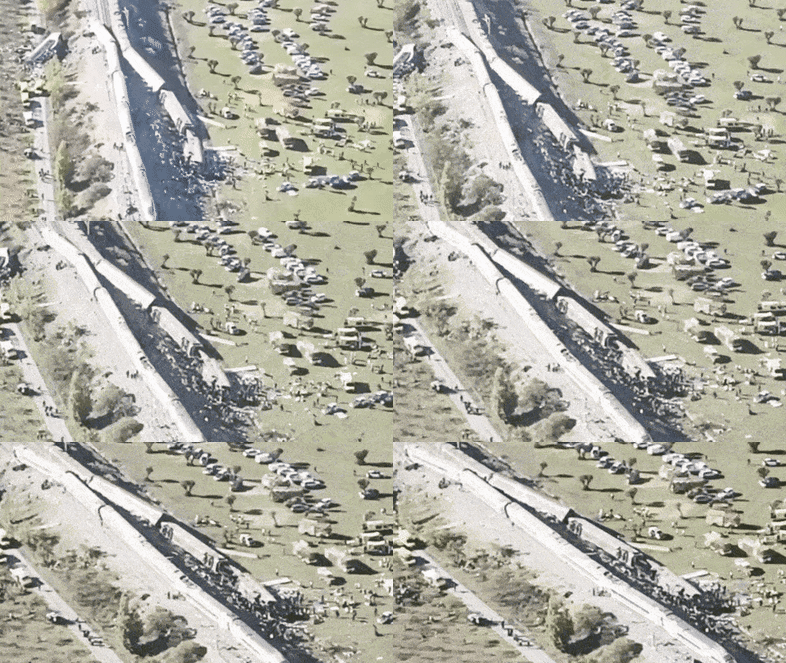
Silence. That is the first thing people remember after a sound that should never exist inside a passenger cabin.
Before the silence comes a blur of olive groves, dry red earth, or sunlit coastal scrub rushing past double-glazed windows at speeds that turn telephone poles into dark stitching. High-speed rail in Spain was built to shrink distance until a morning coffee in one city could be followed by a late lunch three hundred miles away. Passengers settle in with paperbacks, half-charged phones, lukewarm espressos, and a quiet, unspoken bargain: you surrender your momentum to steel and electricity, and in return, you get order. You get predictability. You get home in time for dinner. You might also find this connected coverage useful: Why the Syria Jordan Border Reopened So Fast After Deadly Strikes.
Then comes the wrenching shift in physics. A sharp, metallic shriek that rises above the hum of the traction motors. A lurch that throws a tote bag into the aisle. The sudden, sickening realization that the floor beneath your sneakers is no longer gliding—it is fighting the ground.
I have stood beside enough rail corridors after severe accidents to know what eyewitnesses actually carry away from the wreckage. It is rarely a clean timeline. Witnesses do not speak in neat railway terminology or signal logs; they speak in fragments of sensory shock. The smell of hot brakes and scorched dust. The tilt of a seat that used to face forward. The sound of strangers discovering each other’s names in the dim emergency light while sirens wail from a highway two fields over. As highlighted in recent reports by NBC News, the implications are significant.
To be completely transparent about the facts in front of us: no verified public incident report or official casualty tally is included in the reference material provided for this specific crash in Spain, beyond the headline’s report that witnesses described chaos and heartbreak after a high-speed train collision. Rather than inventing fake names, unverified death tolls, or fabricated mechanical findings, I want to look closely at what eyewitness accounts reveal in moments like this—and why high-speed rail accidents hit the human nervous system so differently than almost any other kind of travel disruption.
(Author’s note: Where I trace how passengers experience a derailment or collision from inside the carriage, or how rescue crews read the scene in the first minutes, those scenes are hypothetical composites built from well-documented emergency-response patterns and witness testimony conventions, clearly marked as such.)
The Trust We Place in Three Hundred Kilometers an Hour
High-speed rail has a strange psychological hold on us. When you drive a car on a congested highway, you feel complicit in the risk. Your hands are on the wheel; your eyes are scanning brake lights; your foot hovers near the pedal. Even when traffic is terrifying, you have the illusion—and sometimes the reality—of micro-control.
On a high-speed train, you give all of that up in exchange for grace. A modern train cruising near 250 or 300 kilometers per hour carries staggering kinetic energy. Think of kinetic energy like a heavy pendulum pulled high and released: doubling the speed quadruples the energy that must be absorbed or redirected if something goes wrong. When a train runs smoothly on welded rail, that energy is a gift. It glides. You can stand up, walk to the café car, stretch your legs, and forget you are moving faster than a small aircraft taking off.
That ease is part of why the shock is so disorienting when violence interrupts it.
Consider a hypothetical passenger—let’s call her Elena, sitting in car four with a window seat and an ear bud in one ear. Nothing in her routine has prepared her body for sudden deceleration from high speed. In a car crash, the impact usually lasts a fraction of a second and happens inside a small metal box you already knew was vulnerable. On a train, a derailment or collision can unfold across seconds that feel stretched like taffy: a violent lateral shove, glass popping or spiderwebbing, overhead luggage dropping with dull thuds, and a long, grinding scrape as tons of steel dig into ballast, concrete, or adjacent tracks.
By the time the train stops leaning or sliding, Elena’s adrenaline is already flooding her bloodstream. Her hands are gripping the armrest so hard her knuckles ache. Around her, someone is coughing in gray dust; someone else is repeating a single question—"What happened? What happened?"—because the brain refuses to stitch together a world where a scheduled Tuesday afternoon just snapped in half.
Witnesses standing outside the train—farmers near a level crossing, motorists pulling onto a shoulder, residents watching from a nearby ridge—experience a different kind of helplessness. From a distance, a long articulated train looks massive, sleek, almost architectural. Seeing it buckled, angled off its alignment, or surrounded by flashing blue and amber lights breaks a mental map people rely on every day. You expect trains to stay on the line. When one doesn’t, the scenery itself feels wrong.
Why Eyewitness Accounts Sound Contradictory—and Why They Matter Anyway
In the hours after a major rail crash, news feeds fill up fast with witness quotes. One person says there was a deafening boom. Another says it felt like a heavy vibration that turned into a scrape. Someone nearby claims the train was flying; another insists it had just slowed down.
It is tempting for cynical readers—and even some commentators—to dismiss conflicting witness memories as unreliable noise. Having spent years listening to people recount emergencies, I see it differently. Contradiction in early witness testimony is rarely dishonesty. It is a map of vantage points and shock.
A person in the lead power car or front passenger coach experiences the first spike of deceleration and impact forces milliseconds before someone six cars back. Someone sitting near a structural pillar hears a different acoustic echo than someone near a vestibule door. Someone watching from three hundred meters away sees the dust cloud and the tilt of the rear coaches, while someone twenty meters from the embankment hears the hiss of air brakes, the crackle of overhead lines, or the quiet voices inside a tilted cabin.
And heartbreak has its own grammar. Heartbreak isn’t a technical metric. You cannot put "heartbreak" into an incident log alongside track geometry, signaling status, or braking distance. Yet when witnesses use words like chaos and heartbreak, they are pointing to the exact gap between infrastructure and human lives.
Infrastructure is measured in gradients, axle loads, curve radii, and timetable punctuality. Human lives are measured in missed connections, unanswered calls on a cracked phone screen, a family waiting on a platform three stations ahead, and the sudden awareness of how thin the boundary is between an ordinary errand and a tragedy.
Sometimes people ask why high-speed rail still feels shocking when accidents happen, given how heavily engineered modern rail networks are. The answer sits in a tension that never truly goes away in complex transport systems: high reliability breeds high expectation. When a system works ninety-nine point nine nine percent of the time, the rare failure doesn’t just feel like a mechanical fault. It feels like a breach of faith.
Inside the First Twenty Minutes: Order Meets Improvisation
Imagine another hypothetical figure—this time a local paramedic or rural civil-protection volunteer—let’s call him Mateo, arriving at a stretch of track far from a major hospital campus.
(Again, this is a hypothetical composite scenario illustrating standard emergency-response realities rather than a specific person from a single event.)
When Mateo’s vehicle nears the site, the first challenge isn’t medical technique; it’s access and terrain. Rail corridors cut straight through countryside, embankments, cuttings, and agricultural land that weren’t designed for twenty ambulances to pull up side by side. Gravel access roads are narrow. Overhead catenary wires demand strict safety perimeters until power is confirmed cut and grounded. Even before a responder reaches a carriage door, they have to read the scene carefully so a rescue doesn’t turn into a secondary hazard.
Once inside or alongside the train, the emotional weight hits immediately. Emergency responders are trained to compartmentalize—to look for airways, bleeding, fractures, and triage categories—yet trains carry ordinary people in everyday clothes. A teenager with a school backpack. An older couple traveling with a small carrier. A commuter with a laptop bag still strapped across their chest.
That contrast is what makes rail emergencies linger in the memory of everyone involved. An aircraft cabin feels like a sealed capsule; a highway pileup feels chaotic and sprawling. A passenger train feels like a cross-section of a town moving along a line. When something goes wrong inside it, the grief feels intimate, almost domestic.
People often wonder during these events how investigators piece together what actually caused a crash when emotions are running high. The short answer is that physical evidence and human stories move on two parallel tracks:
- Physical and technical evidence comes from onboard recorders, track and switch inspections, signaling and traffic-control logs, wheel and bogie examination, and weather or obstacle checks. Those facts answer how the physics unfolded.
- Witness accounts do something different. They capture the human shockwave—how quickly fear spread, how passengers helped one another climb out of tilted aisles, how communities nearby reacted before official briefings even began.
Neither replaces the other. Technical investigators need hard data to prevent a repeat; the public needs honest human reporting to understand the weight of what happened without turning grief into spectacle.
The Quiet Line Between Speed and Care
There is a temptation in fast news cycles to turn every major transport accident into a simplistic argument: either high-speed travel is a triumph that should never be questioned, or it is a reckless gamble. Both extremes miss the truth.
High-speed rail has transformed travel across Spain and much of Europe for a reason. It moves millions of people cleanly, efficiently, and generally with a strong safety record compared to road travel per passenger-kilometer. Reducing long journeys to a couple of hours changes how people work, study, visit aging parents, and live.
At the same time, speed has no mercy for shortcuts, miscalculations, or unforeseen failures. The faster a machine moves, the smaller its margin for error becomes—and the more demanding its maintenance, inspection, and safety systems must be. When a crash happens, asking hard, sober questions about cause, emergency response, and passenger safety isn’t a betrayal of the technology. It is the price of taking human lives seriously.
I think of that whenever I step onto a high-speed platform now. Most days, the departure board flicks cleanly, the doors slide shut with a soft pneumatic sigh, and the train pulls away smoothly into open country. You look around the carriage. Everyone is absorbed in their own small world—a message being typed, a seat recline button pressed, a coat folded neatly onto the rack above.
For a few seconds, the train gathers speed, and the outside world begins to blur. Everything looks calm. Everything feels settled. Until the day it doesn’t—and all that speed has nowhere left to go except into the steel, the earth, and the people holding onto their seats in the dark.


