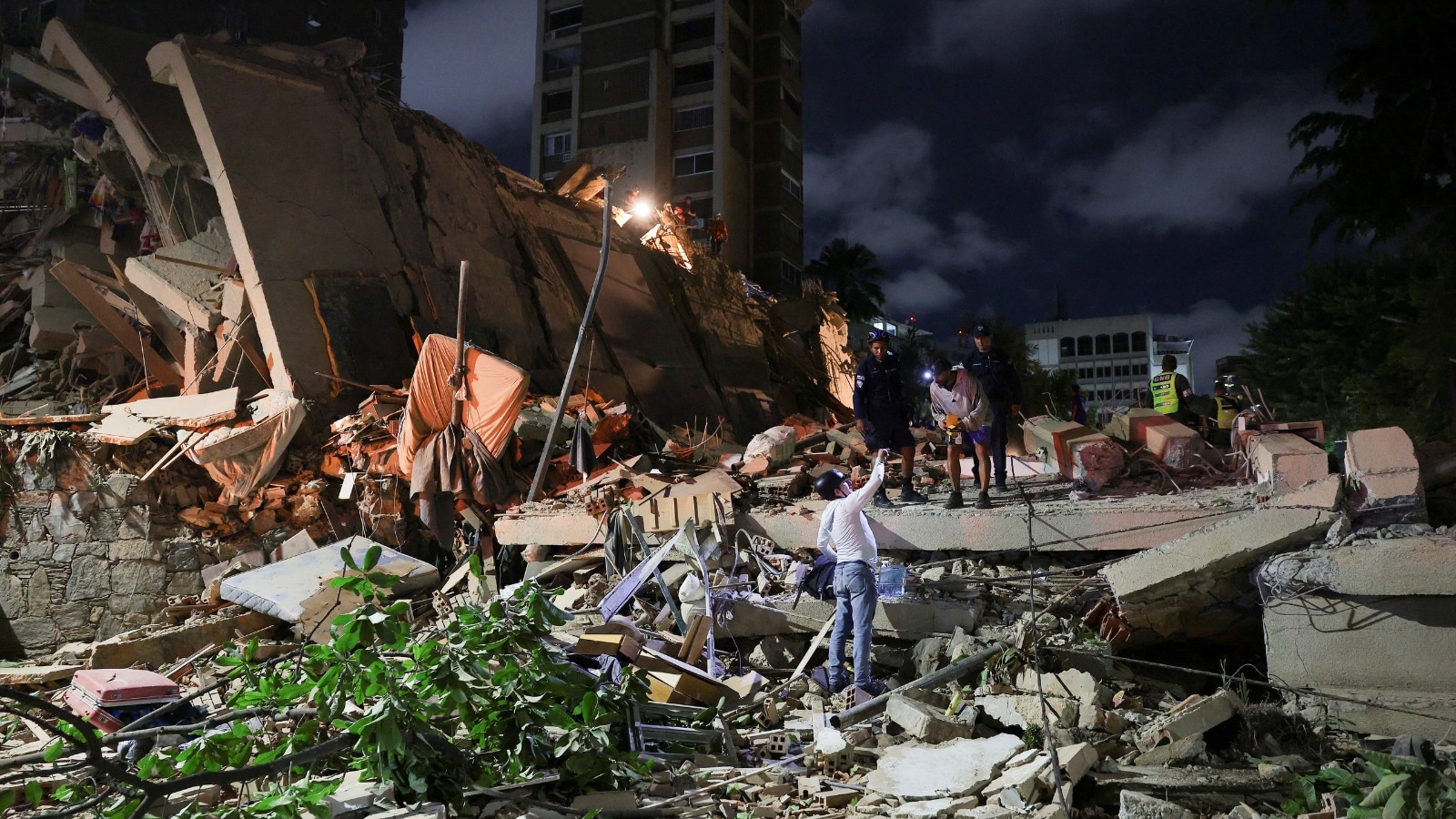
The ground didn't just shake in Venezuela on Wednesday evening. It split the fragile political reality wide open. Within a span of less than sixty seconds, two massive earthquakes ripped through the northern coast, leaving a trail of collapsed buildings, severed power lines, and sheer terror. The initial official count stands at 32 dead and over 700 injured, but anyone on the ground knows those numbers are a tiny fraction of the impending reality.
The first shock hit at 6:04 p.m. local time. It was a 7.2 magnitude quake centered near San Felipe. Before people could even process the screaming and the violent sway of their living rooms, an even bigger 7.5 magnitude monster struck just forty seconds later near Yumare. This wasn't just a standard tremor. This double-seismic event ranks as the strongest earthquake sequence to hit the country in over 125 years.
The Twin Shocks and Why They Were So Deadly
Seismologists from the United States Geological Survey confirmed that the epicenters were only about three miles apart. That proximity created a physical hammering effect. The first shock weakened thousands of older concrete structures across northern Venezuela, and the second, more powerful mainshock completely brought them down.
The timing made things much worse. Wednesday was a national holiday celebrating the 1821 military victory at the Battle of Carabobo. Families were gathered inside their homes, enjoying a day off, when the walls started crumbling. In Caracas, roughly 200 miles from the epicenter, high-rises swayed like trees in a storm. Things flew out of refrigerators. People rushed down dark stairwells into the streets, screaming as chunks of concrete rained down from the skies.
The structural destruction is severe. In La Guaira, a coastal city north of the capital, dozens of residential buildings are now flat piles of rubble. The country's primary aviation hub, Maiquetia International Airport, shut down operations completely after its infrastructure suffered major structural failures.
A Country Already on the Brink
To understand why this disaster is so terrifying, you have to look at the current political state of the country. Venezuela has been operating under an interim government led by Delcy Rodríguez since a military raid in January resulted in the capture of Nicolás Maduro. The political system is fragile. The economy is broken. Infrastructure was failing long before the ground started moving.
Rodríguez appeared on national television to declare a state of emergency, her voice shaking as she extended condolences to the victims. She openly admitted the death toll will rise as rescue crews dig through the debris.
But the scientific data paints an even darker picture than the official statements. The USGS PAGER system, which models human and structural losses after major seismic events, released a harrowing forecast. Their models show a 44% chance that the final death toll could surpass 10,000 people. There is even a 30% chance it goes higher than 100,000.
The reason for these numbers comes down to building codes. For decades, local construction ignored modern seismic standards. High-density neighborhoods crawl up the hillsides of Caracas and surrounding cities, built with heavy concrete roofs and weak reinforcement. When a 7.5 magnitude quake hits structures like that, they pancake instantly.
Washington Steps In with Big Promises
The geopolitical response was almost immediate. United States President Donald Trump took to Truth Social to pledge American support, signaling a massive shift in how Washington intends to handle its relationship with the new Venezuelan leadership.
Trump stated that the two major earthquakes left a devastating number of deaths and declared that the United States stands ready, willing, and able to help. He claimed he instructed all government agencies to prepare to move quickly, calling the Venezuelan people "our new and great friends."
Shortly after Trump's post, Secretary of State Marco Rubio confirmed that the State Department began deploying specialized search and rescue teams, medical resources, and emergency humanitarian supplies. Deputy Secretary of State Christopher Landau also stated that American officials are in direct contact with the Rodríguez administration to coordinate the logistics of the incoming aid.
This fast action isn't just about charity. It's an aggressive move to solidify ties with the interim government and establish a strong footprint in a region that was hostile to US interests for decades.
The Immediate Crisis on the Ground
Right now, the priority is finding survivors. In the hours following the twin quakes, emergency workers and regular citizens used their bare hands to pull screaming survivors from collapsed concrete slabs in downtown Caracas and surrounding towns.
Initial tsunami warnings threw the Caribbean into panic. The US Tsunami Warning System issued urgent alerts for Puerto Rico, the US Virgin Islands, and the British Virgin Islands, while warning of dangerous waves for Aruba and Curacao. Fortunately, those warnings were canceled an hour later when ocean data showed the displacement didn't trigger a massive sea wave.
But the danger isn't gone. Hundreds of aftershocks continue to rattle the region. Every minor tremor threatens to bring down buildings that are currently cracked and structurally unstable. Hospitals in northern Venezuela are completely overwhelmed, running on emergency generators with limited medical supplies to treat the hundreds of lacerations, fractures, and crush injuries flooding through their doors.
What Needs to Happen Next
If you have family in the region or want to understand how the next few days will play out, look at the logistical bottlenecks. Getting aid into a country with a shut-down main airport is a logistical nightmare.
Relief teams will have to redirect through smaller regional airstrips or utilize maritime ports along the northern coast. If you are looking to support relief efforts, focus on international organizations that already have boots on the ground, like the International Federation of Red Cross and Red Crescent Societies, which can bypass the immediate transport gridlocks.
The incoming US search and rescue assets will be critical over the next 48 hours. This is the tight window where trapped survivors can still be saved from collapsed buildings. Watch the distribution of food and clean drinking water closely, as the power outages have knocked out local water pumping stations across multiple states, raising the immediate threat of waterborne disease outbreaks in displaced communities.