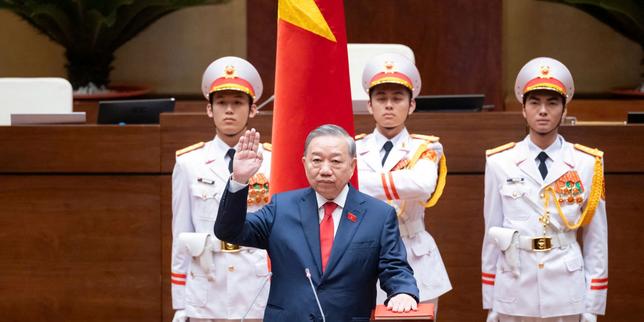
Vietnam's political playbook just got tossed into the furnace. For decades, the country survived and thrived on a "four pillars" system—a carefully balanced act where no single person held too much sway. That's over. On April 7, 2026, the National Assembly officially elected To Lam as State President. But here's the kicker: he’s already the General Secretary of the Communist Party.
By holding both the top party job and the top state job, To Lam has effectively become the most powerful Vietnamese leader since the era of Ho Chi Minh. It’s a move that signals a massive shift toward centralized authority, mirroring the "core leader" model we see in China with Xi Jinping. If you've been following the "Blazing Furnace" anti-corruption campaign, you know this wasn't an accident. It was a takeover.
The Death of the Four Pillars
Historically, Vietnam's power was split between the Party General Secretary, the President, the Prime Minister, and the National Assembly Chair. This structure prevented the kind of one-man rule that often leads to erratic policy shifts or internal coups. It was stable, if a bit slow.
To Lam didn't just step into this role; he carved it out. After the death of long-time leader Nguyen Phu Trong in 2024, the political landscape became a game of musical chairs. Leaders were falling left and right to corruption scandals. Presidents Vo Van Thuong and Nguyen Xuan Phuc were both forced out before their terms ended.
To Lam, the former Minister of Public Security, used those vacancies to solidify his standing. He briefly held both roles in 2024, but this latest election on April 7, 2026, is a formal, five-year term that runs until 2031. This isn't a temporary fix anymore. It's a fundamental change in how Vietnam is governed.
The Blazing Furnace Strategy
Let’s talk about how we got here. The "Blazing Furnace" (Dot Lo) anti-corruption campaign started as an effort to clean up the Party's image. Under Nguyen Phu Trong, it targeted thousands of officials. But under To Lam’s influence, it’s also been a tool for political consolidation.
When you're the head of the security apparatus, you know where the bodies are buried. To Lam has successfully "cleaned out" his rivals by exposing their involvement—or their subordinates' involvement—in corruption scandals. Whether you call it an honest cleanup or a political purge, the result is the same: the old guard is gone, and To Lam is the only one left standing.
Why This Matters for Investors
You're probably wondering what this means for the economy. Vietnam's been the "it" destination for manufacturers fleeing China's high costs. Stability is what keeps the money flowing.
- Faster Decision-Making: One-man rule usually means fewer bureaucratic hurdles. If the Party and the State are one and the same, there’s no more friction between the two branches of government.
- Investment Focus: In his inauguration speech, To Lam pledged a "new growth model" based on science, tech, and digital transformation. He’s signaling to tech giants like Samsung and Intel that Vietnam is ready to level up from low-cost manufacturing.
- Risk of Over-Centralization: The downside? If the top leader makes a bad call, there's no one left to tell him no. The collective leadership model was a safety valve. That valve is now gone.
Vietnam’s New Diplomacy
To Lam isn’t just focused on domestic control. He’s taking Vietnam’s "Bamboo Diplomacy"—the art of bending but not breaking between major powers—and making it more assertive.
Russia’s Vladimir Putin, India’s Narendra Modi, and China’s Xi Jinping were all quick to congratulate him. It’s a delicate dance. He’s maintaining ties with the Kremlin while simultaneously courting Washington for trade and security. He needs the U.S. for economic growth but relies on China for regional stability.
His re-election signals that Vietnam is moving toward a more "authoritarian-capitalist" model. It’s an efficient system for pushing through massive infrastructure projects or administrative reforms, but it’s a nervous time for civil society and anyone who valued the old system’s checks and balances.
What This Means for the Next Five Years
Don’t expect a slow start. To Lam has already begun a massive restructuring of government bodies, cutting down the number of provinces and cities to reduce "red tape." He’s streamlining the bureaucracy into a leaner, more responsive machine that reports directly to him.
The immediate focus will be on these areas:
- Digital Transformation: Lam wants Vietnam to move beyond being a "factory floor" for other nations. Expect huge subsidies for domestic tech startups and green energy.
- Internal Control: The anti-corruption campaign won't stop. It's now the standard operating procedure for the Party. If you’re an official or a business leader in Vietnam, you’d better keep your books clean.
- Self-Reliance: National defense and self-sufficiency are high on his agenda. He wants Vietnam to be a regional power that doesn't have to choose a side between the U.S. and China.
Basically, the era of "collective leadership" is buried. To Lam is the captain of the ship now, and he’s steered it into uncharted waters. If you're looking for political predictability in Southeast Asia, Vietnam just became a lot more centralized and a lot less traditional.
Watch for the next round of administrative reforms. If you see more central bank or ministry heads being replaced by To Lam’s proteges, it’s a sign that the consolidation is complete. It's time to pay closer attention to the individuals in Lam’s inner circle rather than just the official "four pillars" titles.