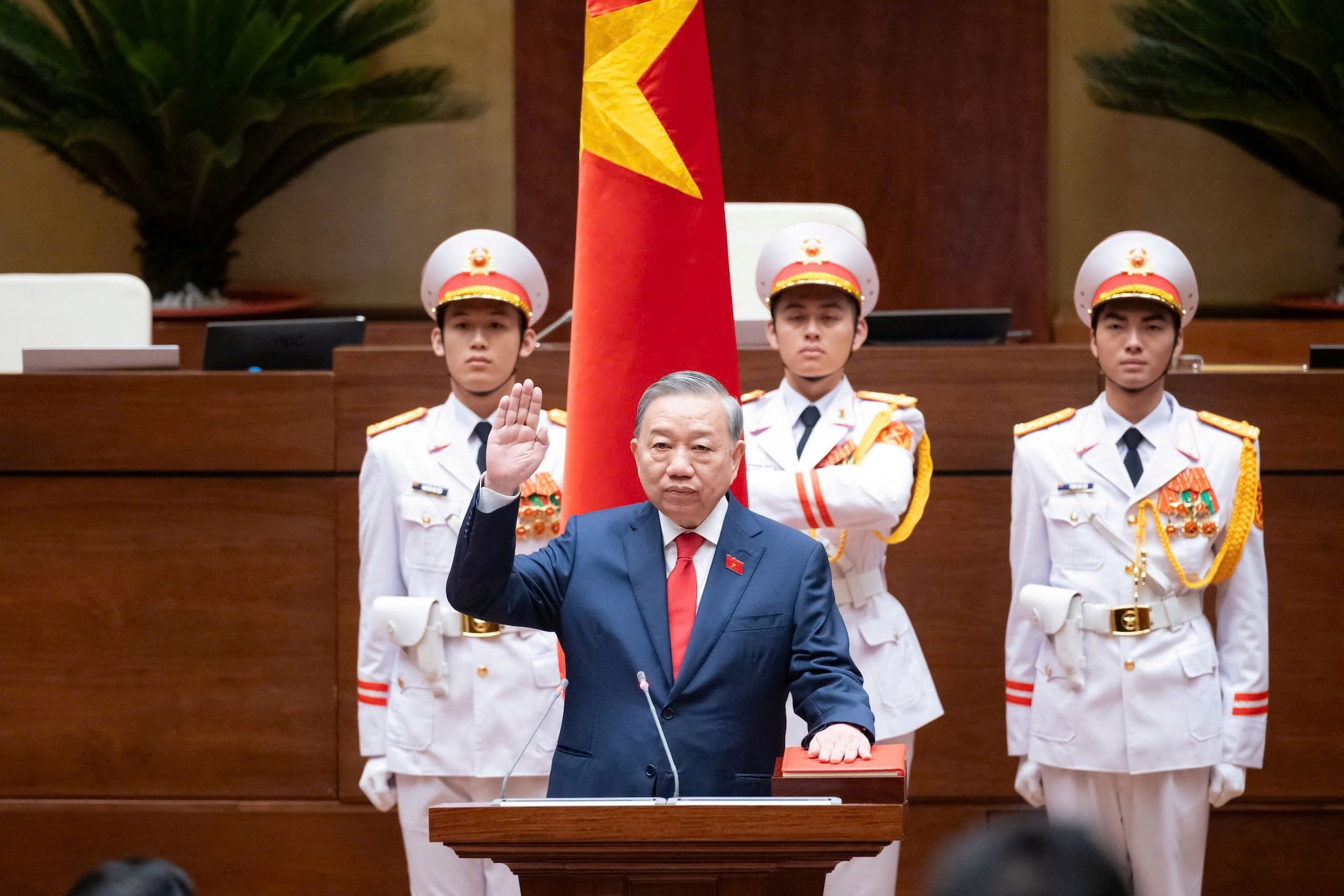
Western analysts love a good carbon copy. When To Lam ascended to the position of General Secretary of the Communist Party of Vietnam (CPV) while holding the State Presidency, the headlines practically wrote themselves. "Vietnam’s Xi Jinping Moment," they shouted. "The Rise of the Red Emperor," they whispered. It is a lazy, intellectually bankrupt comparison that misses the fundamental mechanics of how power actually operates in Hanoi.
The mainstream media is obsessed with the "China-style mandate." They see a single man holding two of the "four pillars" of Vietnamese leadership and assume the collective leadership model is dead. They are wrong. They are looking at the jewelry and missing the handcuffs.
To Lam isn’t consolidating power to become a dictator; he is consolidating power to survive a system that has become dangerously unstable. If you want to understand the real Vietnam, you have to stop looking at it through a Beijing-tinted lens.
The Myth of the Vietnamese Autocrat
The fundamental mistake most "experts" make is assuming that the Vietnamese Communist Party functions like the CCP. It doesn't. In China, Xi Jinping dismantled the consensus model. He purged his rivals and installed a loyalist inner circle that answers only to him.
In Vietnam, the "Four Pillars"—the General Secretary, the President, the Prime Minister, and the Chairman of the National Assembly—exist for a reason. They represent a delicate, often fractious balance between the party ideologues, the state technocrats, the security apparatus, and the regional interests of the north, south, and center.
When To Lam took the presidency in mid-2024, and then the General Secretary role following the death of Nguyen Phu Trong, he didn't "win" a mandate. He stepped into a vacuum.
I have spent years watching regional power dynamics, and what I see in Hanoi isn't a march toward totalitarianism. It's a desperate attempt to stop the bleeding. The Blazing Furnace anti-corruption campaign, spearheaded by the late Nguyen Phu Trong, didn't just catch "bad actors." It paralyzed the bureaucracy. Officials are so terrified of signing off on projects—fearing a future audit might land them in prison—that billions in infrastructure spending are sitting idle.
To Lam’s dual role isn't about personal glory. It is a temporary structural necessity to force the gears of government to start turning again.
Why the China Comparison Fails the Logic Test
Let’s look at the data. In China, the General Secretary is the undisputed alpha. In Vietnam, the Politburo remains a collection of heavyweights who can, and frequently do, push back.
If To Lam were truly a "China-style" leader, we would see a total purge of the technocratic wing. Instead, we see a frantic effort to keep the economic engine running. Vietnam’s economy is trade-dependent in a way China’s simply isn't. Vietnam’s trade-to-GDP ratio often exceeds 180%. You cannot run a country that exposed to global markets with the same iron-fisted isolationism that Xi uses to discipline Chinese tech billionaires.
If To Lam tries to rule like Xi, the capital flight would be instantaneous. The Samsung, Intel, and Foxconn factories that have turned Vietnam into a "plus one" manufacturing hub are not tied to the soil. They are mobile. The CPV knows this. To Lam knows this.
The Security State Fallacy
The most common "insider" critique is that To Lam, as the former Minister of Public Security (MPS), is turning Vietnam into a police state.
Here is the counter-intuitive truth: Vietnam has always been a security-conscious state. But the MPS isn't a monolith of loyalty to one man. It is a massive, sprawling bureaucracy with its own internal rivalries and business interests.
To Lam's biggest challenge isn't the "pro-democracy" movement—which is virtually non-existent as an organized political force—it’s the internal friction within his own former ministry and the military (VPA). In Vietnam, the police and the military are the two biggest power brokers. Traditionally, they balance each other out.
By taking the top party and state roles, To Lam has actually placed himself in a position where he must now mediate between these factions rather than just leading one of them. He has traded his position as a specialized "enforcer" for the role of a "generalist" who has to keep everyone fed.
The Blazing Furnace is Burning the House Down
Everyone praises the anti-corruption drive. "It's cleaning up the system," they say. "It's a game-changer for transparency."
Nonsense.
I've talked to investors who are pulling their hair out because they can't get a simple land-use permit signed. Why? Because the official who should sign it saw his predecessor get twenty years for a similar "irregularity."
Nguyen Phu Trong used the Blazing Furnace as a moral crusade. To Lam is using it as a surgical tool. The transition we are seeing isn't from "consensus to dictatorship." It’s from "moralistic purging to pragmatic management."
To Lam is a pragmatist. He understands that if the lights don't stay on and the exports don't ship, the party’s "mandate of heaven" evaporates. The dual role is an attempt to shorten the distance between a policy decision in the Politburo and its execution in the provinces.
The "Bamboo Diplomacy" Trap
The media loves the term "Bamboo Diplomacy"—bending with the wind, staying neutral between the US and China. They claim To Lam will lean closer to Beijing because of his security background.
This is a fundamental misunderstanding of Vietnamese history.
Vietnam’s relationship with China is defined by a thousand years of resistance. Every Vietnamese leader, no matter how "pro-China" they may seem on paper, is a nationalist first. To Lam’s first international trip as General Secretary was to Beijing. Predictable? Yes. A sign of vassalage? Hardly.
It was a tactical move to reassure a massive neighbor that the house is under control. But watch the follow-up. Watch the quiet deepening of ties with Tokyo, Seoul, and Washington. Vietnam isn't leaning into China’s embrace; it’s making sure China doesn't feel the need to kick the door down while Vietnam reorganizes its furniture.
The Real Risk Nobody Talks About
The danger isn't that To Lam becomes too powerful. The danger is that the "Four Pillars" system was the only thing keeping the country’s regional and factional interests from open warfare.
By combining the Presidency and the General Secretaryship, To Lam has narrowed the path for political advancement for everyone else. When you reduce the number of top-tier chairs, the people left standing don't just go home. They start looking for ways to saw the legs off the chairs that remain.
Imagine a scenario where the 14th Party Congress in 2026 rolls around. If To Lam tries to hold onto both roles permanently, he will face a revolt not from the "people," but from the provincial party bosses and the military elite.
The "China-style mandate" is a myth because the Vietnamese system lacks the centralizing cultural machinery that the CCP has spent seventy years perfecting. Vietnam is more chaotic, more networked, and far more transactional.
Stop Asking the Wrong Questions
The question isn't "Is Vietnam becoming China?"
The question is "Can To Lam make the Vietnamese bureaucracy functional enough to survive the global manufacturing shift?"
Investors don't care if the General Secretary also holds the Presidency. They care if the VAT refunds are processed, if the power stays on in Hai Phong, and if the ports aren't choked by red tape.
To Lam is an attempt at a "functional fix" for a broken consensus. If he succeeds, Vietnam stays on its trajectory as the next Asian tiger. If he fails by actually trying to rule like Xi Jinping, he will break the very engine that keeps the CPV in power.
Vietnam is not a copy of China. It is a unique, high-stakes experiment in whether a Leninist party can run a hyper-capitalist export economy without collapsing under its own weight. To Lam isn't the Emperor; he’s the Chief Restructuring Officer.
And in a restructuring, the first thing you do is fire the people who don't know what they're looking at. Start with the pundits who think Hanoi is just a smaller version of Beijing.
Stop looking for a Red Emperor. Look for the man trying to keep a fractured machine from exploding. That is the only reality that matters.



