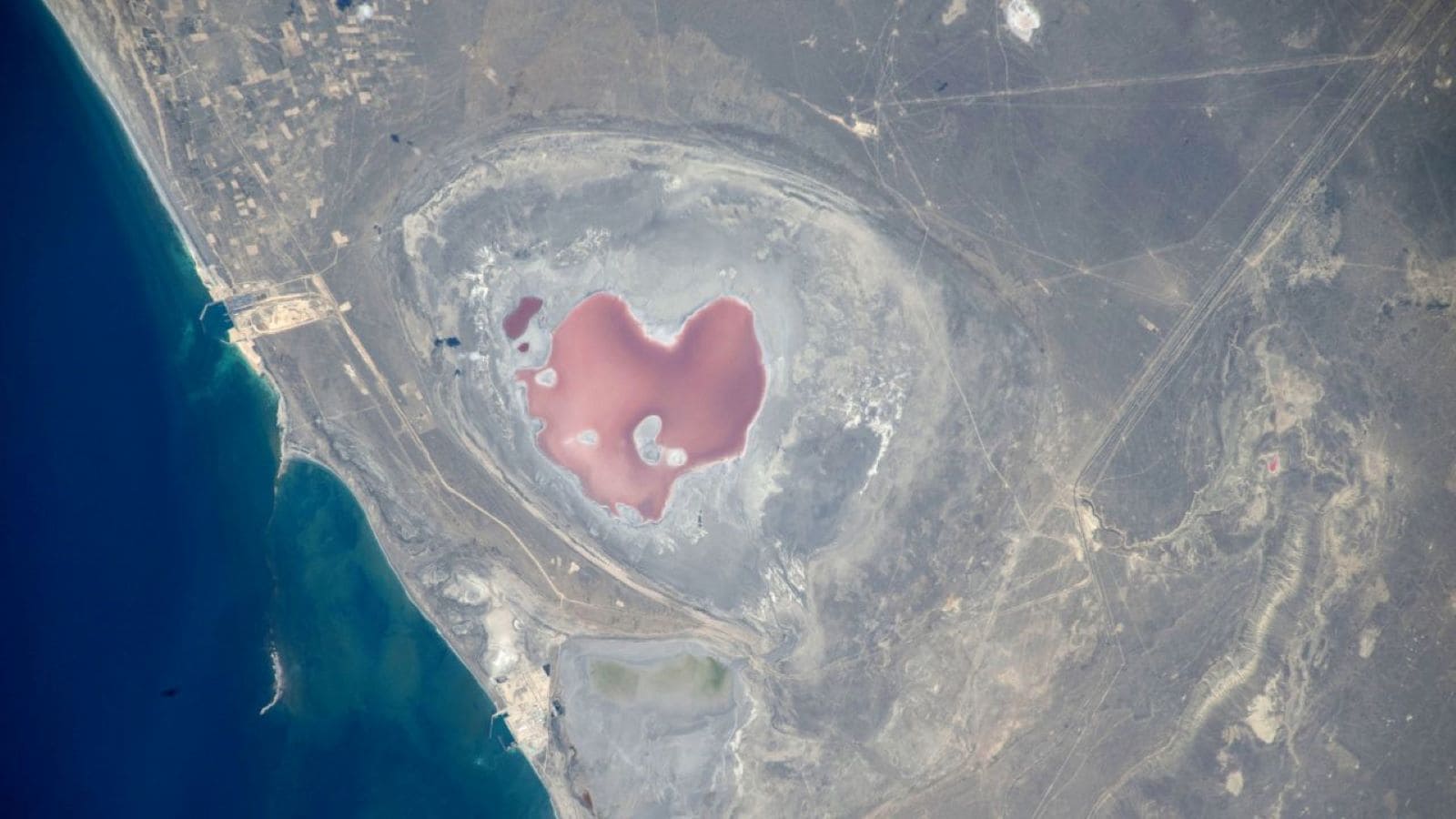
Space photography hits differently. Most of the time, looking down at Earth from orbit gives you sweeping views of massive hurricane spirals, sprawling city lights, or the majestic curvature of the atmosphere. But every once in a while, an astronaut captures something that feels almost too deliberate.
That is exactly what happened when a crew member aboard the International Space Station snapped a crisp image of a natural heart-shaped lake from hundreds of miles above. It went viral instantly. People love a good cosmic coincidence.
You have probably seen the headline floating around social media. An astronaut shares a stunning photo of a heart-shaped lake from space and jokes that Earth is sending a message. Millions of people smashed the share button. It is a cute story.
However, looking at this viral moment purely as a cute internet blip misses the point entirely. Orbital photography changes how we view our home planet. It forces us to pause. It shifts our perspective from the ground-level chaos of daily life to a quiet, planetary scale.
The Science Behind Planetary Geometry
Let us be completely honest about nature for a second. Mother Nature is not intentionally drawing Valentine symbols for astronauts to find. Earth carves out shapes through sheer physics, fluid dynamics, and random geological erosion.
When you see a heart-shaped geographic feature from orbit, you are looking at a masterclass in geomorphology. Usually, these formations are the result of ancient glacial retreats, collapsing sinkholes, or intersecting river deltas where two distinct currents deposited sediment in a symmetrical curve.
Gravity does the heavy lifting. Over thousands of years, water finds the path of least resistance. It wears away softer rock layers while leaving harder mineral boundaries untouched.
What looks like a romantic message to a passing astronaut is actually just water doing what water has always done. It flows, it erodes, and it shapes the stone.
Why Astronauts Fall in Love With Earth Photography
Living on the International Space Station changes people. NASA and international astronauts talk about this constantly. It is called the overview effect. You spend months hurtling through the vacuum of space at seventeen thousand five hundred miles per hour, staring down at a fragile blue marble.
You stop seeing national borders. You stop worrying about local politics. Instead, you see weather systems colliding and coastlines glowing in the dark.
Taking pictures of Earth is not just a hobby for the crew. It is a vital scientific mission and a psychological lifeline. When you are isolated in a cramped tin can filled with humming life support systems, finding familiar, beautiful shapes on the surface grounds you.
Astronauts often spend their rare off-duty hours glued to cupola windows with massive telephoto lenses. They chase sun glints on remote water bodies. They frame barrier islands against deep ocean blue.
When an astronaut spots a geological oddity like a heart-shaped water body, it breaks the monotony of endless desert sands and cloud banks. It triggers a human response to an inhuman environment.
Finding Earth Wonders From Your Own Screen
You do not need a multi-million-dollar rocket ride to hunt for bizarre geographical shapes. Satellite mapping tools have democratized planetary observation. Anyone with an internet connection can spend hours scouring remote corners of the globe for hidden patterns.
If you want to track down incredible landscape features yourself, try these practical steps.
- Open a high-resolution satellite mapping application on your desktop.
- Pick a remote geographic region known for tectonic activity or heavy glaciation, such as northern Canada, Patagonia, or Siberia.
- Follow major river systems upstream and look for isolated alpine lakes tucked into mountain valleys.
- Pay attention to color contrasts where mineral-rich glacial flour turns water a striking turquoise or deep emerald, making shapes pop out against grey stone.
Most people give up after five minutes because they do not know what to look for. Stick to areas where retreating ice sheets left behind scarred terrain. That is where nature gets creative with geometry.
The Real Message From Space
Earth is not actually sending us a romantic text message through random water erosion. The real message written across our planet is far more urgent.
When astronauts look down at lakes, forests, and coastlines, they also see the scars we leave behind. They see shrinking glaciers, massive deforestation projects, and the hazy brown smudge of air pollution choking major metropolitan areas.
A heart-shaped lake makes for a great viral post. It gives us a dopamine hit on a Tuesday morning. But the true value of these space photos lies in how they make us care about the planet beneath our feet.
If looking at a symmetrical patch of water from four hundred miles up reminds us to protect our natural ecosystems, then the viral hype actually serves a purpose. We need every reminder we can get.
Stop treating Earth as an infinite resource bucket. Go outside, look at your local environment, and pay attention to the wild, complex beauty happening right in your backyard.