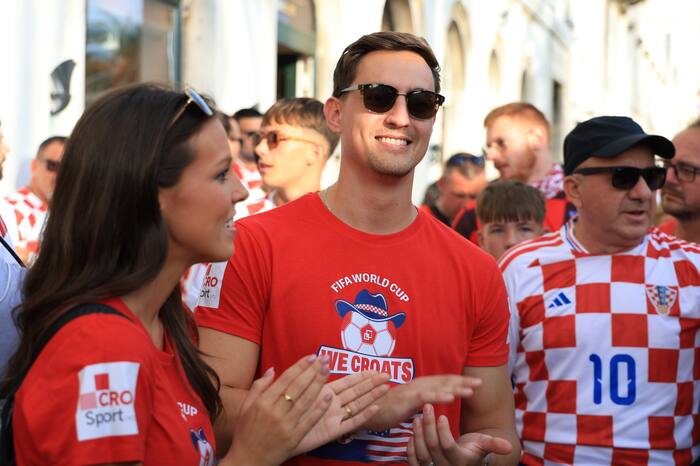
When a newly married couple touring Croatia became the unexpected focal point of an ambient crowd's viral attention during their portrait session, the episode exposed a fundamental shift in modern media mechanics. Traditional public relations and travel marketing rely on high-cost, hyper-curated asset generation. Viral anomalies bypass this cost structure entirely by converting organic, unscripted public interactions into high-velocity media distribution networks.
Deconstructing this phenomenon requires evaluating how decentralized digital fandoms alter the asset valuation of personal milestones. When thousands of secondary observers document, aggregate, and redistribute a single local event, the traditional boundary between private ceremony and public consumption dissolves. The resulting systemic dynamics can be categorized across three distinct vectors: the decentralization of distribution, the compression of production timelines, and the asymmetric return on unscripted attention.
The Structural Mechanics of Decentralized Distribution
Traditional marketing campaigns operate on a top-down broadcast model. An entity produces an asset, allocates capital toward distribution channels, and measures engagement through standard conversion funnels. Conversely, ambient viral capture relies on a bottom-up, peer-to-peer amplification model.
In the Croatian wedding instance, the geographic concentration of tourists equipped with high-resolution capture devices transformed an inert physical space into an active media production hub. Each spectator functioned as an independent distribution node. The mechanics of this network operate through three distinct phases:
- Ambient Capture: An unscripted event occurs within a high-density public environment. Observers capture raw, unfiltered footage without commercial intent.
- Algorithmic Aggregation: Platforms utilizing engagement-weighted algorithms identify spikes in user-to-user sharing velocity, pushing the content beyond local follower graphs into macro-feeds.
- Memeification and Identity Projection: The digital audience projects narratives onto the subjects, transforming an anonymous couple into archetypal figures representing romantic aspiration or comedic timing.
This architecture eliminates the capital expenditure typically required for audience acquisition. The economic value is generated not by the quality of the initial staging, but by the resonance of the serendipity.
The Cost Function of Authenticity
Modern audiences exhibit high friction against overtly polished, synthetic media. High-production advertising campaigns frequently trigger cognitive skepticism; consumers instinctively recognize when an environment has been staged for commercial extraction.
Unscripted events bypass this defensive mechanism. Because the photobombing fans and the newlyweds operated without a script, the resulting media possesses an intrinsic marker of authenticity. The cost function of this authenticity is near-zero production capital paired with infinite upside in organic reach.
[Staged Marketing]
  --> High Capital Expenditure
  --> Audience Skepticism
  --> Linear Return

[Ambient Viral Capture]
  --> Zero Capital Expenditure
  --> High Audience Trust
  --> Exponential Return
When a brand or individual attempts to manufacture this dynamic, the intervention of intent usually destroys the very spontaneity that drives engagement. The lesson for travel destinations and lifestyle entities is clear: structural value is created by positioning assets within high-traffic, culturally vibrant public environments where serendipity can occur, rather than attempting to artificially simulate organic moments within controlled environments.
The Attention Economy Asymmetry
Attention functions as a zero-sum resource. As the volume of digital content scales exponentially, the cost of capturing human focus rises. Traditional tourism boards spend millions of dollars annually attempting to secure fleeting impressions through conventional travel advertising.
An organic viral event achieves higher engagement metrics at a fraction of the cost by exploiting the psychological mechanics of surprise and collective participation. When fans collectively engage with a wedding shoot abroad, they transition from passive consumers of travel content to active co-creators of the narrative. This participatory loop increases the half-life of the media asset. Instead of a single impression lasting three seconds on a banner ad, the audience spends hours reading commentary, tracking down the participants, and generating derivative content.
This creates a structural imbalance in the modern information marketplace. Entities that understand how to absorb and redirect unscripted attention capture disproportionate mindshare compared to those relying on rigid, pre-planned promotional cycles.
Strategic Execution for Dynamic Environments
To capitalize on the mechanics of ambient visibility, stakeholders must transition from defensive asset protection to proactive opportunity integration.
- Optimize for Serendipity: Travel destinations and public-facing enterprises should design physical spaces that encourage, rather than obstruct, organic human interaction and visual documentation. Rigid barriers and sterile environments kill the friction necessary for memorable public anomalies.
- Build Rapid Response Frameworks: When unscripted visibility occurs, the window to capture residual value is compressed. Organizations must possess the agility to acknowledge, humanize, and amplify organic moments within hours of initial distribution before algorithmic attention shifts elsewhere.
- Accept Loss of Narrative Control: The primary friction point for traditional entities is the relinquishment of message control. In decentralized media ecosystems, trying to sanitize or tightly regulate organic narratives guarantees failure. Authentic engagement requires accepting the unpredictable interpretations of a global audience.
The Croatian wedding incident is not merely an isolated human-interest anecdote. It is a textbook demonstration of how modern attention operates: unstructured, highly distributed, and exponentially more valuable than anything capital alone can buy.


