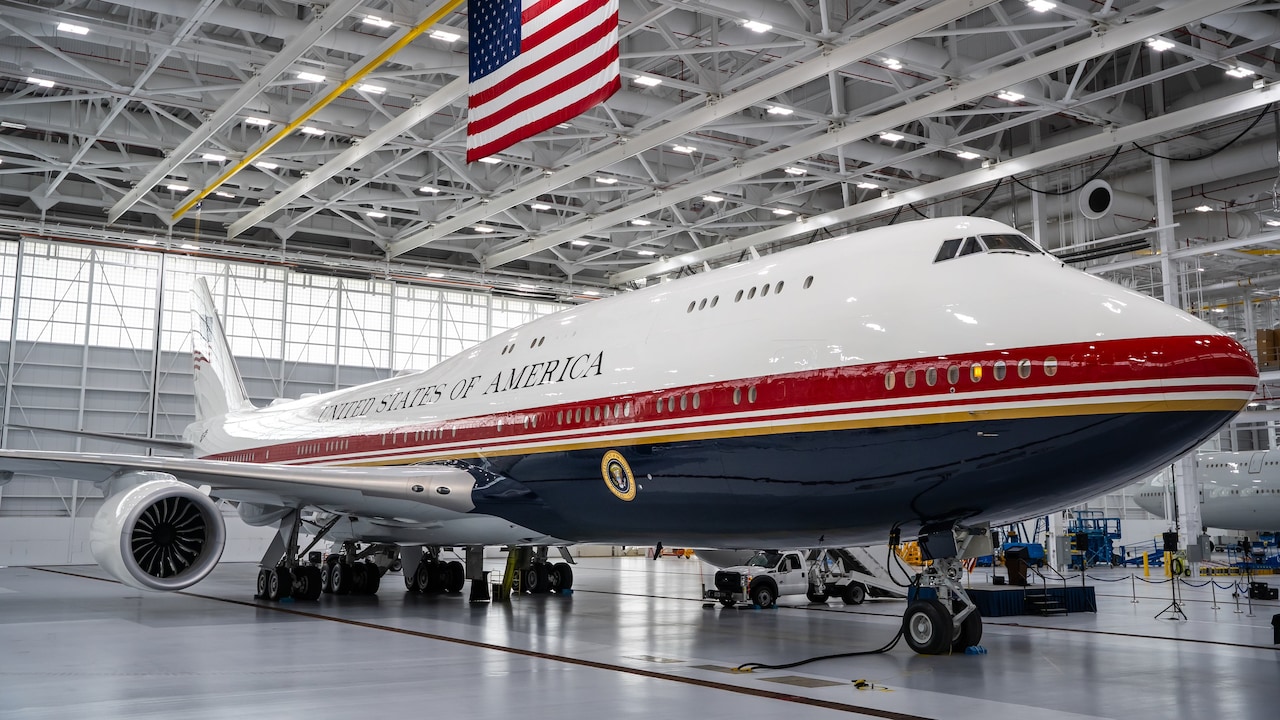
The Structural Imperative of Flying Command Nodes
A head of state's transport aircraft is not merely a vehicle; it is a mobile, survivable command station designed to maintain uninterrupted continuity of government under asymmetric or nuclear threat vectors. When rapid procurement models bypass traditional defense acquisition frameworks to fast-track operational delivery, trade-offs between speed, cost, and survivability inevitably emerge.
The recent decision to take the newly introduced presidential bridge aircraft offline for a one-month modification cycle—termed a process to "max out" its operational posture—highlights a structural friction point between expedited commercial-off-the-shelf (COTS) modifications and rigorous military-grade defensive integrations. Converting a commercial widebody airframe into a hardened, highly survivable presidential platform requires balancing three distinct capability layers: threat mitigation systems, electromagnetic resilience, and secure, high-throughput command communication nodes.
The Three Pillars of Presidential Aircraft Survivability
An airliner converted for executive airlift operates under fundamentally different threat environments than standard commercial fleets. To evaluate why rapid modification programs require secondary integration periods, the platform's requirements must be disaggregated into three functional pillars:
1. Active and Passive Threat Countermeasures
- Directional Infrared Countermeasures (DIRCM): Standard commercial airframes lack sensor suites capable of detecting incoming Surface-to-Air Missiles (SAMs) or Man-Portable Air Defense Systems (MANPADS). Integrating DIRCM requires mounting ultraviolet and infrared tracking sensors across the fuselage coupled with high-powered laser turrets to blind missile seekers.
- Radio Frequency Threat Suppression: Countering radar-guided kinetic threats necessitates integrated electronic warfare (EW) suites capable of threat identification, signal jamming, and the deployment of radar-opaque chaff and pyrotechnic flares.
2. Electromagnetic and Nuclear Hardening
- Electromagnetic Pulse (EMP) Shielding: Strategic command platforms require internal wiring, avionics, and flight control systems to be shielded against high-altitude EMP events resulting from nuclear detonations or directed-energy weapons. Commercial wiring harnesses standard in donated or commercially sourced airframes require extensive replacement or retrofitting to meet these standards.
- Thermal and Blast Mitigation: Structural reinforced skinning and environmental control systems (ECS) must filter chemical, biological, radiological, and nuclear (CBRN) contaminants while enduring intense thermal loads.
3. Redundant and Secure Communications Architectures
- SATCOM and Line-of-Sight Redundancy: Continuous strategic connectivity requires multi-band satellite communications (X-band, Ka-band, Ku-band, and Extremely High Frequency) capable of penetrating hostile jamming environments.
- Cryptographic Hardening: Command staff must execute real-time operational directives across classified networks, demanding isolated data buses that prevent cross-talk or zero-day exploitation between commercial off-the-shelf inflight entertainment systems and defense networks.
The Compression Bottleneck: 10-Month Sprint vs. Decadal Development
The current execution model relies on a dual-track strategy: maintaining legacy VC-25A airframes, engineering next-generation VC-25B platforms under a fixed-price contract model, and fielding an interim bridge airframe—a modified Boeing 747-8—to relieve operational fatigue on aging assets.
┌─────────────────────────────────────────────────────────────────────────┐
│                      PRESIDENTIAL AIRLIFT TIMELINE                      │
├──────────────────────────┬──────────────────────────────────────────────┤
│ Platform                 │ Operational Status / Delivery Window         │
├──────────────────────────┼──────────────────────────────────────────────┤
│ VC-25A (Legacy)          │ Active (Facing fleet aging & fatigue)        │
│ VC-25B Bridge (COTS)     │ Active / Offline for secondary retrofits     │
│ VC-25B Program (Formal)  │ Expected ~2028 (Under fixed-price strain)    │
└──────────────────────────┴──────────────────────────────────────────────┘
When defense contractors execute a rapid 10-month conversion sprint on a COTS platform, functional prioritization dictates the schedule. Basic airworthiness, secure executive communication suites, and VIP cabin modifications are fielded first. Secondary capabilities—specifically physical anti-missile defense suites and advanced EW suites—are deferred to subsequent depot-level modification windows.
This compressed schedule creates a temporary "capability trade space." Operating an aircraft in high-risk regions during this intermediate phase introduces operational constraints, forcing protective detail commanders to elect traditional platforms with fully integrated countermeasure suites when transiting contested or heightened-threat airspace.
Operational Friction in Fixed-Price Defense Contracting
The reliance on rapid bridge modifications is directly downstream of structural delays in primary defense procurement programs. Under a firm-fixed-price (FFP) contract model, development risk and cost overruns are shifted entirely to the prime contractor.
While FFP structures protect public expenditures from unbounded cost growth, they introduce specific secondary failure modes:
- Engineering Bottlenecks: Unforeseen complex wiring harness overhauls and structural airframe modifications cannot easily be offset by expanding engineering headcount without severe financial penalties to the contractor.
- Supply Chain Inflexibility: Sourcing specialized, radiation-hardened components under rigid budget caps extends lead times, driving schedule slippage.
- Resource Allocation Diversion: To mitigate primary program delays, defense agencies deploy rapid-acquisition bridges. However, modifying bridge airframe suites draws upon the same pool of cleared aerospace engineers and specialized modification facilities, indirectly compounding long-term delivery timelines.
Strategic Play: Optimizing Rapid Executive Modifications
To reconcile the tension between rapid operational fielding and full-spectrum defensive survivability on executive platforms, defense acquisition programs must adopt a modular, open-architecture strategy rather than a sequential retrofit model:
- Mandate Podded Defensive Architecture: Instead of embedding threat countermeasures into internal structural bays during primary retrofits, standard hardpoints using open-architecture interfaces should be pre-engineered into COTS fuselages. This allows drop-in DIRCM and EW pods to be attached or removed within 48 hours based on mission threat profiles.
- Decouple Communication Suites from Flight Hardware: Implement air-gapped, modular communications packages that rely on standardized, pre-certified hardware racks. This avoids the requirement to re-certify primary flight control systems every time cryptographic hardware receives an operational update.
- Institutionalize Phased Initial Operational Capability (IOC) Clearances: Define clear threat-tier operational envelopes. Airframes undergoing rapid conversion must be assigned rigid flight-path restrictions matching their current capability block, eliminating operational ambiguity for protective security details operating in high-threat theaters.