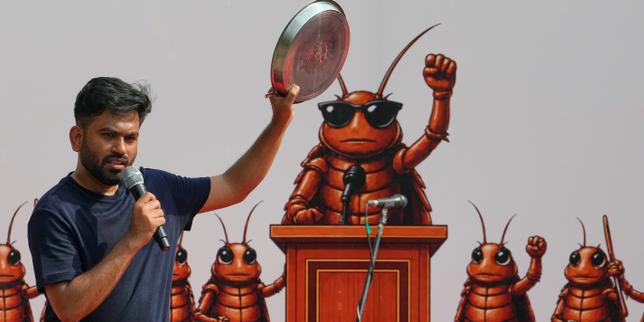
In the crowded arena of Indian politics, dissent has taken a bizarre, highly resilient shape. The Parti du peuple des cafards—translated literally as the Cockroach People's Party—has emerged not as a legitimate legislative contender, but as a razor-sharp satirical tool designed to mock systemic corruption. While mainstream commentary treats it as a passing joke, the movement represents a tactical evolution in how citizens protest when conventional political avenues are blocked. By claiming the cockroach as their mascot, activists are making a bleak statement about the political class. They argue that politicians are like pests: virtually impossible to eliminate, thriving in filth, and scattering the moment a spotlight hits them.
This isn't mere theater. It is a calculated response to a tightening political environment where traditional protest often invites swift state retribution.
The Strategy Behind the Pests
Satire in political movements serves a dual purpose. It builds immediate camaraderie among the public while creating a tactical shield against state crackdowns. It is incredibly difficult for authorities to prosecute citizens for declaring themselves cockroaches without appearing utterly ridiculous on the global stage.
The movement operates by staging mock press conferences, issuing absurd manifestos, and demanding "accountability" through deliberately inverted logic. Where a traditional opposition party would publish white papers on economic mismanagement, the Cockroach Party publicly congratulates officials for achieving world-class levels of bureaucratic stagnation.
This inverted critique exposes the underbelly of local governance. By demanding that leaders "render accounts" for their failures as if they were achievements, the movement highlights a painful truth. In many municipalities, the basic infrastructure of daily life—clean water, functional roads, transparent waste management—has broken down so completely that the reality already borders on the absurd.
Survival Mechanisms in Controlled Spaces
To understand why this method is gaining traction, one must look at the narrowing corridor for legal and physical dissent. Over the last decade, activists, journalists, and student leaders have faced escalating legal pressures under sweeping anti-terror laws and public order statutes.
Traditional Protest Model:
Grievance -> Public Demonstration -> State Crackdown -> Suppression

Satirical Protest Model:
Grievance -> Absurd Self-Deprecation -> Public Engagement -> State Bureaucratic Paralysis
When a movement strips itself of traditional ambition, it confuses the standard apparatus of state control. The Cockroach Party does not want votes. It does not field candidates to win seats. Because it seeks no formal power, it cannot be bought off with political concessions, nor can it be easily dismantled by standard political counter-strategies.
Historical precedents show that this brand of resistance flourishes precisely when a regime feels most unassailable. During the Soviet era, anekdoty—underground political jokes—served as a crucial pressure valve and an alternative record of truth. In a similar vein, the activists behind the cockroach movement are building a cultural archive of dissatisfaction, wrapped in a laugh.
The Limits of Laughing at Power
Satire possesses a structural flaw that veteran organizers know all too well. It creates awareness, but it rarely builds infrastructure.
While the Cockroach Party successfully channels public anger, it offers no blueprint for governance. A community cannot drink clean water provided by an ironic press release. When the laughter fades, the original problems remain exactly where they were, untouched by the mockery.
There is also the risk of normalization. When corruption becomes the punchline of a daily joke, the public can inadvertently grow more cynical and complacent. If politicians are universally accepted as indestructible pests, the incentive to vote for genuine reform diminishes. The satire that was meant to provoke action can end up anesthetizing the electorate.
Global Echoes of the Absurd
India's satirical surge is not an isolated phenomenon. It connects directly to a global lineage of Dadaist political movements that surface whenever the gap between official rhetoric and lived reality becomes too wide to bridge through normal debate.
- The Polish Orange Alternative: In the 1980s, this movement used surrealist happenings, like dressing up as dwarfs, to mock the communist regime, making arrests look farcical.
- The Best Party in Iceland: Founded by a comedian after the 2008 financial collapse, it actually won control of Reykjavik's city government by promising open corruption.
- Die PARTEI in Germany: A satirical party that successfully exploited European election laws to send representatives to the European Parliament.
The Indian iteration differs because the stakes are significantly higher. In Western Europe, a satirical party is often a luxury of a stable, wealthy democracy. In the Global South, it is a desperate measure born from systemic vulnerability.
The true metric of success for the Cockroach Party will not be found in election registries or legislative tallies. It will be measured by its ability to keep critical conversations alive in spaces where silence is increasingly mandated. When the cost of speaking truth to power becomes too expensive, citizens will always find a way to laugh at it instead.