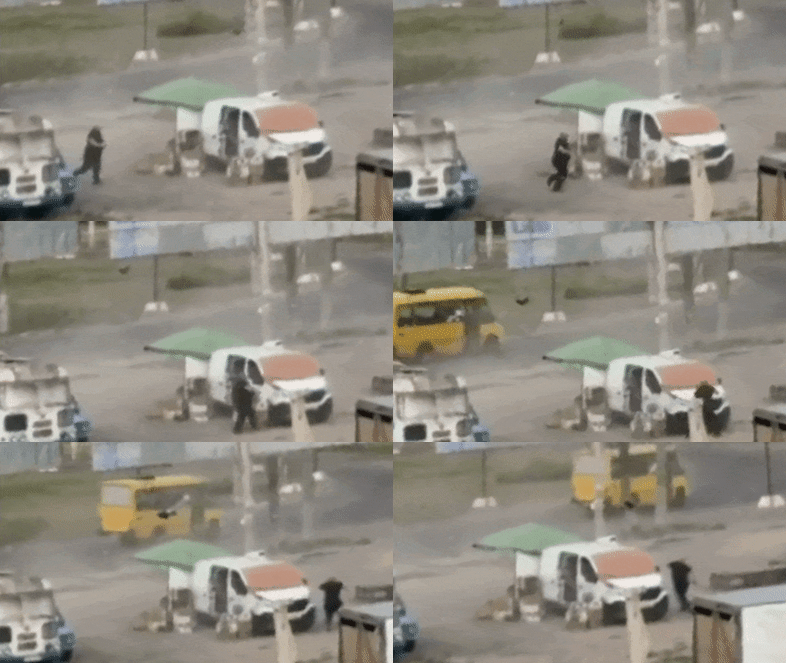
Commercial unmanned aerial systems were once billed as silent couriers of packages and passive observers of infrastructure. That polite fiction evaporated the moment off-the-shelf flying cameras became accessible to anyone with cash and a grievance. A chilling video circulating online depicts a pedestrian hunted down by an aggressive operator flying a quadcopter at street level, turning a public thoroughfare into a personal hunting ground. The footage is brutal to watch. It is also an early symptom of a much larger institutional failure regarding aerial accountability.
Security researchers and airspace regulators have spent years debating remote identification standards and geofencing while hobbyist hardware raced ahead of the law. When a consumer drone costing less than a high-end smartphone transforms into a weapon of psychological terror, the debate shifts from privacy compliance to physical safety. Society is staring down the barrel of an unregulated aerial threat vector, and the systems designed to protect the public are years behind the curve.
The Evolution of Aerial Intimidation
Intimidation tactics evolve alongside consumer electronics. Historically, stalking required physical presence, carrying inherent risks for the perpetrator including identification and confrontation. The quadcopter removes proximity from the equation. An operator can sit inside a parked vehicle three blocks away, sip lukewarm coffee, and systematically terrorize a target without ever entering the victim's field of vision.
The physics of these machines make them uniquely suited for harassment. Modern multirotors are fast, highly maneuverable, and capable of generating a distinct, high-pitched acoustic whine that triggers an instinctive psychological stress response. When that sound locks onto a person running down a public sidewalk, the experience mimics being stalked by a low-flying predator. The machine does not need to make physical contact to inflict damage. The psychological toll of persistent, inescapable tracking is severe, leaving victims hyper-vigilant long after the rotors stop spinning.
Regulatory Blind Spots and Enforcement Gaps
Current aviation frameworks treat small unmanned aircraft systems with bureaucratic leniency. Authorities prioritize commercial integration, delivery trials, and agricultural mapping over urban safety enforcement. Law enforcement agencies face significant operational hurdles when attempting to counter rogue pilots.
- Jurisdictional confusion: Local police departments often lack the legal authority or technical equipment to intercept or disable flying hardware in municipal airspace.
- Identification limits: Radio-frequency trackers rarely capture the physical identity of the person holding the controller, making retroactive prosecution exceptionally difficult.
- Response latency: By the time a squad car arrives at a location, the operator has usually landed the device, packed it into a backpack, and melted into pedestrian traffic.
This enforcement vacuum creates a dangerous loophole. Potential offenders realize that the probability of getting caught mid-flight is remarkably low. Without automated counter-measures deployed in public spaces, the burden of defense falls entirely on the individual targeted from above.
The Technical Reality of Counter-Measures
Defending public spaces against rogue operators requires more than wishing the problem away. Technical solutions exist, but they introduce complex legal and safety dilemmas.
Electronic jamming devices can sever the link between a pilot and an aircraft, forcing it to land or return to its launch point. However, deploying high-powered radio frequency jammers in dense urban environments risks interfering with critical emergency communications, cellular networks, and legitimate commercial airspace. Kinetic interception nets or trained raptors present logistical nightmares in crowded metropolitan areas where a falling drone poses a severe hazard to pedestrians below.
We are forced to confront an uncomfortable reality. Total airspace security in an open society is nearly impossible without compromising civil liberties. If every street corner requires anti-drone defense grids, the public realm changes fundamentally, trading one form of anxiety for another.
Industry Responsibility and Hardware Design
Manufacturers of consumer quadcopters bear a substantial share of the blame. For years, major producers resisted implementing mandatory telemetry reporting and hardcoded no-fly zones, arguing that software restrictions stifle innovation and burden hobbyists. While geofencing exists near major airports, standard consumer firmware rarely prevents a device from being flown aggressively down a suburban street or rural highway.
Software can be rewritten. Hardware can be serialized more strictly. If manufacturers were held legally liable for the misuse of unencrypted, easily modified flight control systems, the engineering priorities would shift overnight. Until market incentives align with public safety, the onus remains on legislators to force accountability down the supply chain.
The roadside hunting video is not an isolated prank or a bizarre anomaly. It is a preview of urban life under an unpoliced sky. Ignoring the trajectory of aerial harassment will only accelerate the transformation of public spaces into hostile territory.
The quiet hum overhead is no longer just a delivery or a photograph. It is a warning.