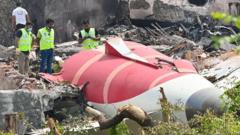
The coffee in the glass-walled offices of Air India’s headquarters has likely gone cold. For months, the air in those rooms has been thick, not with the smell of caffeine, but with the suffocating weight of anticipation. Everyone is waiting for a document. It isn't just any document; it is the final report on the Ahmedabad crash, a collection of pages that will dictate the survival of an icon.
Aviation is a world built on the rigid pillars of physics and the fragile threads of trust. When a plane goes down, those threads don't just snap. They disintegrate. In similar developments, take a look at: Understanding the Haiti Gang Violence Crisis Beyond the Headlines.
Consider a hypothetical passenger named Arjun. He represents thousands of travelers who once booked a seat on Air India without a second thought. To Arjun, a flight is a bridge between his grueling job in London and his mother’s kitchen in Ahmedabad. But lately, he lingers on the checkout page. He looks at the red and white logo and sees more than a Maharaja; he sees a question mark. He wonders if the bolts are tight. He wonders if the pilot is tired. He wonders if the system designed to keep him at 35,000 feet is fraying at the edges.
This is the invisible crisis. It isn't found in the charred remains on a runway or the black boxes recovered from the debris. It is found in the hesitation of a finger hovering over a "Book Now" button. NBC News has also covered this important issue in extensive detail.
The Paper Trail of Gravity
The impending report from the Aircraft Accident Investigation Bureau (AAIB) is more than a technical post-mortem. It is a mirror. For years, the narrative surrounding the national carrier was one of a "deepening crisis," a phrase so overused in financial circles that it has lost its teeth. But for those within the hangar, the crisis is tactile. It is the shortage of spare parts. It is the aging fleet that requires more "massages" than a professional athlete just to stay airworthy.
Reliability is a silent partner. You only notice it when it leaves the room.
The facts of the Ahmedabad incident are cold. They speak of approach angles, wind shear, and mechanical response times. However, the data hides the human reality of a cockpit under pressure. When an alarm screams in a flight deck, it doesn't sound like a machine. It sounds like a judgment. The final report will dissect every millisecond of that judgment.
If the findings point toward systemic negligence—a failure to maintain, a failure to train, or a failure to listen—the cost will be measured in more than rupees. Air India is currently in the middle of a massive rebranding and fleet expansion effort under new ownership. They are trying to buy their way out of a legacy of decline. But you cannot buy trust. You have to earn it, one safe landing at a time.
The Ghost of the Maharaja
There was a time when the Maharaja was a symbol of luxury and safety. He was a gracious host in the sky. Today, he looks more like a man trying to hold back a flood with a silk umbrella.
The merger with Vistara and the massive orders for hundreds of new Boeing and Airbus jets were supposed to be the turning point. On paper, the strategy is brilliant. In reality, it is a race against time. The airline is trying to replace its soul while the body is still in motion.
Staffing remains the sharpest thorn. Imagine being a flight attendant who has spent twenty years watching the interior of your cabin slowly fall apart—the broken armrests, the flickering screens, the tray tables that won't stay upright. You are the face of the airline, tasked with projecting calm while the very environment around you suggests neglect.
That friction creates a specific kind of exhaustion. It’s the fatigue of apologizing for things you didn't break and can't fix. When the Ahmedabad report finally lands, these employees will be the ones feeling the impact. If the report is scathing, it validates their frustrations but also threatens their livelihoods. If it is exonerating, it provides a brief gasp of air in a room where oxygen is running low.
The Math of Fear
Let’s look at the numbers, though they rarely tell the whole story.
Air India’s market share has been a volatile heartbeat. Every time a technical snag makes the headlines—a wheel falling off, an engine fire, a cabin filling with smoke—the heartbeat falters. In the age of social media, a single video of a leaking overhead vent travels faster than the plane itself.
The math is simple:
- One incident creates doubt.
- Two incidents create a pattern.
- A final crash report creates a verdict.
The airline is currently navigating a narrow corridor. On one side is the mountain of debt and the legacy of bureaucratic stagnation. On the other is the lightning-fast competition of low-cost carriers who run their operations with the clinical precision of a Swiss watch.
The Ahmedabad report will act as a structural stress test. It will reveal if the "new" Air India has actually fixed the rot or if they have simply painted over it.
Shadows in the Hangar
In the late hours at an engineering bay, the lights are harsh and the shadows are long. An engineer wipes grease from his hands and looks at a jet engine. He knows that every signature he puts on a maintenance log is a promise.
He also knows that the pressure to keep planes in the air is immense. Turnaround times are the gods of the modern aviation industry. Delayed flights mean lost revenue, angry passengers, and a tarnished reputation. But rushing a repair is a gamble where the stakes are human lives.
The Ahmedabad report will likely scrutinize the maintenance culture of the airline. Was there a culture of "making do"? Were warnings ignored? These are the questions that keep the engineers awake. They are the ones who have to live with the technical reality that the executives only see as a line on a spreadsheet.
Aviation is an industry that does not forgive. Gravity is a constant, and it is always waiting for a mistake. The report is the physical manifestation of that lack of forgiveness. It is the industry’s way of saying, "We saw what happened, and we know why."
The Passenger’s Verdict
Back to Arjun. He eventually books the flight. He chooses Air India because it’s the only direct route, or perhaps because of a lingering sense of national pride. But as he walks down the jet bridge, he isn't thinking about the brand's heritage. He is looking at the gap between the bridge and the plane. He is listening to the sound of the engines as they roar to life.
He is looking for a reason to feel safe.
The tragedy of the Ahmedabad crash isn't just in the event itself, but in the ripple effect it has on the collective psyche of a traveling public. We want to believe in the magic of flight. We want to believe that the people at the controls are the best in the world and that the machines they fly are perfect.
When that belief is shaken, the world becomes a smaller, more frightening place.
The final report is currently sitting on a desk somewhere, likely under a stack of other urgent matters. But when it is released, it will not be read as a technical document. It will be read as a confession or a redemption.
Air India is standing at a crossroads. One path leads toward a renewed commitment to excellence, where the lessons of Ahmedabad are used to build a fortress of safety. The other path leads toward a slow slide into irrelevance, where the brand becomes a cautionary tale of what happens when growth outpaces integrity.
The report will provide the map. But the airline has to decide which way to turn.
As the sun sets over the tarmac in Delhi, the planes continue to rise and fall. They are beautiful, silver slivers against the orange sky. Each one is a miracle of engineering and a testament to human ambition. But beneath the wings, in the dark corners of the hold and the intricate wiring of the cockpit, the truth of the Ahmedabad crash remains.
It is a truth that cannot be ignored for much longer. The report is coming. And with it, the final verdict on whether the Maharaja can still command the skies, or if he is simply a ghost of a more confident era.
The engines whine. The tires smoke as they hit the asphalt. Another flight has landed. For now, the silence of the report is the loudest sound in the industry. But soon, the pages will turn, and the story will have its ending. All that remains is to see if it is a story of a narrow escape or a final descent.