The plastic key hangs on a living room wall in Amman, Jordan. It is oversized, painted a dull black, and belongs to a man named Youssef who has not seen his childhood home since 1948. For decades, that key was a literal object representing a specific front door in a specific village. But over the last year, Youssef has noticed something strange when he watches global news channels. His family’s private grief, the concrete dirt of his ancestral olive grove, and the very word for his homeland have been lifted out of the soil. They have been transformed into something abstract. A currency. A universal shorthand.
Across universities in Paris, boardrooms in New York, and government halls in London, the word Palestine has undergone a profound metamorphosis. It is no longer just a strip of land by the Mediterranean or a scarred geopolitical fault line. It has become a global metric of morality. To many, it is the ultimate symbol of resistance against oppression, a baseline test for anyone claiming to possess a progressive conscience. To others, it has been twisted into a metaphor for existential threat, a catch-all term used to signal radical alignment. Discover more on a similar topic: this related article.
When a piece of earth becomes a metaphor, the actual people living on it begin to disappear.
The Abstraction of Human Suffering
Consider a hypothetical student named Maya sitting in a café in Berlin. She wears a keffiyeh, posts updates daily on her social feeds, and speaks passionately about global liberation. For Maya, the struggle is pristine. It is an intellectual equation where justice balances perfectly against injustice. The reality of the Middle East is viewed through the clean lens of a textbook theory. More reporting by The New York Times highlights related perspectives on the subject.
Now, look at the reality she is projecting her ideals upon. In the West Bank, a real-world farmer named Tariq wakes up at four in the morning to navigate a maze of concrete roadblocks just to pick his crops. He is not thinking about global post-colonial theory. He is thinking about the cost of diesel, the permits he was denied, and whether his children will come home safely from school.
When global observers turn a brutal, complicated local conflict into a universal baseline of virtue, they strip away its human messiness. The conflict is no longer about borders, water rights, security guarantees, or municipal governance. It becomes a secular religion. In this new secular religion, taking a side is not about solving a political crisis; it is about proving your own moral purity to your peers.
This transformation does not help Tariq. In fact, it isolates him. When your daily survival is turned into an intellectual symbol for teenagers and academics thousands of miles away, your actual needs are ignored. The symbolic crusade demands perfection. It demands total victory or total martyrdom. But people living in a war zone rarely want to be symbols. They want clean water. They want electricity. They want the bombs to stop falling and the checkpoints to open.
The Double-Edged Sword of Global Symbols
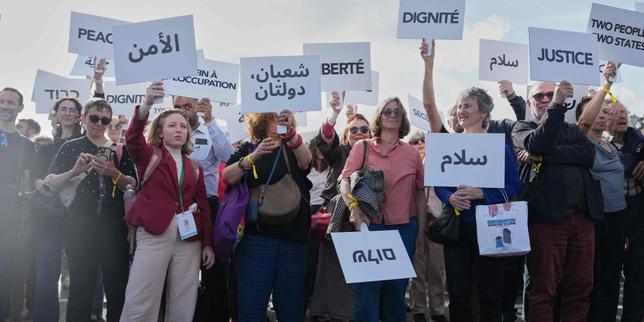
Turning a nation into a metaphor is a powerful tool for mobilization. It captures the imagination of millions who would otherwise ignore a distant war. It fills squares from Jakarta to Washington. But the weight of this metaphor causes a dangerous distortion in how the world processes tragedy.
When one specific conflict becomes the exclusive yardstick for global morality, a strange silence falls over the rest of the planet.
Think about the borders of Sudan. Think about the eastern provinces of the Democratic Republic of Congo. Millions have been displaced, starved, and killed in conflicts that carry immense historical weight. Yet, those battlefields lack the specific symbolic resonance required to become global metaphors. They do not fit neatly into the current Western cultural vocabulary of intersectional struggle or identity politics. Because they cannot be easily used as a badge of virtue, they are largely forgotten.
This creates a hierarchy of suffering. It implies that a life lost in one region carries more symbolic value than a life lost in another. The tragedy is that this hyper-focus does not even benefit the people at the center of the spotlight. Instead of receiving practical, compromised diplomatic solutions, they are burdened with the impossible expectations of a global audience that views compromise as a betrayal of the metaphor.
The Linguistic Shift
Language adapts quickly to political trends. The word Palestine is now regularly detached from its geographic anchor. It is used in academic papers to describe struggles that have absolutely nothing to do with the Levant. It is invoked in climate protests, labor union strikes, and indigenous rights marches across the Americas.
But look at what happens when the metaphor is reversed by its detractors. For those on the opposing political spectrum, the word has been weaponized into a different kind of metaphor. It is used as a synonym for chaos, civilizational decline, and the erasure of democratic values. When a politician in Washington or Jerusalem uses the term, they are often not talking about the physical place or the civilians trapped within it. They are invoking a ghost to frighten their electorate.
Both sides of this rhetorical war are guilty of the same sin: they have flattened a living population into a flat, two-dimensional caricature. One side sees an unblemished icon of pure innocence; the other sees an unredeemable symbol of terror.
Neither side sees the accountant in Ramallah who just wants to pay his mortgage. Neither side sees the mother in Gaza searching through rubble for a clean pair of shoes for her daughter. The human beings are crushed beneath the weight of the meanings we force them to carry.
The Price of Purity
The danger of using a conflict as an étalon de vertu—a standard of virtue—is that it makes peace impossible. Politics is an inherently dirty, compromised business. It requires sitting in rooms with people you despise. It requires signing agreements that make you feel sick to your stomach because the alternative is more funerals.
But you cannot compromise on a metaphor. You cannot negotiate a symbol.
If the struggle is entirely metaphysical, then any concession is a sin against the ideal. The global cheering sections, insulated from the flying shrapnel, encourage maximum resistance from the comfort of their laptops. They cheer for the preservation of the narrative, not the preservation of life. They want the story to stay dramatic, clear-cut, and heroic.
We must ask ourselves what happens when the news cycle inevitably moves on. Metaphors are fickle. The global attention span is short. Eventually, the crowds on the streets of Western capitals will find a new symbol to adopt, a new badge of morality to pin to their lapels.
When that day comes, the tents will be packed up. The slogans will fade from the brick walls of university campuses. The influencers will update their profiles to reflect the next global crisis.
But the plastic key will still hang on the wall in Amman. Tariq will still wake up at four in the morning to face the concrete walls of the checkpoint. The people will still be there, trapped in the dust, wondering why their lives were used as a mirror for a world that never truly saw them.