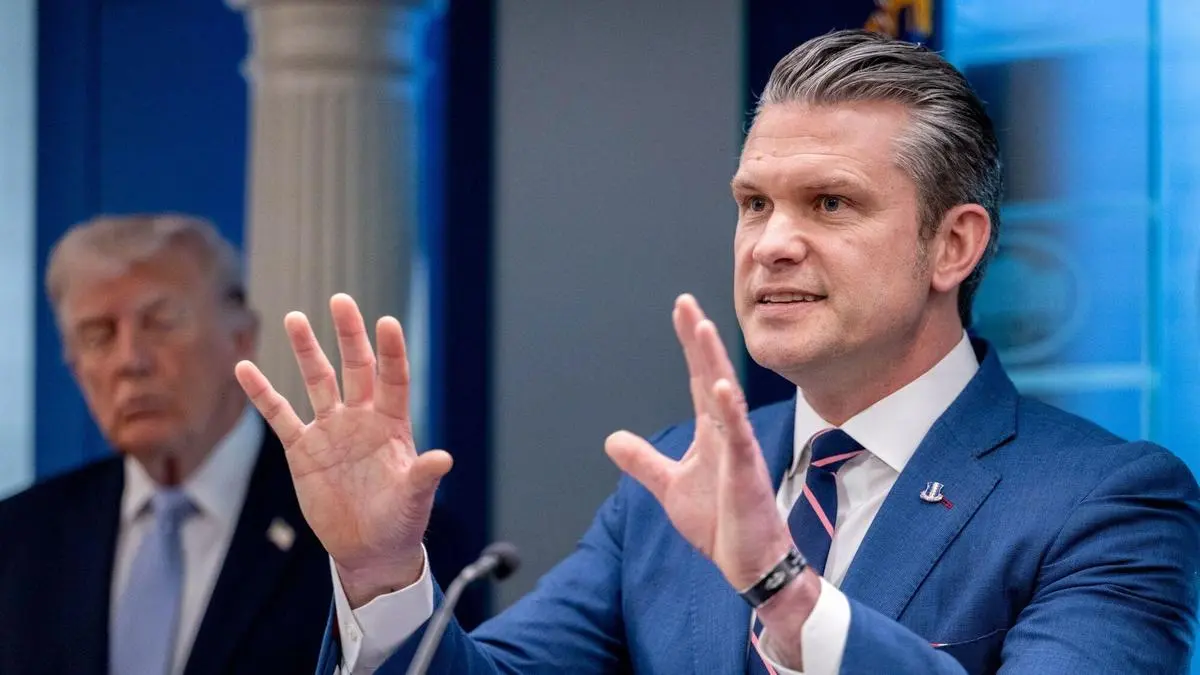
The air inside the Pentagon is recycled, cool, and carries a faint scent of floor wax and old paper. It is a quiet environment that betrays nothing of the kinetic energy it manages across the globe. But when the Secretary of War speaks, the silence in those hallways takes on a different quality. It becomes heavy. Pete Hegseth didn't just issue a press release today. He threw a shadow across the Middle East.
He warned of the largest volume of strikes to date.
To a casual observer scrolling through a news feed, "volume of strikes" is a sterile phrase. It sounds like a metric from a quarterly earnings report. It is not. To understand the gravity of this moment, we have to look past the podium and the tailored suits. We have to look at the machinery of consequence that grinds into motion the second those words are uttered.
The Anatomy of a Warning
Military force is often compared to a hammer, but that is too crude. It is more like a massive, complex clock where every gear is a human life, a billion-dollar asset, or a decade of diplomatic maneuvering. When Hegseth stands before the cameras and names Iran, he is winding that clock to the breaking point.
Consider a hypothetical officer—let’s call him Lieutenant Commander Miller—stationed on a destroyer in the Persian Gulf. For Miller, this isn't a headline. It is a change in the vibration of the ship. It is the sudden, sharp transition from "routine patrol" to "imminent action." He isn't thinking about geopolitical strategy or the Secretary's political standing. He is looking at a radar screen, calculating the trajectory of incoming threats, and wondering if tonight is the night the training stops being a simulation.
Hegseth’s rhetoric serves a dual purpose. It is a deterrent, a loud and public "stop" sign aimed at Tehran. But it is also a commitment. By promising the "largest volume," he has removed the option of a measured, quiet response. He has signaled to the world—and to the sailors like Miller—that the era of proportional "tit-for-tat" exchanges might be over.
The Invisible Stakes of Escalation
Why now? The facts tell us that the regional temperature has been rising for months. Pro-Iranian militias have pushed their luck, testing the resilience of American defenses with drone swarms and missile volleys. Until now, the U.S. response has been a series of surgical, localized strikes. They were designed to sting, not to maim.
Hegseth’s announcement suggests a pivot from surgery to demolition.
When a superpower shifts its posture this dramatically, the ripple effects are felt in places that have nothing to do with a battlefield. Oil markets flinch. Traders in London and Singapore watch the same clips of the Secretary and begin to price in the risk of a closed Strait of Hormuz. A few cents at the pump in Kansas is the ghost of a threat made in D.C.
But the deepest stakes are the ones we cannot quantify. They are found in the nerves of the people living in the region. Imagine a family in Baghdad or a merchant in Isfahan. They hear these warnings and they don't see a "strategic shift." They see the sky turning into a source of terror. The human element of war is often lost in the talk of "targets" and "assets." We forget that behind every "volume of strikes" is a map of a city where people are trying to live.
The Language of Power
There is a specific rhythm to the way Hegseth speaks. It is direct. Unflinching. It lacks the cautious, lawyerly hedging that defined much of the previous decade's military communication. This is intentional. The goal is to project an image of a military that is no longer interested in the nuances of "gray zone" conflict.
He is communicating that the threshold for a massive response has been lowered.
However, there is a danger in such clarity. When you promise the "largest" of anything, you create a baseline. You set an expectation. If the subsequent action is anything less than overwhelming, the deterrent loses its teeth. If the action is as large as promised, it risks sparking a wildfire that no one—not the Secretary, not the commanders, not the diplomats—can easily extinguish.
It is a high-stakes gamble played with the most expensive currency on earth.
History shows us that wars rarely start because someone wanted a global catastrophe. They start because of a series of escalations where neither side felt they could afford to blink. Each move feels logical in the moment. Each response feels justified. But eventually, the room runs out of space. Hegseth has just moved the furniture to the walls and cleared the floor.
The View from the Cockpit
Let’s go back to the human scale. Think of the pilot of an F-35, sitting on a carrier deck, waiting for the green light. The cockpit is cramped. The suit is heavy. The mission brief is etched into their mind: specific coordinates, specific hangars, specific command centers.
The pilot knows that their actions will be the physical manifestation of the Secretary’s words. They are the "volume" he spoke of.
There is an incredible, almost unbearable tension in that wait. It is the silence before the storm, amplified by the knowledge that once the engines ignite, there is no taking the words back. The missiles don't have a "delete" key. Once they are away, the narrative is no longer written by speechwriters in Washington. It is written in fire and debris.
The Cost of Certainty
We live in an age where we crave strength. We want leaders who speak clearly and act decisively. In a world of ambiguity, Hegseth’s "warning" feels like a return to a more straightforward era. It feels like a promise that the chaos will be met with order—even if that order is delivered via 2,000-pound munitions.
But certainty has a cost. The cost is the loss of flexibility. By drawing such a bright, thick line in the sand, the U.S. has committed itself to a path that is very difficult to walk back.
If Iran chooses to test this new resolve, the resulting collision will be unlike anything we have seen in decades. It won't be a headline. It won't be a snippet on a news crawl. It will be a seismic shift in the global order. We are watching a masterclass in the theater of power, but the actors are using live ammunition and the stage is the cradle of civilization.
The Secretary has spoken. The gears are turning. The clock is wound.
Now, the world holds its breath and waits to see if the first strike is a period or a colon—the end of a provocation, or the beginning of a much longer, much darker story.