The humidity in Washington on the fourth of July does not merely hang in the air. It presses against you. It sticks to your skin like wool, turning the briefest walk down Constitution Avenue into an exercise in endurance. On this particular afternoon, the heat seemed magnified by the sheer mass of humanity packed between the white marble monuments.
Two hundred and fifty years. Meanwhile, you can explore related developments here: The Lightning Rod on the National Mall.
It is a number that feels almost too large to comprehend when you are standing in the middle of it. A quarter of a millennium since a group of wealthy rebels signed a document in a sweaty Philadelphia room, wagering their necks on a radical idea. Now, on July 4, 2026, the experiment has reached its milestone anniversary, and the capital has transformed into a sprawling, loud, and deeply complicated stage.
Near the base of the Washington Monument, a man named Arthur sat on a folding nylon chair, wiping his brow with a damp handkerchief. He is seventy-two, a retired railroad machinist from Pennsylvania who drove five hours with his grandson just to be here. To Arthur, the anniversary isn't an abstract concept found in a textbook. It is a tangible marker of time, a line connecting his grandfather, who fought in the trenches of France, to his grandson, who spent the morning staring at his phone while waiting for the security checkpoints to open. To understand the complete picture, we recommend the recent analysis by NPR.
"We made it this far," Arthur said, squinting through the glare of the midday sun. "Nobody thought we would, but we did."
The air smelled of roasted nuts, sunscreen, and the faint, sulfurous tang of early firecrackers. Security was suffocating. Drones buzzed like mechanical hornets against the pale blue sky, their cameras tracking the shifting tides of red, white, and blue caps. This was not just a birthday party. It was a demonstration of survival.
The Spectacle and the Sound
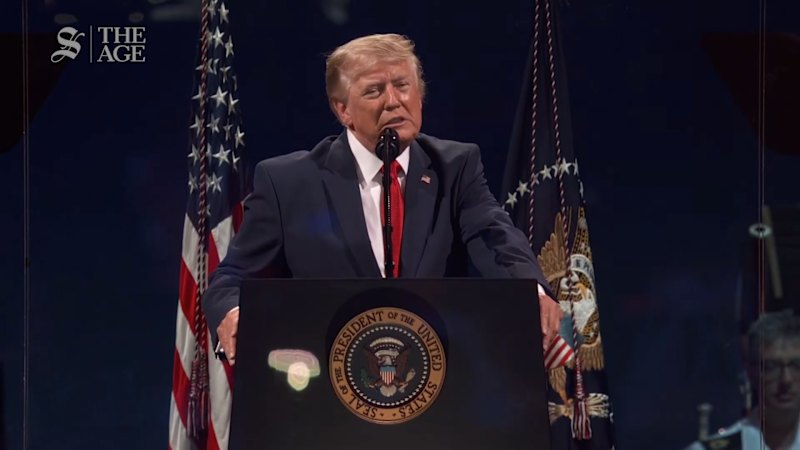
When Donald Trump took the stage, the atmosphere shifted instantly. The crowd, which had been wilting under the oppressive heat, surged forward with a collective roar that rattled the temporary metal bleachers. For his supporters, his presence at the helm of the nation during this specific milestone was a poetic victory, a validation of a years-long political crusade. For his detractors, who watched from the fringes or through screens across a fractured nation, it was a stark reminder of how deeply the American identity has been rewritten.
He stood before a backdrop of massive American flags, the podium gleaming under the harsh television lights. His voice, carried by banks of stadium-grade speakers, rolled across the National Mall, bouncing off the stone walls of the museums.
The speech did not dwell long on the standard platitudes of textbook history. Instead, it was an assertion of power, heritage, and survival. He spoke of the founders not as distant statues, but as fighters. He drew a straight, uncompromising line from the muskets of Lexington to the modern political battlegrounds of the twenty-first century.
To understand the impact of the moment, you had to look away from the podium and watch the faces in the crowd. There was an intense, almost breathless focus. People did not just listen; they absorbed. When he spoke of American greatness and the refusal to let the national legacy be diminished, fists clenched. Cheers went up in rhythmic waves.
Consider what happens when a nation reaches this age. Empires often begin to fray at the edges by their third century. The internal friction becomes too great. The shared story starts to break down. Trump’s rhetoric leaned heavily into this exact anxiety, framing the celebration not just as a look backward, but as a defense mechanism against a changing world.
The Invisible Fault Lines
A mile away from the main stage, near the steps of the Lincoln Memorial, the energy was entirely different. Here, away from the direct blast of the loudspeakers, groups of people gathered in smaller, quieter clusters.
A hypothetical observer might assume that a 250th anniversary would unite a people, if only for twenty-four hours. The reality on the ground was far more nuanced. For many, the celebration was laced with a quiet, persistent worry. The country celebrating its Semiquincentennial is vastly wealthier, more powerful, and technologically superior to anything the founders could have imagined. Yet, it feels fragile.
A young woman named Elena, a high school history teacher from Virginia, stood by the reflecting pool, watching the ripples on the water. She had chosen not to join the dense crowd near the stage.
"Teaching history right now is like walking through a minefield," she murmured. "We are celebrating two hundred and fifty years of an idea, but we can't even agree on what the idea actually means anymore. Half the room thinks the story is perfect, and the other half thinks it’s fundamentally broken."
This is the quiet paradox of modern America. The country possesses an unparalleled capacity for self-reinvention, yet that very process causes immense friction. The facts of the nation's economic output, its military might, and its cultural dominance are undisputed. But facts do not feed the human need for belonging. A nation requires a shared narrative, and right now, two distinct versions of the American story are competing for the soul of the country.
One narrative sees the past 250 years as a glorious, unbroken ascent toward liberty, a exceptional experiment that must be preserved exactly as it was conceived. The other sees it as a long, painful, and unfinished struggle to live up to promises that were broken the moment they were written down.
The Anatomy of the Crowd
To walk through the National Mall during the celebration was to witness a living map of the country’s demographic and cultural geography.
In one corner, a group of young men wore matching shirts emblazoned with slogans from the current political era, their voices loud and confident as they chanted. A few yards away, an immigrant family from El Salvador sat on a checked blanket, sharing a cooler of fruit, the parents speaking in rapid Spanish while their children argued in perfect, unaccented English about which food truck to visit.
They were all sharing the same grass. They were all breathing the same humid air. But they were living in entirely different Americas.
The stage production was flawless. The music swelled at precisely the right moments, brass instruments piercing the thick afternoon air with patriotic marches. When Trump concluded his remarks, promising that the next century of the American experiment would eclipse the last, the applause was deafening. Confetti shot into the air, drifting down like giant snowflakes over the sweaty, sunburnt faces of the crowd.
But the real test of a nation does not happen during the engineered crescents of a national holiday. It happens in the quiet gray spaces of the days that follow.
As the sun began to dip lower, casting long, dramatic shadows behind the Washington Monument, the crowd began the slow, shuffling trek toward the metro stations and parking lots. Empty plastic water bottles littered the gravel paths. The collective adrenaline of the speeches and the pageantry was beginning to fade, replaced by the physical exhaustion of a long day in the sun.
Arthur, the retired machinist, stood up slowly, leaning on his grandson’s shoulder for a brief moment before finding his footing. He looked back toward the empty stage, where crew members were already beginning to dismantle the lights.
"It’s a long time," Arthur said, almost to himself. "Two hundred and fifty years is a long time for anything to last."
The city prepared for the evening fireworks, the massive pyrotechnic shells that would soon light up the Potomac River and the monuments in brilliant flashes of crimson and gold. The explosions would be loud enough to shake the windows in the Capitol, a grand, fleeting display of fire and noise designed to make people look upward, if only for an hour, into the dark, shared sky.