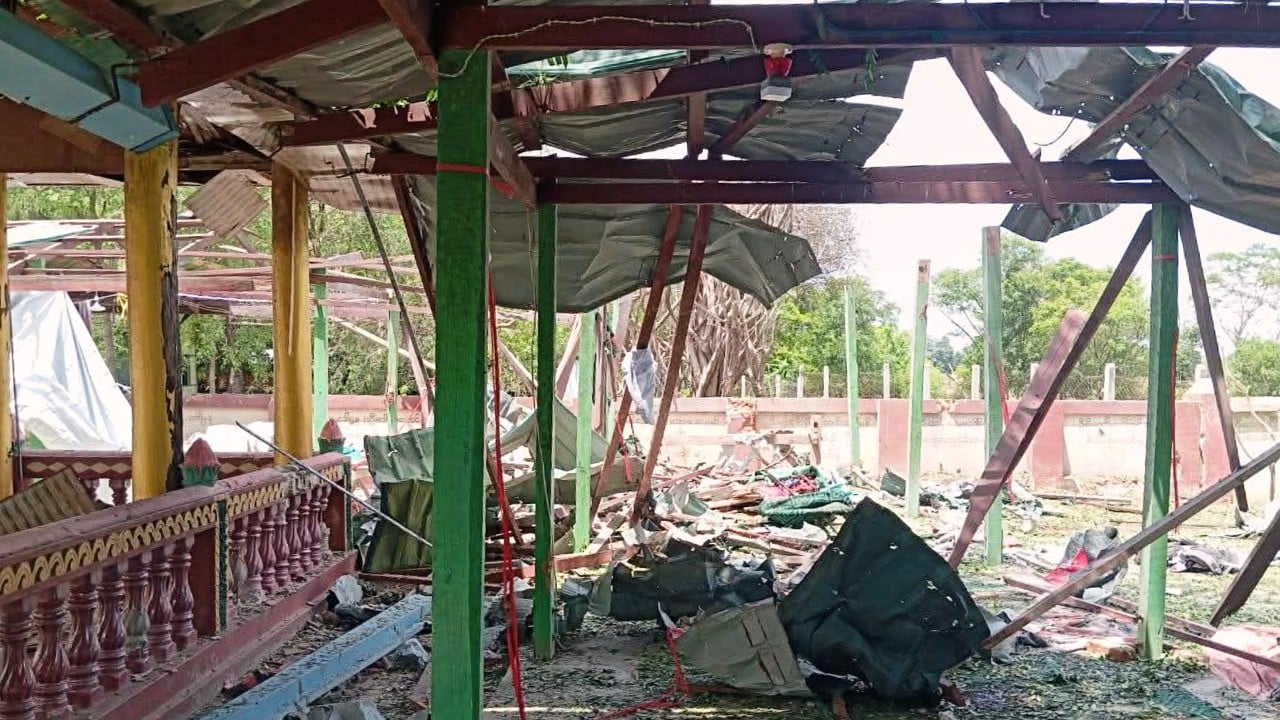
Another headline drops. Another tragic tally of fourteen dead at a monastery in Sagaing. The narrative runs like clockwork: ruthless junta jets strike peaceful civilians at prayer, shocking the international community. Everyone nods in solemn agreement. Everyone expresses outrage. And everyone misses the entire structural reality of how modern asymmetric warfare actually functions on the ground.
Stop treating complex civil conflicts like random atrocities detached from strategic gravity.
The Lazy Consensus of Pure Victimhood
The standard mainstream reporting on Myanmar relies on a comforting, lazy binary. On one side stands a cartoonish, purely destructive military regime dropping ordnance out of sheer malice; on the other, an entirely passive civil populace caught in the crossfire. This framing treats airstrikes like freak weather events.
I have watched foreign policy analysts and international bodies spend millions tracking casualty logs while completely ignoring the logistical realities of insurgency integration. When opposition governance structures, local defense forces, and civil administration bleed into communal spaces like monasteries, the strategic calculus shifts entirely. Insurgencies do not operate in a vacuum separated from civilian infrastructure. They live, store supplies, and coordinate inside the exact social fabric that the state targets.
Pretending that a monastery in Myaung Township exists as a hermetically sealed zone of pure contemplation during a nationwide multi-factional civil war is dangerous fantasy. It strips agency from local actors and reduces a brutal, grinding war of survival to a simple moral morality play.
Logistics, Cover, and the Blurry Line of Military Necessity
Let us look at the mechanics. The Myanmar military junta, pressed hard by the People's Defense Forces and ethnic armed groups across central regions like Sagaing, faces severe ground mobility constraints. Supply lines are ambushed. Convoys are mined. The junta has lost territorial control over vast swaths of the country.
Because ground projection has failed, air power becomes their only remaining instrument of state coercion. When a fighter jet drops munitions on a compound, Western outlets scream war crimes—rightfully citing reports from bodies like the Independent Investigative Mechanism for Myanmar. But stop for a second to examine the intelligence failure underneath. The junta operates on a paranoid, blunt-force doctrine: any gathering of over a hundred people during wartime is classified as an operational risk, a potential staging ground, or a shelter for command elements.
Imagine a scenario where a local militia uses religious sanctuaries for logistical staging, resting, or communications relay, banking on the absolute moral shield that sacred spaces historically provide. When that shield fails, the resulting tragedy is weaponized twice: once by the kinetic force of the bomb, and a second time by the propaganda value of the civilian death toll.
The Danger of Ignoring the Resistance Blueprint
The mainstream narrative wants you to believe that the anti-junta resistance has no responsibility for civilian safety. That is nonsense. Modern asymmetric warfare doctrine dictates that weaker forces blend seamlessly with non-combatant populations precisely to deter heavy strikes or to harvest international sympathy when the inevitable kinetic retaliation arrives.
By refusing to analyze how local defense organizations integrate with village governance, international journalists commit journalistic malpractice. They report the body count but redact the tactical context. They tell you that people died during a meditation retreat, but they refuse to ask why command structures allowed high-density civilian gatherings to persist in active contested firebases.
The junta's strategy is barbaric, yes. But the opposition's reliance on human shielding through social density is a calculated gamble. Until we analyze both sides through the cold, unfeeling lens of tactical realism rather than emotional headline-chasing, the cycle will repeat.
Stop weeping over the sanitized reports. Start looking at the structural incentives of a fractured state tearing itself apart from the inside out.