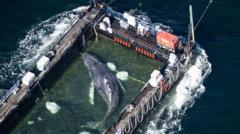
We love a good spectacle. There is something deeply satisfying about watching a multi-ton marine mammal being hoisted by a crane, settled into a bed of damp straw on a barge, and ferried across the German Bight. It feels like we are winning. It feels like humanity is finally paying its debt to the ocean.
It is mostly a lie.
The recent "rescue" of a stranded whale in German waters, transported via barge to deeper seas, is the perfect example of what I call Bureaucratic Compassion. We spend hundreds of thousands of Euros to move a sentient creature from one location to another, ignoring the biological reality that the whale didn't end up in a shallow estuary because it forgot how to use a compass. It ended up there because it is dying.
The Mathematical Impossibility of the Happy Ending
Let's look at the physics. A large cetacean, such as a humpback or a fin whale, is designed to be supported by the buoyancy of the ocean. The moment that whale touches a sandbank, gravity becomes its executioner.
In a medium-to-large whale, the sheer weight of its own body begins to crush its internal organs. We call this compartment syndrome. The muscles, deprived of blood flow due to the pressure, begin to break down and release myoglobin into the bloodstream. This protein is toxic to the kidneys. Even if you get that whale back into 50 meters of water, you haven't "saved" it; you’ve just given it a swimming pool in which to experience acute renal failure.
When authorities brag about a successful "refloating" or a "barge transport," they almost never follow up with the satellite tag data three weeks later. Why? Because the data is depressing. A whale that strands is usually a whale that is already compromised by illness, acoustic trauma, or starvation. Putting it on a boat is the marine equivalent of taking a patient in the middle of a massive coronary and driving them to a scenic park instead of a hospital.
The Logistics of Optics
I’ve spent years watching environmental agencies navigate these crises. The pressure isn't coming from marine biologists—most of whom will tell you, off the record, that euthanasia is the most humane path. The pressure comes from the "Digital Peasantry" on social media.
Imagine the PR nightmare of shooting a whale on a public beach in 2026.
Instead, the government chooses the barge. The barge is expensive. The barge requires specialized cranes, a flotilla of support vessels, and dozens of personnel. It is a massive expenditure of tax revenue that serves one primary purpose: absolution. If the whale dies at sea, out of sight of the cameras, the mission is deemed a "valiant effort." If it dies on the beach under a vet's needle, it's a "tragedy of government inaction."
The Acoustic Elephant in the Room
We talk about the barge, but we don't talk about why the whale was in German waters to begin with. The North Sea is a construction site. Between offshore wind farm development, seismic surveying, and heavy shipping traffic, the underwater environment is a cacophony of low-frequency noise.
For a creature that "sees" through sound, this isn't just annoying. It's blinding.
$SL = 20 \log_{10}(P/P_0)$
When we calculate the Sound Pressure Level (SPL) of a pile-driver for a wind turbine, we are looking at decibels that can cause permanent threshold shifts in cetacean hearing. A deaf whale is a dead whale. It cannot hunt. It cannot navigate. It wanders into the shallows of the Wadden Sea because it is disoriented and desperate.
The "heroic" barge transport is a convenient distraction from the industrial noise we refuse to mitigate. We would rather pay for a one-off rescue mission that makes for a great 20-second clip on the evening news than address the systemic acoustic pollution that drove the animal to the shore in the first place. It is the height of hypocrisy to provide a "ride" to a creature whose home we’ve made uninhabitable.
The Biohazard Nobody Mentions
There is also the grim reality of the "Successful Transport." When we move a sick animal back into the wild population, we aren't just saving an individual; we are potentially introducing a vector.
Whale strandings are often linked to morbillivirus or brucellosis. By ferrying a symptomatic animal back into a migratory corridor, we are taking a biological hazard and placing it right back into the mix. But again, the optics of the barge outweigh the logic of epidemiology.
Stop Reaching for the Crane
If we actually cared about marine conservation—rather than the performance of it—our response to a stranding would look very different:
- Immediate Triage Over Public Relations: If the animal has been grounded for more than one tidal cycle, the internal damage is likely irreversible. We need to normalize euthanasia as a conservation tool, not a failure.
- Investment in Acoustic Buffers: Instead of spending €200,000 on a barge and a crane, that money should be diverted into "bubble curtain" technology for every single North Sea construction project.
- Necropsy as Priority One: Every stranded whale is a data point. When we push them back out to sea to die quietly, we lose the chance to understand the toxins, parasites, or plastic loads that brought them there.
We need to stop treating whales like fallen characters in a Pixar movie. They are apex indicators of a failing ecosystem. Moving them a few miles offshore on a flatbed boat doesn't fix the ocean; it just cleans the blood off our hands so we can go back to scrolling.
The barge isn't a solution. It's a funeral procession with a better marketing budget.
If you want to save the whales, stop cheering for the cranes and start demanding a quieter ocean. Anything else is just expensive theater for the benefit of humans who can’t handle the sight of nature taking its course.