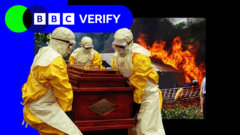
The plastic of the hazmat suit creates a private, suffocating ecosystem. Inside, the only sound is the rhythmic, raspy rasp of your own breath, hot and tasting of stale panic. Outside, through a fogged triple-layer visor, the world is blurred. You see a tropical sky heavy with unreleased rain, the brilliant green of the Congolese foliage, and a crowd of people screaming.
They are not screaming for help. They are screaming at you.
To understand how a life-saving medical intervention becomes a target for a machete-wielding mob, you have to stop looking at data points on an epidemiological tracker. You have to step into the mud. You have to understand fear. Not the rational fear of a microscopic pathogen, but the terrifying, dizzying fear of the unknown, mutated by whispers into something monstrous.
During the height of recent Ebola outbreaks in the Democratic Republic of Congo, a terrifying paradox emerged. Health workers—people who left their families and risked agonizing death to contain one of the world’s most lethal viruses—found themselves hunted. Not by the disease. By the communities they came to save. Treatment centers were torched. Ambulances were stoned. Brilliant, dedicated doctors and local community health liaisons were assassinated in their beds.
The weapon that killed them wasn't the virus. It was a lie.
The Anatomy of a Rumor
Consider a hypothetical mother named Bahati. She lives in a remote village where governance is a distant myth and the only infrastructure that ever arrives comes on the back of a military truck or a foreign NGO Jeep. For decades, people in Bahati’s village have died of malaria, typhoid, and malnutrition without the world blinking.
Then, suddenly, the white trucks arrive.
Men dressed like astronauts descend upon her village. They carry spray tanks filled with chlorine. They tell Bahati that her brother, who has a high fever and is vomiting, has a disease called Ebola. They take him away in a zippered plastic bag. Two days later, they return to tell her he is dead. They do not allow her to touch his body. They do not allow her to perform the sacred burial rites that ensure his soul will find peace. Instead, they bury him in a nameless plot, sprayed with chemicals.
Now, listen to the whisper that reaches Bahati’s ear at the local market.
The whisper says that Ebola is a myth invented by foreigners to harvest African organs. The whisper says that the white tents are actually factories where blood is drained from the living to be sold overseas. The whisper says that the chlorine spray is what actually kills the patients, not the fever.
To an outsider sitting in a comfortable room with high-speed internet, these claims sound absurd. Preposterous. But to Bahati, the rumor possesses a terrifying, airtight logic. No one cared when her children had malaria. Why do these foreigners care so much about this fever? Why do people only die after the trucks arrive?
Fear fills the gaps where trust was never built.
When Words Turn to Iron
Misinformation is rarely a passive misunderstanding. It is an active, living force that reshapes reality. In an environment fractured by years of civil war, political instability, and exploitation, trust is a luxury no one can afford. When a population already believes that outside forces wish them harm, misinformation doesn't just sprout; it explodes.
The numbers back up this grim psychological reality. During the 2018–2020 Ebola outbreak in the eastern DRC, researchers found a direct, quantifiable link between belief in misinformation and a refusal to seek care or accept vaccines. If you believe the vaccine is a tool for sterilization, you run into the jungle when the medical teams arrive. If you believe the treatment center is a slaughterhouse, you fight to keep your sick child at home.
But the tragedy compounds. A sick child kept at home infects the mother. The mother infects the neighbors. The virus spreads exponentially in the shadows, hidden from the medical teams who could contain it.
When the health workers try to intervene, the tension snaps.
Imagine being a local nurse. Let's call him Jean. Jean grew up three villages over. He knows the language, the customs, the elders. He joined the response team because he saw his neighbors dying. He wears the heavy protective gear for hours under a punishing sun until his boots are filled with his own sweat. He is exhausted.
One evening, Jean’s team drives toward a hotspot where a secret burial is reportedly taking place. A traditional burial involves washing the body, a practice that, with an Ebola victim, is essentially a death sentence due to the immense viral load on the skin. The team must stop it.
They turn a corner and meet a barricade of burning tires.
A crowd has gathered. They are armed with stones and clubs. They see the white truck, and they do not see medical aid. They see the thieves of their dead. They see the bringers of the plague. Someone throws a rock. It shatters the windshield. Jean ducks, glass showering his hair. The crowd surges forward, chanting slogans born from a WhatsApp voice note that circulated the previous night, claiming that health workers were poisoning the local water supply.
Jean survives that night because the driver reverses frantically down a dirt track. Others have not been so lucky. Dr. Richard Valery Mouzoko Kiboung, a Cameroonian epidemiologist working for the World Health Organization, was shot dead in a hospital meeting room in Butembo. He was there to save lives. He was executed because a community had been convinced he was the enemy.
The Failed Blueprint of Pure Logic
For a long time, the global health apparatus responded to these crises with more data. They believed that if they just shouted the facts louder, the misinformation would melt away. They printed pamphlets. They set up mega-speakers on trucks to blast educational loops about viral transmission.
It failed.
Data cannot combat a story. When someone is trapped in a narrative of survival against a perceived oppressor, presenting them with a chart on viral loads feels like mockery. It confirms their suspicion that the outsiders do not see them as human beings, but as biological hazards to be managed.
The real problem lies elsewhere. The breakdown isn't intellectual; it is relational.
To bridge the chasm, the response had to learn humility. Medical teams had to accept that a pristine epidemiological protocol is worthless if it outrages human dignity. They had to stop acting like an invading army and start acting like guests.
Consider what happens next when the strategy shifts from dictation to listening.
Instead of banning traditional burials outright, teams began negotiating safe and dignified burials. They allowed family members to put on protective gear to see their loved ones, to throw earth onto the coffin, to pray from a safe distance. They engaged the real gatekeepers of the community: the traditional healers, the religious leaders, the market women.
If a traditional healer tells a village that the virus is real, the village listens. If a foreign doctor says it, they doubt.
The Infection of the Mind
The battle against Ebola is fought on two fronts simultaneously, and the digital front is proving to be just as lethal as the biological one. The proliferation of cheap smartphones and mobile data across sub-Saharan Africa has democratized information, but it has also weaponized rumor at an unprecedented scale.
A lie travels across a province in seconds via encrypted messaging apps. It morphs as it goes, adapting to local anxieties. By the time a health agency can draft, approve, and translate a factual correction, the lie has already hardened into a conviction. The conviction has already dictated action. The action has already drawn blood.
This is not a problem unique to remote rainforests. The Western world watched the exact same psychological machinery operate during recent global health crises, where cell towers were burned and doctors received death threats over vaccines. The human brain, when saturated with fear, reverts to a tribal, defensive posture. It seeks a scapegoat.
The only difference is the stakes. In a wealthy nation, misinformation might cause a localized dip in herd immunity. In an Ebola zone, it triggers an immediate, catastrophic resurgence of a virus with a fifty percent mortality rate.
The sun begins to set over the treatment center, casting long, bruised shadows across the gravel. Inside the hot zone, a young girl who arrived three days ago terrified, bleeding from her gums, takes her first sip of oral rehydration solution without vomiting. Her fever is breaking. She will likely survive.
Outside the double-fenced perimeter, a group of young men stands on the hillside, watching the facility with sullen, distrustful eyes. They are holding stones. They are waiting for the darkness.
The medical staff inside finish their shifts, peeling off the layers of yellow rubber and plastic, their skin pale and wrinkled from sweat. They know the statistics. They know the treatment works. But as they walk to the transport vans that will take them to their guarded compound, they do not look at the sky or the road. They look at the hills.
They are listening for the whispers.