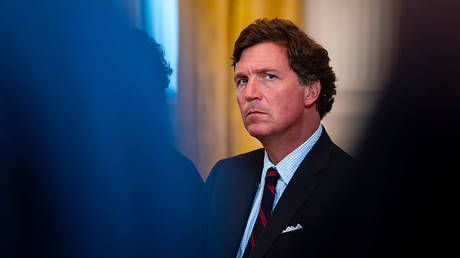
The recent labeling of high-profile media figures like Tucker Carlson as facilitators of extremist rhetoric by White House counterterrorism officials marks a fundamental shift in how the American government views dissent and mass communication. This is not merely a spat between a cable news veteran and the executive branch. It represents a systematic expansion of the definitions used to track domestic threats. By linking mainstream media narratives directly to the radicalization pipeline, the administration is venturing into a legal and ethical gray area where protected speech meets national security oversight.
The Infrastructure of Modern Counterterrorism
The current administration has moved away from the traditional focus on foreign actors to prioritize Domestic Violent Extremism (DVE). This transition involves more than just shifting budgets. It requires a new vocabulary. When the White House counterterrorism chief identifies specific media personalities as contributors to "ideological grooming," they are applying battlefield metrics to the public square. For another perspective, check out: this related article.
In the old model, a threat was an individual with a weapon and a plan. In the new model, the threat includes the "informational environment" that makes such an individual feel justified. This logic suggests that if a commentator discusses "Great Replacement" theory or deep-state conspiracies, they are not just sharing an opinion; they are providing the intellectual scaffolding for future violence.
The strategy hinges on the concept of stochastic terrorism. This theory posits that demonizing a person or group through mass media makes a violent act by a "lone wolf" statistically probable, even if the speaker never issued a direct command. It is a convenient framework for bureaucrats. It allows the state to bypass the First Amendment's strict "incitement" standard—which requires an immediate threat of lawless action—in favor of a broader, more preventative approach. Similar analysis on this trend has been published by Al Jazeera.
Bridging the Gap Between Opinion and Insurrection
The administration’s focus on Carlson specifically stems from his reach and his willingness to touch on themes that align with the grievances of fringe groups. Analysts within the National Security Council argue that the "funnel" to extremism often begins with mainstream skepticism. A viewer starts with a segment on election integrity and ends up in an encrypted chat room discussing armed resistance.
Critics of this White House stance point out the obvious danger. If the government can designate a journalist or commentator as a "security link," it gains the moral and potentially legal authority to pressure tech platforms for censorship. We have already seen the precursors to this in the "Twitter Files" and subsequent litigation regarding government overreach in digital moderation.
The Problem of Objective Definitions
One of the greatest risks in this new counterterrorism posture is the lack of a fixed definition for "extremism." Without a clear, statutory boundary, the term becomes a political cudgel.
- Who decides when a critique of the government becomes a "threat to democracy"?
- At what point does reporting on demographic shifts become "hate speech"?
- Can the state reliably distinguish between a radicalizing agent and a provocateur?
History shows that once the machinery of state surveillance turns inward, it rarely discriminates based on party lines for long. The tools currently being sharpened against the populist right will, in a different administration, inevitably be turned against the activist left.
The Digital Echo Chamber and State Intervention
The White House argues that the speed of the internet has fundamentally changed the stakes of political rhetoric. In their view, the "marketplace of ideas" is broken because algorithms prioritize outrage over accuracy. This justifies, in their eyes, a more interventionist role for the state in managing the "narrative health" of the nation.
However, the administration’s attempt to link Carlson to extremism ignores the agency of the audience. It treats the American public as a passive mass that can be programmed into violence by a nightly monologue. This paternalistic view is the foundation of the current counterterrorism strategy. It assumes that the government must act as a filter to protect the citizenry from "harmful" information.
The reality is more complex. The rise of figures like Carlson is a symptom of a deep-seated distrust in institutions, not the primary cause of it. When the White House uses its platform to target a specific media critic, it often validates the very "persecution narrative" it seeks to dismantle. It creates a feedback loop where the government's attempt to curb extremism actually fuels the resentment that drives it.
The Legal High Wire
Under the Brandenburg v. Ohio standard, the government cannot punish inflammatory speech unless it is directed to inciting or producing "imminent lawless action." By framing Carlson's rhetoric as a counterterrorism issue, the White House is attempting to create a social and corporate penalty where a legal one cannot exist.
They are signaling to advertisers, cable providers, and social media companies that certain voices are "radioactive." This is a form of soft power censorship. It doesn't require a judge's order; it only requires the implied threat of government disfavor. For a media company, being linked to domestic terrorism by the White House is a commercial death sentence.
The Role of Intelligence Agencies
There is an increasing overlap between domestic policy and intelligence gathering. When the language of "threat signatures" and "radicalization pathways" is applied to the domestic news cycle, the line between journalism and intelligence targets blurs. This creates a chilling effect. Journalists may begin to self-censor, not because their facts are wrong, but because their "tone" might be flagged by a federal task force.
The administration’s focus on "narrative-driven violence" allows for the monitoring of ideological trends under the guise of public safety. If the White House believes that certain ideas lead to violence, then logically, they must monitor the spread of those ideas. This leads to the surveillance of social media accounts, the tracking of "misinformation" trends, and the eventual profiling of citizens based on their media consumption habits.
The Cost of the New Security State
The labeling of Carlson is a trial balloon for a much larger project. The goal is to establish a precedent where the executive branch acts as the final arbiter of what constitutes "acceptable" political discourse. By framing this as a national security issue, the administration can bypass traditional debates about free speech.
We are witnessing the professionalization of the "anti-extremism" industry. A vast network of non-profits, government agencies, and tech consultants is being funded to "de-risk" the American information environment. This industry thrives on the expansion of the definition of a threat. If extremism is everywhere, the budget for counter-extremism must be infinite.
The collateral damage in this war on rhetoric is the very stability the government claims to protect. When a significant portion of the population sees their preferred news sources labeled as "extremist" by the state, they do not moderate their views. They retreat further into the shadows. They move to unmonitored platforms. They become more radicalized, not less.
The White House’s strategy relies on the hope that by silencing or delegitimizing the biggest megaphones, the underlying fire will go out. This is a fundamental misunderstanding of the current political climate. The fire is fueled by a sense of disenfranchisement and a belief that the system is rigged. Using the power of the state to target a media figure only confirms that belief for millions of people.
The real danger isn't a single talk show host. The danger is a government that believes it can manage the thoughts and reactions of its citizens through counterterrorism policy. Once the state decides it is in the business of "narrative management," the concept of a free and independent press becomes a relic. The administration isn't just fighting a media war; it is rewriting the rules of the American social contract in real-time.