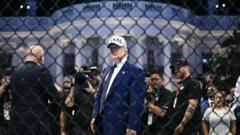
You wake up on a Tuesday morning to read that a group of internet radicals planned to turn the White House South Lawn into a war zone. The headlines sound terrifying. The FBI just unsealed federal affidavits revealing a multi-stage plot to attack the historic UFC 250 event this past Sunday. The strategy sounded like a high-budget action movie: fly explosive-laden drones over the arena, detonate them to spark a mass stampede, and herd wealthy elites directly into the crosshairs of pre-staged sniper teams. A second wave would then storm the gates to "jumpstart" a new American revolution.
It makes for great clickbait, but anyone who understands tactical reality knows this plan was fundamentally detached from logic.
The federal government is taking it seriously, as it should. Five men—Tycen Proper, Michael Alan Thomas, Bryan Omar Roa, Daniel Eskridge, and Abraham Hermosillo Alvarez—face federal conspiracy and attempted murder charges. But when you peel back the layers of the unsealed court documents, you don't find a sophisticated paramilitary cell. You find a disjointed group of internet-brained individuals operating in encrypted chat rooms who forgot that real-world operations require actual logistics, not just dark fantasies shared on Signal and SimpleX.
The Mother of All Intelligence Failures
Forget high-tech surveillance or undercover stings. The entire multi-state counterterrorism operation, which eventually looped in 12 different FBI field offices, started because a mom in Knox County, Ohio, got worried about her 19-year-old son.
On June 10, just four days before the cage match, Tycen Proper’s mother called local law enforcement. Her teenager had spent roughly $3,000 of his graduation money on an alarming checklist: body armor, ballistic plates, a shotgun, a rifle, massive amounts of ammunition, and camping gear. He had just quit his job. His father told deputies that the kid was talking about going on "recons" and "missions" with people he met online. Local police briefly hospitalized Proper for homicidal ideation and immediately looped in the feds.
When agents opened Proper’s phone, the digital illusion shattered. Proper admitted he belonged to a TikTok group called "Vanguard of the Old" that formed back in March. The members shared a vague, chaotic ideology: they believed the country was heading in the wrong direction, hated "capitalist elites" and politicians who accepted money from groups like AIPAC, and bizarrely wanted to target anyone associated with the late Jeffrey Epstein.
To achieve this, they migrated to an encrypted Signal chat of about 20 people. There, they drew up a plan to attack the White House during UFC Freedom 250, an event hosted on President Donald Trump’s 80th birthday as a kickoff for the nation's 250th anniversary.
The Blueprint vs Reality
The group’s operational plan relied on a level of chaos they had no actual ability to control.
According to the FBI affidavits, the plotters intended to gather in Fredericksburg, Virginia, before driving into Washington, D.C. Once there, they planned to launch small unmanned aerial vehicles rigged with explosives over the northern side of the temporary outdoor arena, dubbed "The Claw."
The goal wasn't just to kill people with the drones. The explosions were meant to cause a panicked mass evacuation toward the south. The plotters believed they could funnel high-profile targets—including Donald Trump, UFC CEO Dana White, tech billionaire Mark Zuckerberg, and various Cabinet members like Marco Rubio and Robert F. Kennedy Jr.—right into the waiting arms of their own sniper teams.
Here is why that plan collapses under any serious scrutiny.
The D.C. Airspace Myth
Washington, D.C. features the most heavily restricted, electronically jammed airspace on the planet. The Special Flight Rules Area (SFRA) and the Flight Restricted Zone (FRZ) mean that flying even a basic consumer drone within miles of the White House is nearly impossible without commercial signals being automatically dropped or overridden. For a group of loosely organized citizens to successfully pilot multiple explosive-laden drones into a high-security event requires overcoming military-grade electronic warfare assets. They didn't have the tech for that.
Pre-Staging Snipers in Downtown D.C.
The idea of establishing hidden sniper nests around the White House during a massive, globally televised event borders on delusional. Security for UFC 250 was spearheaded by the Secret Service, with heavy reinforcement from the U.S. Park Police and the Metropolitan Police Department. The entire perimeter around the South Lawn and the National Mall was locked down under an estimated $12 million local policing budget funded by Dana White. Checkpoints extended blocks into the city. Streets were closed, and counter-sniper teams from the Secret Service routinely occupy the highest vantage points in the area. The plotters' plan assumed they could just set up rifles on nearby rooftops without anyone noticing.
The Fredericksburg Safe House Bottleneck
The group planned to meet in Fredericksburg, Virginia, and commute into the city with a trunk full of illegal firearms, tactical vests, and explosive materials. Anyone who lives in the DMV area knows that traveling up the I-95 corridor into Washington on a high-traffic weekend is a logistical nightmare even without federal heat. They were driving straight into an expanded, hard-security perimeter with zero operational security.
What This Tells Us About Modern Domestic Threats
The FBI and Secret Service are projecting total confidence, and they have earned a victory lap. FBI Director Kash Patel noted on social media that the plot was stopped cold due to rapid multi-state intervention. Secret Service Deputy Director Matt Quinn explicitly stated that the event itself was never truly at risk because investigators intercepted the network before the plotters could even assemble in Virginia.
But we need to look honestly at what this threat actually represents. This wasn't an organized foreign cell or a highly trained domestic militia. This was a collection of deeply alienated, online-radicalized individuals who found each other in a TikTok comment section and convinced themselves they could pull off a historical coup.
The danger of groups like "Vanguard of the Old" isn't their tactical brilliance. It's their sheer unpredictability and access to firepower. Tycen Proper was a teenager with graduation money and an internet connection. If his mother hadn't made that call on June 10, these individuals still would have failed to breach the White House, but they easily could have caused a tragedy at a softer target along the way.
The federal government will continue tracking down the remaining individuals identified in those 23 Signal accounts. As the court dates approach in Ohio, Missouri, and California, the public will likely see just how amateurish the actual logistics were. For now, the takeaway is simple: the security apparatus surrounding the presidency worked exactly as intended, fueled not by algorithmic surveillance, but by a parent noticing her kid was buying too many bullets.