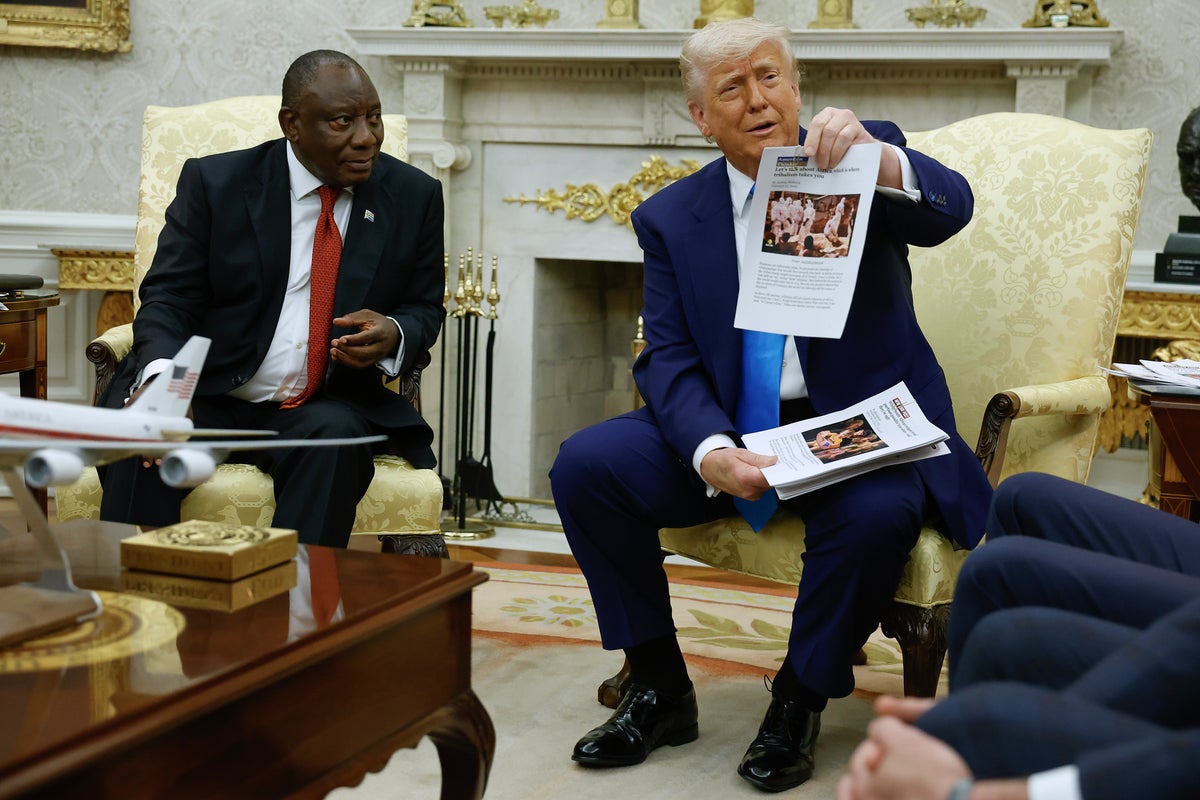
Legacy media is choking on its own outrage over the latest federal immigration data. The headlines scream about a weaponized system: 6,000 refugees admitted to the United States this fiscal year, and with the exception of three stranded Afghans, every single one of them is a white South African. The consensus across the political aisle is as lazy as it is predictable. Critics call it explicit racial favoritism, while the administration's defenders frame it as a heroic rescue of an endangered minority fleeing state-sanctioned expropriation.
Both sides are entirely blind to the actual mechanics of what is happening. This is not a masterclass in border control, nor is it a functional humanitarian program. It is a spectacular administrative failure that exposes the deep decay of the American immigration apparatus.
By shifting the entirety of the United States Refugee Admissions Program to a single, hyper-specific demographic, the federal government has created an economic and logistical bottleneck that serves no one. The administration sold this policy as an injection of culturally compatible, highly skilled human capital into the American heartland. Instead, the reality on the ground reveals a system that traps these new arrivals in bureaucratic gridlock, exposes them to immediate financial ruin, and guts the geopolitical leverage of the American state.
The Assimilation Myth Meets Bureaucratic Reality
The core argument for the "Mission South Africa" initiative was seamless economic integration. Proponents claimed that because these Afrikaner refugees are overwhelmingly English-speaking, skilled, and culturally aligned with Western traditions, they would bypass the traditional friction points of resettlement. They were supposed to touch down at Dulles International Airport and immediately fill the labor voids of the American Midwest.
Step outside the policy memos and look at Akron, Ohio.
The state of Ohio has spent decades fighting population decline. Local municipal leaders initially eyed the arrival of hundreds of South African families as a demographic lifeline. But the administration forgot a fundamental truth: you cannot fast-track a population into an economy while simultaneously dismantling the very infrastructure required to let them work.
On day one, the federal refugee cash assistance program was slashed from twelve months to four. For an arriving family, four months of bare-minimum stipends do not cover the runway required to secure housing, pass state-level licensing exams, or navigate local infrastructure.
Worse, the administration's own domestic policies have turned routine logistics into insurmountable barriers. In Ohio and Michigan, newly arrived Afrikaners are currently running headfirst into hyper-restrictive Republican-sponsored driving regulations designed to crack down on undocumented immigration. Because these refugees lack traditional domestic identification pipelines, getting a standard driver's license now takes up to nine months and hundreds of dollars in legal fees.
Imagine a scenario where a skilled mechanic or agricultural manager from the Western Cape is resettled in a suburban Michigan township. They have no access to public transit. They cannot legally drive to a job. Their federal stipends dry up in 120 days.
The result is not a thriving entrepreneurial class. It is a subset of families launching frantic GoFundMe campaigns just to secure transport to and from local food banks. The administration did not build a pipeline for talent; it engineered a dependency trap.
The Erasure of Geopolitical Leverage
The structural failure goes far beyond domestic logistics. Immigration policy is not just a domestic spreadsheet; it is one of the most potent levers of foreign policy the executive branch possesses. By narrowing the entire nation's refugee capacity to a singular group based on a widely disputed domestic narrative, the United States has effectively castrated its own intelligence and diplomatic networks.
Consider what was traded away to clear these 6,000 slots.
The State Department is actively blocking the resettlement of more than a thousand highly vetted Afghan interpreters and Special Operations allies currently sitting in geopolitical limbo in Doha. These are individuals who possess deep, uncopiable operational intelligence, linguistic capability, and proven loyalty to American assets. During recent congressional hearings, the justification for this blockade was laid bare: the national interest demands individuals who can "quickly assimilate."
This is a profound miscalculation of what constitutes a strategic asset. The state has traded battle-tested military intelligence and regional leverage in Central Asia for rural families who are currently struggling to navigate the BMV in Akron.
Furthermore, the implementation of this policy required cutting off all foreign aid to South Africa and boycotting major international summits like the G20 in Johannesburg. In doing so, the U.S. vacated its seat at the table in one of the most resource-rich, strategically vital economies on the African continent. When you walk away from the table out of ideological spite, your adversaries do not leave the room. They buy the building. China and Russia have already moved to fill the diplomatic and economic vacuum left by the U.S. exit from Pretoria, securing long-term supply chain agreements while Washington manages the logistics of chartered flights for farm managers.
The Numbers Do Not Lie
To understand the sheer scale of the administrative incompetence, you have to look at the baseline capacity of the system.
| Fiscal Year | Total Refugee Admissions | Top Source Countries |
|---|---|---|
| 2024 | 100,060 | Democratic Republic of Congo, Syria, Afghanistan |
| 2026 (Current) | 6,668 | South Africa (6,665), Afghanistan (3) |
The United States immigration system is an incredibly heavy, slow-moving machine. It is built to process hundreds of thousands of applications through distributed global pipelines. When the executive branch forces that entire machine to pivot, close down dozens of processing centers across Asia, the Middle East, and Latin America, and funnel its entire operational budget into a single embassy in Pretoria, efficiency does not double. The machine breaks.
The administration recently announced plans to lift the current refugee cap by 10,000 slots, specifically allocating them to more Afrikaners under the banner of an "emergency refugee situation." This move will cost American taxpayers an estimated $100 million.
That money is not going toward infrastructure, language training, or job placement. It is being swallowed by the sheer operational friction of running an expedited, ideologically driven visa operation out of a single geographic point, all while resettlement agencies across the United States face mass layoffs because their traditional, diversified pipelines have been legally choked off.
The Hard Truth
The tragedy of the current refugee crisis is not that the system is exclusive. The tragedy is that it is fundamentally broken for the very people it claims to prioritize.
The legacy media wants you to believe this is a story about a successful, targeted intervention. The reality is that the administration has taken a population that possessed genuine economic potential, stripped away their international support systems, dropped them into domestic environments hostile to new arrivals, and isolated the United States from its global allies in the process.
Immigration cannot be run as a boutique ideological project. When you treat the refugee program as a political signaling tool rather than a cold, calculated mechanism for building strategic depth and economic power, you get exactly what we see today: empty coffers, abandoned allies, and families stranded in suburban Ohio who cannot even drive to the supermarket.