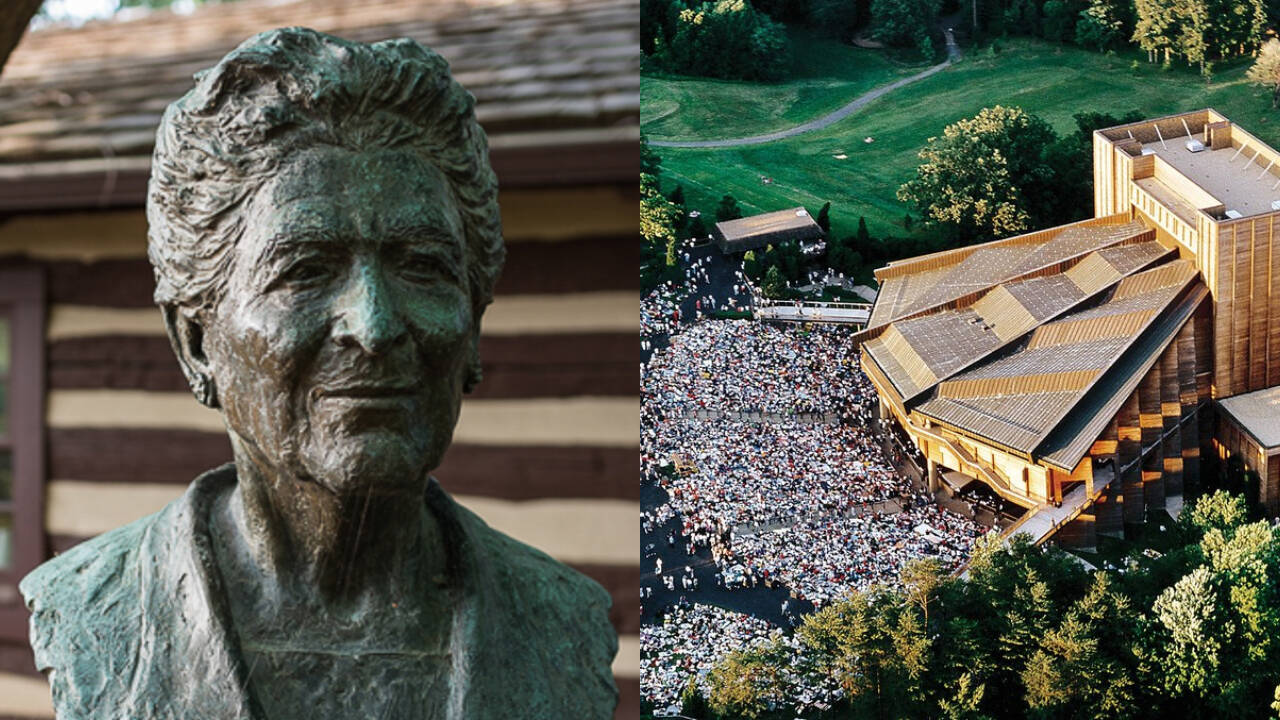
Catherine Filene Shouse was seventy-one years old when she dismantled the private seclusion of her Virginia estate to build a monument to the performing arts. Most accounts frame this as a simple act of generosity. It was, in reality, a masterclass in institutional navigation and political influence. By donating nearly one hundred acres of her Wolf Trap Farm to the federal government in 1966, Shouse did more than provide a venue for music and theater; she essentially forced the United States national park system to expand its mission statement beyond land preservation and into the realm of cultural maintenance.
The narrative often suggests this park emerged from a sudden stroke of inspiration. The historical record indicates otherwise. Shouse operated at the center of Washington power structures. She was a political insider who served on the inaugural board of the John F. Kennedy Center for the Performing Arts, a position that granted her the leverage to understand exactly how to secure federal designation for a private asset. Her initial attempt to gift the property to the National Symphony Orchestra failed, blocked by logistical concerns that would have buried a lesser advocate. Shouse did not retreat. She pivoted to the Department of the Interior, aligning her personal agenda with the broader cultural aspirations of the Kennedy and Johnson administrations.
This intersection of private wealth and public policy is where the true story lies. The creation of Wolf Trap National Park for the Performing Arts was not merely a gift. It was a calculated expansion of the American public commons.
To understand why this matters, look at the mechanisms involved. Most land donations to the government involve tax benefits or the simple desire to see a space preserved in perpetuity. Shouse, however, required the legislative machinery of Congress to change how a national park was defined. When she approached Secretary of the Interior Stewart L. Udall, she was not asking for a donation; she was asking for a permanent, federal partnership that would outlive her.
Consider the logistical gravity required to sustain such an institution. Maintaining a world-class amphitheater within a national park framework introduces a constant tension. You have the mission of environmental stewardship clashing with the high-impact reality of thousands of visitors, amplified sound systems, and commercial production requirements. This is a fragile equilibrium. Many observers assume these sites run smoothly by default, but the reality involves a constant struggle between the National Park Service and the demands of modern event management.
Take a hypothetical example of a similar land trust transfer. If a donor today wished to replicate the Wolf Trap model, they would face a web of environmental impact assessments, zoning conflicts, and liability concerns that were far less obstructive in the 1960s. The regulatory barrier to entry for establishing a new national park is immense. Shouse navigated a political landscape where cultural prestige was considered a legitimate federal asset. Today, the federal government is far more cautious about accepting financial liabilities masked as charitable donations.
The brilliance of the Shouse move was the timing. By the mid-1960s, Washington was undergoing a deliberate cultural transformation. The reopening of Ford’s Theater and the development of the Kennedy Center were clear signals that the government viewed art as a public necessity. Shouse inserted her project into this momentum. She understood that if you want to leave a lasting mark on public infrastructure, you do not just provide the land. You provide the political cover and the institutional framework that makes the government feel it is expanding its own legacy, rather than just managing yours.
This dynamic explains the scarcity of such parks. We see private estates donated to nature conservancies or state agencies with relative frequency. We rarely see them integrated into the federal national park system. The criteria for national park status are rigorous, usually demanding unique geological or historical significance. By framing her farm as a venue for educational programming and national cultural expression, Shouse redefined what the "public interest" meant in the eyes of the National Park Service.
Critics might argue that such partnerships create a permanent dependency on public funding for what is essentially a specialized venue. There is validity in that concern. When an private entity is converted into a federal park, the maintenance costs become a taxpayer responsibility. Yet, the social return on that investment is found in the accessibility of the arts to a wider demographic. The park operates not as a private club, but as a public stage, which was the core of Shouse’s vision.
She proved that the right influence, coupled with a well-timed asset transfer, can shift the trajectory of public policy. The land was a secondary consideration. The real donation was the institutional mandate she forced the government to accept.
The amphitheater at Wolf Trap remains a monument to that specific form of ambition. It is a reminder that the most significant public spaces are often the result of private individuals who understood the levers of power better than the politicians they negotiated with. Shouse did not just give away a farm. She set the terms for how the government interacts with the arts, a precedent that stands nearly six decades later.
If you look at the lawn on a summer evening, you see the audience, the actors, and the trees. What you are witnessing is the lasting infrastructure of an influence campaign that succeeded precisely because it was framed as a gift. The barrier between private vision and public reality is never as thick as people think. It simply requires the right timing and the absolute refusal to accept the first rejection.