Silence.
When a human being reaches 112 years of age, the world tends to wrap them in a soft, protective blanket of nostalgia. We ask them about their favorite childhood candy, the secret to their longevity, or what it felt like to watch the first airplanes rattle across an empty sky. We treat supercentenarians as living monuments to human endurance, gentle vessels carrying the harmless dust of a vanished century.
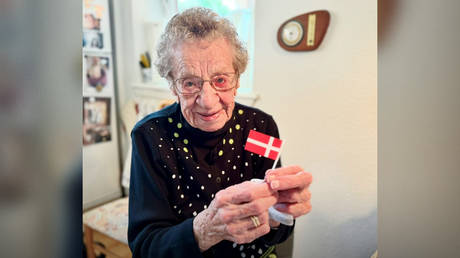
For a few luminous weeks in the autumn of 2026, Kirsten Schwalbe was precisely that kind of monument. Born in central Jutland on March 10, 1914—four months before the assassination of Archduke Franz Ferdinand plunged Europe into the First World War—she had survived two global conflicts, the Spanish flu, the moon landing, and the digital revolution. On October 14, at 112 years and 218 days old, she officially surpassed Karla Lindholm Jensen to become the longest-lived person in recorded Danish history.
Denmark fell in love with her.
Cameras hummed quietly in her modest kitchen in Struer as she blew out birthday candles and knitted on her sofa. Television viewers tuned into a documentary series celebrating her spirited late-life adventures, titled Kirsten’s Wild Years. Just six days before she broke the national longevity record, Denmark’s oldest and most prestigious publishing house, Gyldendal, released her biography. Its title felt like a warm embrace from a grandmother who had seen it all and chosen joy anyway: We Need Something to Laugh About.
Then, someone opened a box in the Danish National Archives.
The Weight of Yellowed Paper
Paper does not forget. While human memory softens the jagged edges of the past—rounding off guilt, blurring motives, and editing out the chapters we wish we had never written—ink pressed onto bureaucratic forms in 1943 remains stubbornly, mercilessly exact.
When investigative journalists and historians examined the dusty wartime records of the Danish National Socialist Workers’ Party, known as the DNSAP, the cozy portrait of Denmark’s favorite great-grandmother fractured overnight. The documents revealed that Kirsten Schwalbe had not merely lived through the German occupation of Denmark between 1940 and 1945. She had actively served the ideology that occupied it.
When whispers of her party membership first surfaced in October, Schwalbe offered an explanation that sounded entirely plausible to anyone familiar with early twentieth-century gender roles. She told reporters that she had joined in August 1941 solely at the request of her husband, that she barely knew what Nazism was, and that back then, wives simply did not get involved in politics. She expressed frustration that anyone would expect her to pay for a passive signature more than eight decades later.
It was a comfortable story. Many people wanted to believe it.
But the archives told a different tale. According to records unearthed in November 2026, Schwalbe was not a reluctant bystander signing a form to keep peace at the dinner table. From August 1943 to July 1944, she served as the acting local branch leader and head of the women’s group for the Danish Nazi Party in the town of Holstebro.
Historian Claus Bundgaard Christensen, one of Denmark’s foremost experts on the occupation, examined the evidence and delivered a verdict that left little room for ambiguity. A local branch group leader was the organizational equivalent of a middle manager. Schwalbe was no mere name on a forgotten roster; alongside her husband, she was a prominent, active Nazi figure in her community during the darkest years of the war.
The fallout was immediate and seismic. Gyldendal halted sales of We Need Something to Laugh About, acknowledging that the book’s uplifting premise had been fundamentally broken by the omitted truth. Television broadcaster TV Midtvest pulled the plug on its coverage and canceled the final episode of her documentary. The national celebration curdled into a quiet, uncomfortable reckoning.
Why a Small Number Casts a Long Shadow
To understand why a 112-year-old woman’s wartime paperwork triggered such intense shock across Denmark, you have to understand the particular scar that the German occupation left on the Danish psyche.
Unlike many nations conquered by the Third Reich, Denmark initially experienced what historians often call a "model protectorate." Following the invasion in April 1940, the Danish government remained largely intact for three years in exchange for economic cooperation, preserving a fragile illusion of normalcy. Yet beneath that surface, a fierce moral divide hardened. The Danish Nazi Party, which adopted the swastika, the Hitler salute, and the virulent antisemitism of its German counterpart, never won broad public support. At its peak, its membership represented a tiny fraction of the population.
Because their numbers were so small, joining the DNSAP was never an act of passive conformity. In occupied Denmark, you did not accidentally drift into the Nazi Party to fit in with the neighbors. Becoming a member—let alone stepping forward to lead a local branch and organize its women’s division—was a deliberate, conspicuous choice to align yourself with an invading force against your own countrymen.
Consider the timeline of Schwalbe’s leadership. She took the reins in Holstebro in August 1943. That exact month marked the collapse of Danish cooperation with Germany, triggering widespread strikes, sabotage by the Danish resistance, and the imposition of German martial law. Two months later, in October 1943, the Gestapo launched its operation to round up Denmark’s Jewish population, prompting ordinary Danes to risk their lives smuggling more than seven thousand Jewish neighbors across the water to safety in neutral Sweden.
While thousands of Danes were paddling fishing boats through dark, freezing waters to save lives, the local Nazi branch in Holstebro was being managed by a young woman who would one day tell journalists she had never been interested in politics.
The Anatomy of Moral Amnesia
Think of historical memory like a house built over an old well. For decades, the floorboards look solid. Families gather in the living room, hang portraits on the walls, and tell stories about how they survived the storms outside. Everyone agrees not to lift the rug in the corner, because nobody remembers who nailed the boards shut—and besides, the water down there has been still for eighty years.
When someone finally pries up those boards, the shock isn't just about what lies at the bottom. It is the realization that the entire house was standing over it the whole time.
We encounter this phenomenon constantly in public life, though rarely stretched across a lifespan exceeding a century. Psychologists and historians recognize a deeply human instinct to sanitize our own biographies as we age. When we look backward across decades, we rarely see ourselves as villains or ideological foot soldiers; we remember ourselves as young, overwhelmed, pressured by spouses, or simply trying to get through hard times.
Consider a hypothetical scenario to see how easily this happens. Imagine a young man in 1965 who joins a radical, violent organization out of anger and ambition, organizing meetings and recruiting neighbors. Fifty years later, that same man is a frail grandfather volunteering at a local animal shelter, baking bread for his street, and genuinely believing he was always a gentle soul who just happened to live through turbulent times. Is his kindness at eighty-five a performance? Probably not. Human beings are capable of profound reinvention, or at least profound compartmentalization. Yet his genuine warmth today does not erase the bruises left by his actions half a century ago.
This is where our collective intuition gets tangled. We want people to be simple. We want heroes to be pure from cradle to grave, and we want villains to look monstrous even when they are blowing out candles on a birthday cake. When a frail 112-year-old woman sitting in a sunlit kitchen turns out to have been a local Nazi official, our brains struggle to hold both images in the same frame.
The Invisible Stakes of the Missing Chapter
When Gyldendal pulled Kirsten Schwalbe’s biography from bookshelves, critics in some corners asked a predictable question: What is the point of punishing a 112-year-old woman for something she did eighty-three years ago?
Her family noted that she was deeply affected by the media storm, asking for privacy in her final days. Looking at photographs of a tiny, white-haired centenarian knitting in her living room, it is almost impossible not to feel a flicker of basic human discomfort at the sight of global headlines descending upon someone at the very edge of mortality. It feels uneven. It feels late.
But the stakes here have very little to do with punishing an old woman. They have everything to do with what we owe the truth—and what we owe the dead.
Every biography published by a respected house makes an implicit promise to its readers: This is the real story of a life. When a book celebrates a figure as a charming emblem of national resilience while leaving out her leadership in a fascist party, it ceases to be a biography and becomes a fairy tale. Worse, it becomes an unintentional insult to the people who suffered under the regime she helped administer.
During the occupation of Denmark, resistance fighters were tortured in Gestapo basements. Danish Jews fled their homes in the dead of night, leaving behind everything they owned, while hundreds who could not escape were deported to the Theresienstadt camp. Ordinary citizens lived under curfews, rationing, and the constant threat of arbitrary violence.
To celebrate a former local Nazi leader as a national treasure without mentioning her role in the party is to decide, quietly and conveniently, that those victims’ memories matter less than our desire for a feel-good human-interest story. Longevity is a biological accident, not a moral absolution. Living to 112 does not wash away 1943.
What Remains When the Applause Stops
There is a strange, haunting irony in the title of Schwalbe’s withdrawn book. We Need Something to Laugh About.
Laughter requires lightness. It requires the freedom to let go of heavy things, to look at the absurdity of the world and smile without looking over your shoulder. For more than eighty years, Kirsten Schwalbe lived in a quiet town in western Jutland, outliving her husband, outliving her peers, outliving almost every single person who could have walked into a room and said, I remember what you did in Holstebro.
She came extraordinarily close to completing the ultimate escape: outrunning history itself. Had she passed away at 105, or 110, or even in September 2026 at 112, her secret would have gone into the earth untouched, tucked neatly beneath decades of knitting needles and birthday cakes.
It was only because she lived long enough to claim a national record—only because the spotlight grew bright enough to illuminate every corner of her past—that the archives were finally opened. Her greatest triumph, the sheer miraculous endurance of her body, became the very thing that exposed her.
Now, the television cameras are packed away. The books sit in warehouse boxes instead of bookstore windows. In a quiet room in Struer, the oldest person in Danish history sits surrounded by the stillness of extreme old age, while a few hours away in Copenhagen, neatly labeled folders rest once again inside climate-controlled archival drawers—proof that no matter how long a human heart keeps beating, the ink always outlasts the pulse.