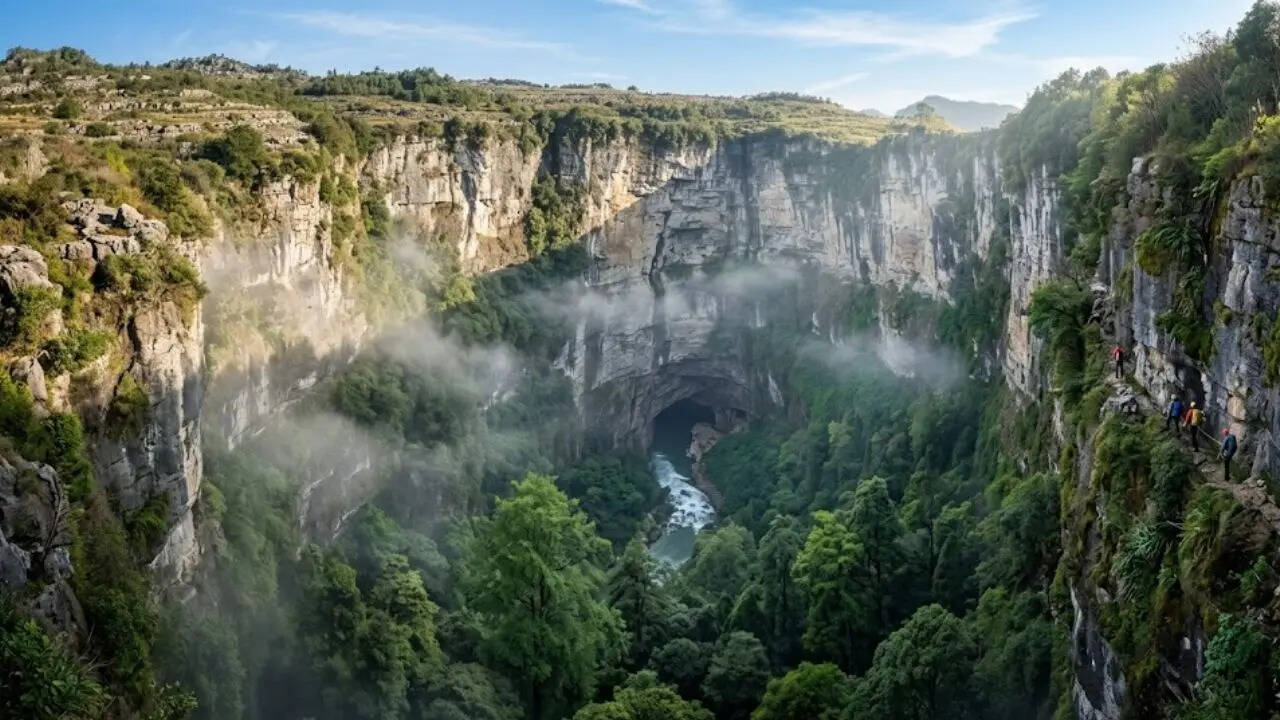
He stood at the lip of the abyss, a place the locals call Tiankeng. In Mandarin, it means "Heavenly Pit." For a man like Chen—a hypothetical researcher we might find clinging to a nylon rope 600 feet above the floor of the Leye-Fengshan Global Geopark—the name feels less like poetry and more like a warning. Below him, the Earth simply ceases to exist. It is a jagged, vertical wound in the limestone of Southern China’s Guangxi province, a void so deep that the clouds do not just pass over it; they get trapped inside.
Most people look at a map and see solid ground. They see borders, topography, and GPS coordinates. But the karst topography of South China is a lie. It is a honeycomb. Beneath the surface lies a subterranean ghost world, and in 2022, explorers stumbled into a sinkhole that didn't just break records—it broke the rules of biology. Meanwhile, you can read related events here: The Stone and the Thread That Could Mend History.
This isn't a story about rocks. It is a story about how life finds a way to build a cathedral in the dark.
The Gravity of the Unknown
The descent is the first test. As you rappel down, the temperature shifts. It isn't a gradual slide; it’s a sudden, damp embrace. The air grows heavy with the smell of wet stone and ancient decay. You are leaving the Anthropocene—the age of humans—and entering a pocket of the planet that hasn't changed since the dawn of the Holocene. To see the bigger picture, we recommend the detailed report by Condé Nast Traveler.
Geologically, this phenomenon is a masterpiece of slow-motion destruction. For millions of years, slightly acidic rainwater trickled through cracks in the limestone. It ate the rock from the inside out, carving massive chambers until the "ceiling"—the very ground people walk on—could no longer support its own weight. It collapsed. What remained was a hole 630 feet deep, 1,000 feet long, and 500 feet wide.
But the collapse wasn't an ending. It was an opening.
As Chen hits the floor, his boots sink into a carpet of moss and fallen debris. He looks up, and the sun is a distant, flickering coin. This is the moment the realization hits: the bottom of this sinkhole isn't a cave. It’s a forest.
A Greenhouse at the Bottom of the Earth
On the surface, the sun is a harsh master. Plants compete for every drop of moisture and every inch of soil. But down here, the microclimate acts like a natural terrarium. Because the walls are so steep and the depth so profound, the wind cannot reach the floor. The humidity stays locked at near-saturation levels.
Imagine a forest where the trees don't just grow; they stretch.
In this specific sinkhole, explorers found ancient trees reaching nearly 130 feet toward the light. Their trunks are thin and elegant, desperate to reach the small circle of blue above. Beneath them, the undergrowth is a waist-high sea of ferns and rare plants that might not exist anywhere else on the planet.
This is the "invisible stake" of the Leye sinkholes. We are currently living through a global extinction crisis, yet here, tucked away in a limestone pocket, is a biological backup drive. These sinkholes serve as refugia—places where species can survive environmental shifts that wipe out their cousins on the surface. While the rest of the world warms and dries, the Heavenly Pit stays cool, moist, and silent.
The Physics of a Hidden Atmosphere
Why does it feel different down there? It’s more than just shade.
The sinkhole creates its own weather. Because the limestone walls absorb heat during the day and release it slowly at night, the temperature fluctuations are minimal. It’s a thermal buffer. When the hot, humid air of the Guangxi jungle hits the cool air trapped in the pit, it creates a persistent mist.
Sometimes, from the surface, you can see the sinkhole "breathing." A column of white vapor rises from the mouth of the cave, a physical manifestation of the life churning hundreds of feet below.
Consider the mathematics of the shadows. In a normal forest, light is chaotic. In the Tiankeng, light is a scheduled event. For only a few hours a day, the sun aligns perfectly with the opening, sending a "God ray" through the mist to the floor. The plants have adapted to this. They don't waste energy growing thick bark or massive root systems to fight the wind. They put everything into their leaves—broad, deep green canvases designed to catch every stray photon.
The Human Ghost in the Machine
We often think of discovery as a triumph of technology. We have satellites that can read a license plate from orbit and LiDAR that can see through the thickest jungle canopy. But LiDAR didn't find the heart of this place. Humans did.
The explorers who first touched the floor of this sinkhole reported a sensation of profound insignificance. It is a rare thing in 2026 to stand somewhere and know, with absolute certainty, that no human foot has ever pressed into this specific patch of dirt.
There is a psychological weight to these places. They remind us that the Earth is not a finished project. It is a living, breathing, collapsing organism. The sinkholes of China are not just "holes" in the ground; they are portals to a version of Earth that existed before we started shaping it in our image.
But there is a darker side to the wonder. These microclimates are incredibly fragile. Because they are closed systems, even a small change on the surface can have catastrophic effects below. If a nearby farm uses a specific pesticide, that chemical travels through the karst groundwater and ends up in the sinkhole. If the climate on the surface shifts too far, the "breath" of the sinkhole might fail.
We are looking at a museum of the past that is also a warning for the future.
The Secret Language of the Underworld
As you move through the undergrowth, the sounds change. On the surface, the jungle is a cacophony of insects and birds. Down here, the acoustics are dampened by the soft walls and the dense vegetation. It sounds like a recording studio. Every snap of a twig carries for a hundred yards.
Researchers have speculated that there may be undocumented species of insects and small mammals living in these pits. Isolated for thousands of years, these creatures would have evolved in total darkness or the perpetual twilight of the pit floor. They are the true masters of the microclimate. They have never seen a sunset. They have never felt a gust of wind. To them, the entire universe is a 1,000-foot-long box of green and grey.
When we talk about "protecting the environment," we usually mean the oceans or the rainforests. We rarely talk about the cracks in the world. But these cracks hold the blueprints for resilience.
The Ascent
Leaving the Tiankeng is a physical and emotional labor. As the rope pulls you back toward the surface, the humidity drops. The air becomes thinner and hotter. The silence of the pit is replaced by the roar of the modern world—the distant sound of a highway, the hum of a drone, the chatter of other people.
You look back down one last time. From above, the sinkhole looks like nothing more than a dark spot in a sea of green hills. It is easy to miss. It is easy to ignore.
But down there, in the damp dark, a tree that started growing when the Ming Dynasty was in power is currently reaching for a sun it can barely see. It is breathing in the mist, sheltered by a thousand feet of stone, existing in a world that doesn't care about our maps, our technology, or our frantic, surface-level lives.
The Earth is still hiding things from us. Some of those things are small. Some are 600 feet deep. All of them are reminders that we are merely guests on the surface of a planet that has a very long memory and a very deep heart.
The rope goes taut. The light of the 21st century hits your eyes. The pit remains, exhaling its white mist into the sky, a secret kept in stone.