The Drop Into the Void
Gravity does not let go easily. Even at two hundred and fifty miles up, where the International Space Station traces its silent, luminous arc across the dark velvet of the thermosphere, Earth reaches out with a whisper of its atmosphere. That whisper is friction. It is a slow, relentless drag that pulls orbital outposts down, inch by inch, day by day, demanding constant correction just to stay afloat.
Stationed up there, floating in the microgravity of the orbital laboratory, humans live on borrowed time and machine-made air.
I remember standing in front of a full-scale mockup of the Destiny laboratory years ago, listening to a retired flight director describe the sheer fragility of orbital habitation. He tapped a bulkhead panel with his knuckle, the hollow metallic ring echoing through the hangar.
"People think space is about rockets," he told me, his eyes crinkled with the memory of a hundred sleepless shifts in Mission Control. "Rockets are just the violent delivery mechanism. Space is about the gaskets. It is about the wiring harnesses. It is about two people in bulky, pressurized suits turning bolts for seven hours in total vacuum, hoping a stray flake of paint doesn't puncture their glove."
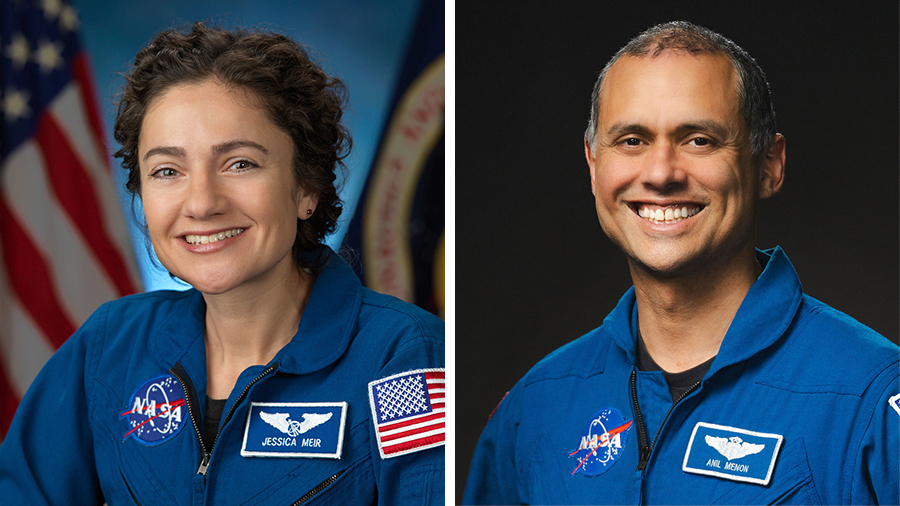
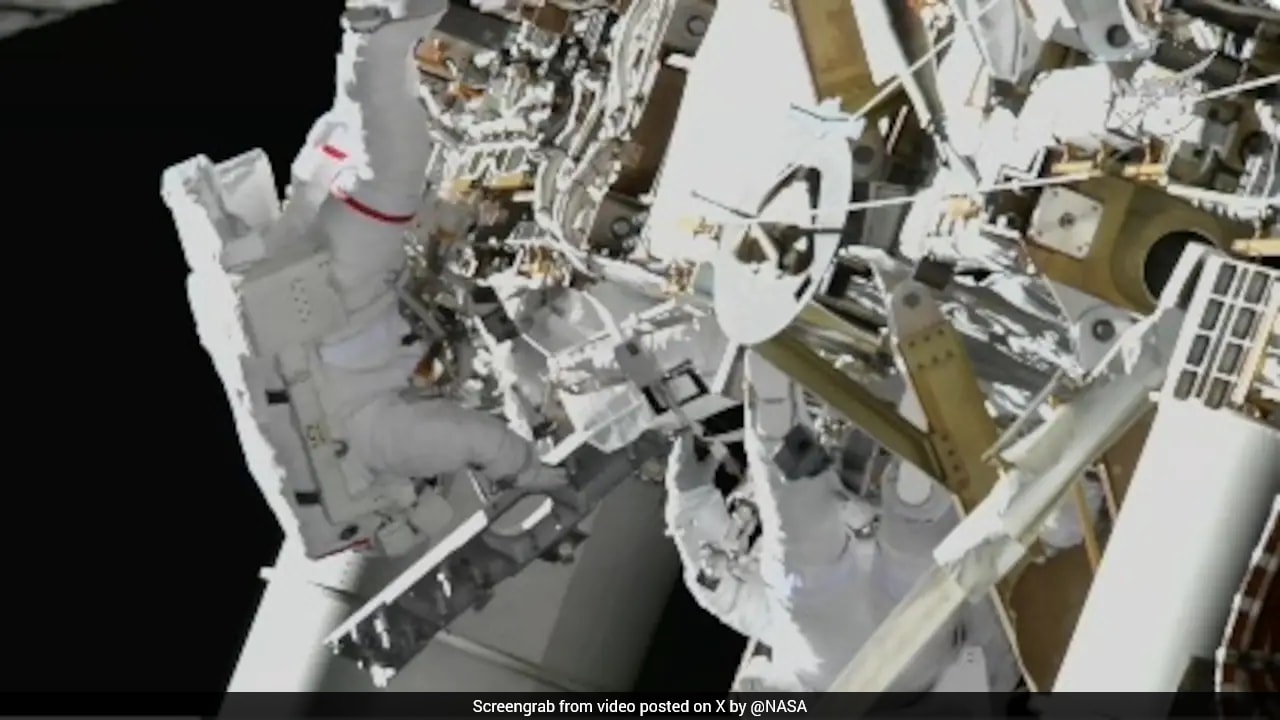
That reality came rushing into sharp focus when NASA astronauts Anil Menon and Jessica Meir floated out of the Quest airlock to perform a critical maintenance spacewalk.
We rarely think about the plumbing of the heavens. We see the stunning astrophotography, the swirling blue-and-white marble of our home planet framed against the infinite black, and we imagine poetry. But poetry doesn't keep carbon dioxide scrubbers running. Poetry doesn't route high-voltage solar power through aging truss structures.
Menon and Meir stepped out into an environment where sunlight brings a searing, unfiltered glare that pushes temperatures past two hundred degrees Fahrenheit, while shadow plunges into a bone-chilling minus two hundred and fifty.
The Anatomy of an Orbital Outpost
To understand what Menon and Meir faced, you have to look past the gleaming modules and understand the station as a living, breathing organism that is slowly wearing out.
The International Space Station has been continuously occupied since November 2000. Think about that for a moment. For over a quarter of a century, human bodies, exhaling moisture, shedding skin cells, and consuming power, have lived inside a metal tube hurtling through space at seventeen thousand five hundred miles per hour.
Every system aboard is redundant, until it isn't.
When NASA schedules an extravehicular activity, commonly known as a spacewalk, it is never a routine errand. It is a calculated exposure to the most hostile environment humanity has ever tried to tame.
Anil Menon, a physician and former SpaceX flight surgeon who transitioned to NASA's astronaut corps, knew the physiological stakes intimately. He understood what microgravity does to the human cardiovascular system, how fluids shift upward toward the head, how the heart adapts to a weightless state. And Jessica Meir, a veteran marine biologist and physiologist who previously made history on the first all-woman spacewalk, brought a fierce, methodical calm to the airlock.
They were not just astronauts checking off a task list. They were surgeons operating on a beating heart while skydiving at Mach 25.
Consider what happens when you turn a screw in orbit. On Earth, your feet anchor you to the floor, your core stabilizes your torso, and your arm applies directional force. In space, every action has an equal and opposite reaction that wants to flip you upside down. If you do not lock your boots into foot restraints, a simple twist of a torque wrench will send you spinning lazily into the void, a human satellite tumbling through the cosmos.
Into the Hardware Labyrinth
The objectives for this particular excursion were deceptively simple on paper: upgrade power channel components and perform vital maintenance on the station's exterior truss system.
The station draws its lifeblood from massive solar arrays, wings of photovoltaic cells that track the sun to convert light into electricity. But power distribution in space is a delicate dance of voltage regulation, battery storage, and thermal management. Over years of operation, the original nickel-hydrogen batteries have been systematically replaced with high-capacity lithium-ion units. Maintaining that power grid requires getting hands-on with hardware that was designed to last, but not necessarily designed to be easily serviced by human hands encased in pressurized rubber and reinforced fabric.
As Menon and Meir stepped past the hatch, the umbilical cords of their Extravehicular Mobility Units began feeding them chilled water and oxygen.
Inside the helmet, the air smells faintly of ozone and plastic, a smell every astronaut learns to associate with work.
They moved hand-over-hand along the rails of the Integrated Truss Structure, using tether hooks like mountain climbers scaling an invisible cliff. Every movement is deliberate, choreographed down to the second by teams on the ground in Houston and Huntsville.
Down below, flight controllers watch telemetry data stream across bank after bank of monitors. They track suit pressure, battery levels, and carbon dioxide partial pressure. But up there, outside the hull, the astronauts rely on instinct, training, and each other.
"Verify your safety tether is locked, Anil," Meir’s voice crackled over the comm loop, steady and clear against the static of space-to-ground transmission.
"Tether is secure, Jessica. Moving to the worksite," Menon replied.
There is a profound intimacy in this kind of teamwork. Your survival is literally strapped to your partner’s situational awareness. If a glove catches on a sharp thermal blanket edge, or if a bolt strips under the relentless expansion and contraction of orbital thermal cycles, the entire timeline shifts.
The Invisible Stakes
Why do we spend billions of dollars maintaining a football-field-sized laboratory in low Earth orbit?
The answers are often buried in dry academic papers about protein crystal growth, fluid dynamics, and combustion research. We are told that microgravity allows us to manufacture better fiber optics, understand cellular aging without the complicating factor of gravity, and test life support systems that will eventually take us to Mars.
All of that is true. But it misses the deeper, human pulse of the endeavor.
The International Space Station is the single most complex machine ever built by our species. It is a physical manifestation of stubborn hope. It is a place where former Cold War adversaries share coffee, where national flags take a backseat to the shared realization that our planet is terribly small and remarkably fragile.
When Menon and Meir completed their spacewalk, successfully routing upgraded hardware and securing the station's electrical arteries, the news cycle moved on within hours. A brief headline flashed on screens around the world, and then the algorithm buried it beneath political bickering and celebrity gossip.
We have grown dangerously accustomed to miracles.
We look at orbital flight the way we look at commercial aviation, treating a journey to the edge of space with the same casual indifference as a commuter train ride. We forget that every successful spacewalk is a victory wrested from the jaws of catastrophe. We forget that the vacuum of space does not negotiate, does not forgive mistakes, and does not care about our deadlines.
The Final Orbit
Back inside the Quest airlock, the hatch was sealed. The heavy bolts slammed home, and the hiss of returning atmospheric pressure filled the small chamber.
As the air pressure equalized to cabin norms, the smell of space—that strange, metallic tang clinging to their suits from exposure to atomic oxygen—mingled with the scent of recycled station air.
Menon and Meir peeled off their bulky gloves, revealing sweat-soaked hands and tired, smiling eyes. They had done it. Another shift completed. Another small anchor holding humanity to its high-frontier outpost.
Outside the triple-paned windows of the cupola, the sun dipped below the horizon in a brilliant flash of turquoise and amber, turning the blackness into a canvas of fire for a fleeting thirty seconds before plunging the station back into night.
Down here, we walk on solid ground, rarely looking up. But two hundred and fifty miles above our heads, the work continues in the dark, sustained by the quiet, steady hands of people willing to step out into the void so that the rest of us can keep breathing.