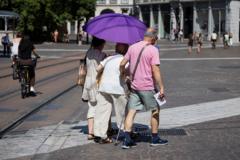
The recording of 2,025 excess deaths in France during a single heatwave peak exposes a critical vulnerability: public health infrastructure is failing to adapt to systemic shifts in baseline climate risks. Traditional emergency response mechanisms treat extreme weather as isolated, episodic shocks. This is a structural error. To mitigate accelerating mortality rates across Europe, public health strategy must transition from reactive crisis management to a formalized, data-driven framework that treats extreme heat as a predictable, compounding macroeconomic and physiological stressor.
Understanding this crisis requires deconstructing the phenomenon into three distinct operational vectors: physiological heat-stress mechanics, urban infrastructure design failures, and systemic healthcare capacity bottlenecks.
The Triad of Heat-Induced Mortality
Excess mortality during extreme weather events is rarely a direct result of heatstroke alone. Instead, it is driven by a compounding causal chain that accelerates underlying chronic pathologies. This structural failure can be mapped across three distinct vectors.
1. The Physiological Thermal Boundary
The human body maintains homeostasis through thermoregulation, primarily driven by vasodilation and sweat evaporation. When ambient temperatures surpass the critical threshold of 35°C (95°F) concurrent with high relative humidity, the efficiency of evaporative cooling drops sharply.
This triggers a cascade of physiological strain:
- Cardiovascular Overload: To dissipate heat, cardiac output must increase significantly. For individuals with pre-existing ischemic heart disease or congestive heart failure, this sustained demand causes acute myocardial infarction or cardiovascular collapse.
- Renal Failure: Prolonged heat exposure without aggressive hydration induces severe volume depletion, leading to acute kidney injury (AKI).
- Systemic Inflammatory Response: Extreme hyperthermia can compromise the integrity of the intestinal epithelial barrier, letting endotoxins enter the bloodstream and causing a condition clinically similar to sepsis.
2. The Urban Heat Island (UHI) Coefficient
The geographic distribution of the 2,025 excess deaths highlights a severe design flaw in modern European cities. Urban centers act as thermal batteries. The high concentration of asphalt, concrete, and dark roofing materials absorbs solar radiation during the day and re-radiates that thermal energy at night.
This creates an infrastructure bottleneck where ambient nighttime temperatures fail to drop below the threshold required for human physiological recovery (typically 20°C or 68°F). The risk is unevenly distributed; lower-income urban micro-climates consistently exhibit higher UHI coefficients due to low green-space density, poor building insulation, and a lack of mechanical cooling systems.
3. Institutional Capacity Under-Sizing
The peak of a heatwave introduces a simultaneous surge in emergency medical services (EMS) demand and acute care admissions. The failure mode in France was not a lack of clinical awareness, but an inability to scale operational capacity dynamically.
When hospital bed availability, triage throughput, and staffing ratios are optimized for average seasonal Baselines, a sudden 15% to 25% spike in heat-related admissions causes immediate system saturation. Patients experience delayed definitive care, which artificially inflates mortality rates for both heat-related and non-heat-related acute conditions.
The Failure of Current Early Warning Frameworks
The core limitation of existing public health protocols—such as France’s Plan Canicule—lies in their reliance on meteorological thresholds rather than impact-based forecasting models. Triggering a public health alert based solely on predicted ambient temperature ignores the non-linear relationship between weather and human mortality.
A rigorous predictive model must incorporate three distinct variables to calculate true community vulnerability:
$$Vulnerability = f(Exposure \times Sensitivity \times Adaptive\ Capacity)$$
- Exposure: The duration, intensity, and nighttime minimums of the thermal event, adjusted for local UHI metrics.
- Sensitivity: The demographic reality of the target population, specifically the concentration of individuals over the age of 65, those taking psychotropic or beta-blocking medications (which inhibit thermoregulation), and isolated individuals.
- Adaptive Capacity: The penetration rate of residential air conditioning, local access to designated cooling centers, and the baseline operational reserves of the regional healthcare system.
Because current frameworks lack this multi-layered integration, resources are deployed uniformly rather than being directed toward high-risk, micro-targeted zones. This lack of precision dilutes the efficacy of municipal interventions.
Structural Bottlenecks in European Climate Adaptation
Western Europe faces a unique compounding crisis: its infrastructure was historically engineered for a cool-temperate climate regime. Retrofitting an entire continent's built environment requires navigating severe structural and economic constraints.
The Legacy Housing Stock Deficit
Unlike regions in the southern United States or East Asia, where mechanical air conditioning is integrated into building codes, European residential architecture historically prioritized heat retention. Thick masonry and minimal passive ventilation mean that older apartment complexes turn into thermal traps during a multi-day heatwave. Retrofitting these structures with heat pumps and external shading is slow and capital-intensive, presenting a multi-decade infrastructure backlog.
The Energy Grid Paradox
As municipalities encourage the adoption of air conditioning to lower heat-related mortality, they simultaneously create a secondary vulnerability point: grid destabilization.
The widespread deployment of low-efficiency, localized cooling units causes a sharp, correlated spike in peak electricity demand. If the transmission grid or local distribution transformers are not scaled to handle this load under high ambient operating temperatures—which reduce equipment cooling efficiency—the risk of localized or cascading blackouts increases. A mid-heatwave power failure represents a worst-case public health scenario, instantly disabling medical equipment and residential cooling systems.
Capital Allocation and Operational Playbook
To transition from reactive crisis management to a resilient, zero-excess-mortality state, public health authorities and municipal leaders must execute a synchronized, structural strategy across two distinct horizons.
                  [ Heatwave Prediction Engine ]
                                |
         +----------------------+----------------------+
         |                                             |
[ Tactical Phase (T-48 Hours) ]          [ Strategic Phase (Multi-Year) ]
  • Dynamic EMS Staffing                   • District Cooling Networks
  • Predictive Triage Protocols            • Albedo Maximization (Cool Roofs)
  • Targeted High-Risk Outreach            • Decentralized Solar + Storage
Tactical Interventions (Execution Window: T-48 Hours to Event Peak)
- Deploy Predictive Triage Protocols: Hospitals must implement algorithmic triage adjustments 48 hours before an expected thermal peak. Non-elective surgeries should be deferred to free up critical care beds, and emergency departments must establish dedicated rehydration and rapid-cooling zones.
- Execute Micro-Targeted Outreach: Rather than relying on generic public service announcements, municipal health boards must use integrated social-services databases to identify high-risk individuals. Direct, physical interventions—such as transporting vulnerable citizens to cooled institutional spaces—must be prioritized based on local vulnerability scores.
- Optimize Emergency Service Staffing: EMS deployment patterns must shift from centralized hubs to decentralized, high-UHI zones to cut down response times during peak thermal hours (14:00 to 20:00).
Long-Term Strategic Capital Expenditure
- Invest in District Cooling Architecture: Municipalities must view cooling as a public utility, comparable to clean water or sewage treatment. Investing in large-scale, closed-loop district cooling networks that utilize deep-water sources or centralized absorption chillers is significantly more energy-efficient than relying on millions of individual air conditioning units.
- Mandate Albedo Maximization and Passive Cooling: Building codes must be updated immediately to require high-albedo roofing materials, green roofs, and exterior solar shading on all new constructions and major renovations. Maximizing urban reflectivity directly lowers the UHI coefficient, dropping ambient urban temperatures by several degrees during peak events.
- Build Grid Resilience with Distributed Energy Resources (DERs): To protect the power grid from high cooling loads, cities must incentivize the pairing of rooftop solar photovoltaic systems with localized battery storage. This ensures that the period of highest cooling demand (peak solar hours) matches local, zero-emission generation, reducing the strain on regional transmission lines.
European public health authorities cannot continue treating thousands of excess summer deaths as an unavoidable cost of changing weather patterns. The 2,025 deaths recorded in France provide a clear, data-driven warning. If municipal leaders fail to transition from broad, weather-based warnings to precise, infrastructure-driven interventions, the mortality baseline will continue to scale non-linearly with global temperatures. The solution requires a fundamental shift: treat extreme heat not as a seasonal weather story, but as a severe, predictable threat to public infrastructure and human biology that demands rigorous engineering and targeted operational execution.