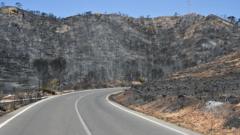
The heat of a Mediterranean summer is supposed to slow everything down. It softens the asphalt, induces long mid-afternoon dozes, and turns the air into a thick, honeyed weight. But when the pine forests in the southeastern Spanish province of Almería caught fire on a brutal Thursday afternoon, the heat did the opposite. It accelerated. It became a predatory thing, moving faster than a human being could possibly run.
For two British holidaymakers hiking through the rugged terrain near the village of Bédar, the shift from a serene afternoon to an apocalyptic trap happened in minutes. One moment they were navigating the dry, rocky paths of a landscape they had traveled across the sea to admire; the next, they were breathing ash. The wind didn’t just carry the fire. It weaponized it.
When a wildfire moves through mountainous terrain, it creates its own microclimate. It drafts up hillsides like an absolute chimney, pulling oxygen inward and pushing a wall of localized, five-hundred-degree heat ahead of the actual flames. Trapped on the slopes, the couple sought the only refuge that seemed logic-adjacent in the blinding panic: a steep ravine. They climbed down, hoping the earth would insulate them.
Instead, the ravine became a furnace.
We talk about disasters in numbers because numbers are clean. We read about the twelve people who lost their lives in this particular Andalusian blaze. We process the statistic of six thousand hectares of scorched earth, or the one thousand four hundred people evacuated from their homes, fleeing into the night as the sky turned a bruised, terrifying orange.
But statistics are an anesthetic. They keep us from feeling the true weight of what occurs when the skin meets the reality of forty percent burns.
To understand what happened in that ravine, you have to look at the anatomy of human endurance. When forty percent of the body is severely burned, the skin loses its ability to regulate temperature, protect against infection, or retain fluids. The nervous system goes into an immediate, shattering state of shock. As the fire swept over the ravine and moved onward toward the coast, it left behind a quiet, smoldering wasteland. In that silence, the couple lay semi-conscious, completely isolated by the terrain and the sheer severity of their trauma.
Every breath taken in that state is a negotiation with agonizing pain. The air smells of carbon and cooked earth. Survival ceases to be a grand, heroic concept; it shrinks down to the agonizing mechanics of the next single inhale.
Enter Sergeant Pedro Barre and his three-member Civil Guard team.
By the early hours of Friday morning, the rescue workers were navigating a graveyard of blackened trunks and hot ash. The air was still thick enough to choke on. They were looking for survivors, but the psychological reality of searching a disaster zone of this scale is heavy. You expect to find nothing but loss.
Then, Barre heard it. A sound.
It was faint, mangled by distance and the strange acoustics of the charred hillsides. In the dark, the team initially dismissed it. The human mind is wired to find patterns, and in the silence of a disaster zone, desperation can make you hallucinate a voice out of the wind or the settling of burnt timber. They thought it was just an echo.
But a seasoned rescuer operates on something beyond cold logic. Call it instinct, or perhaps a stubborn refusal to accept the worst until it is proven. Barre told Spain's state broadcaster TVE that experience teaches you a specific, quiet rule: Look again. Try one more time.
They changed direction and moved toward the sound, descending the treacherous, loose rock of the ravine. What they found was a testament to the absolute limits of human willpower. The couple was there, critically injured, barely clinging to consciousness.
Consider what happens next: the physical reality of a two-hour extraction from a steep, roadless ravine in the pitch black, carrying two fragile human beings whose skin cannot bear to be touched. Every movement must be calculated. Every step on the loose scree threatens to drop the litter or cause further injury to individuals already on the absolute precipice of mortality.
Officer Rafael Zea would later note that the mere act of the couple crying out—of gathering enough air into scorched lungs to make a sound that could carry out of that ditch—was a titanic, almost impossible effort. When the flashlights finally illuminated their faces, the rescuers didn't see panic. They saw a profound, unforgettable mixture of shock and raw emotion.
The couple was airlifted to a specialized intensive care unit, joining eight others fighting severe burn injuries from the same inferno. As they began their long, uncertain medical battle, the world outside their hospital room dissolved into a messy, human debate about how we handle the changing nature of summer danger.
In the villages surrounding Bédar, the anger is as palpable as the smoke. Residents like Emma Mitchell have openly questioned why the authorities did not deploy a mass mobile phone emergency alert. A timely text message, she argues, might have given hikers and remote homeowners the precious minutes needed to avoid the fire altogether.
The official response from local authorities reveals the terrifying tightrope emergency services must walk. They argued that a mass broadcast alert could have triggered a blind panic, clogging narrow, winding mountain roads with fleeing vehicles from zones that weren't even in immediate danger. In a panic, cars become metal traps. In fact, during this very fire, the Civil Guard had to arrest two individuals for serious disobedience after they attempted to break through police cordons to return to evacuated properties.
It is easy to judge those who disobey from the comfort of a cool room. It is harder when you are Mike and Belinda Lithgoe, who fled their holiday home near Bédar with nothing but their dog and their camper van, spending days sleeping in a parking lot, staring at the horizon, wondering if the life they built still exists or if it has been reduced to gray powder.
The truth is, as Mediterranean summers grow hotter and drier, our relationship with travel and leisure is colliding with an increasingly hostile natural world. Tourism boards and rental platforms sell us the dream of untouched, rural isolation—the beautiful villa at the end of a dirt track, the remote hiking trail far from the crowds. But isolation is a luxury that quickly turns into a liability when the hills catch fire. Visitors rarely know the local escape routes. They don’t speak the language of the local radio broadcasts. They don't know which way the wind usually blows when the afternoon heat peaks.
The fire crews in Almería have finally moved from defense to offense, aided by a fortunate drop in the wind and a rise in humidity. The immediate threat to the densely populated coastal towns is shrinking. But for the family members waiting outside the intensive care ward, and for the forensic experts in Madrid using DNA samples to identify those who didn't make it out of the hills, the valley will never really stop burning.
We look for meaning in these events, but nature does not provide moral closures. There is only the charred earth, the political arguments over warning systems, and the memory of an echo in the dark that turned out to be alive.