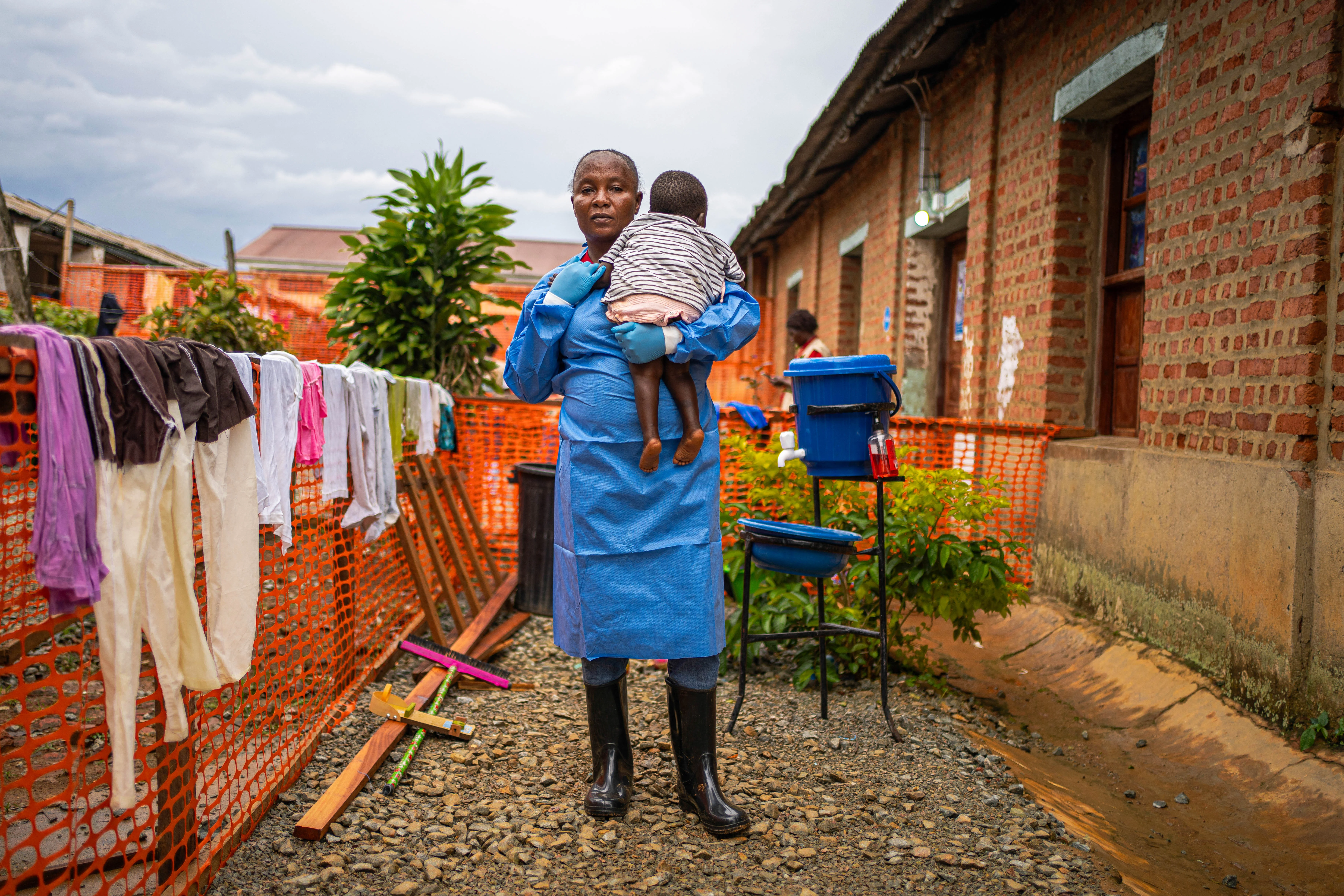
Record-breaking Ebola outbreaks do not occur because the filovirus mutates into an airborne super-pathogen; they occur when transmission chains intersect with systemic friction in healthcare infrastructure, geographic mobility, and community trust. When an epidemic crosses a grim mortality or duration milestone, headline reporting typically fixates on raw case counts. Those trailing indicators obscure the operational mechanics driving exponential growth. Evaluating an active outbreak requires stripping away sensationalist framing and analyzing the epidemiological parameters, logistical bottlenecks, and behavioral feedback loops that dictate whether containment succeeds or collapses.
The Mathematical Mechanics of Outbreak Escalation
To understand why an Ebola outbreak breaks historical records, analysts must look at the relationship between the basic reproduction number ($R_0$), the effective reproduction number ($R_t$), and the serial interval. Ebola virus disease (EVD) generally exhibits an $R_0$ between 1.5 and 2.5 in unmitigated settings. Unlike respiratory viruses with short incubation periods and pre-symptomatic transmission, Ebola becomes transmissible primarily when a patient is visibly symptomatic, shedding viral particles through blood, vomit, diarrhea, and other bodily fluids. Don't miss our earlier coverage on this related article.
This biological reality creates a clear theoretical pathway for eradication: isolate symptomatic individuals rapidly, trace every contact, and enforce safe burial protocols. When an outbreak crosses historic thresholds, it signals a breakdown in the time-to-isolation metric.
- The Incubation Window: Lasting between 2 and 21 days, this period determines the quarantine duration required for exposed contacts. A single missed contact resets the 42-day outbreak-free clock (two full incubation cycles) required by the World Health Organization to declare an epidemic over.
- Viral Load Trajectory: Infectivity correlates directly with viral load, which peaks during the late stages of illness and remains exceptionally high post-mortem. Hospital admissions that occur on day five of symptoms rather than day two exponentially increase the secondary attack rate within households.
- The Nosocomial Amplifier: Before an outbreak is formally declared—or when peripheral clinics lack personal protective equipment (PPE) and triage protocols—healthcare facilities act as super-spreading nodes. Undiagnosed patients presenting with febrile symptoms resembling malaria or typhoid expose healthcare workers and other patients, removing frontline capacity precisely when surge demand begins.
The Three Pillars of Containment Friction
Standard epidemiological models assume uniform compliance and frictionless logistics. Real-world outbreaks unfold in complex environments where three distinct operational variables degrade containment efficiency. To read more about the context of this, Psychology Today offers an in-depth summary.
1. Geographic Topology and Mobility Corridors
Historical outbreaks in isolated rural villages burned out quickly because human mobility was constrained by poor infrastructure; the virus killed hosts faster than they could travel to dense population centers. Modern outbreaks break records when transmission chains reach major transit arteries, peri-urban settlements, or cross-border trade routes. High population density multiplies daily contact rates, while porous borders complicate bilateral contact tracing. Once a pathogen enters a transient urban population, contact lists expand from dozens of known relatives to hundreds of anonymous commuters, overwhelming manual tracing teams.
2. The Trust Deficit and Information Asymmetry
Containment relies on voluntary behavioral modification: reporting symptoms early, surrendering sick relatives to isolation wards, and abandoning traditional funeral rites involving washing or touching the deceased. In regions marked by historical political marginalization, armed conflict, or weak state governance, public health directives are frequently interpreted through a lens of suspicion.
When communities perceive Ebola Treatment Units (ETUs) as facilities where relatives disappear rather than recover, families hide symptomatic individuals. Hidden cases generate unmonitored transmission chains. Attacks on treatment centers or healthcare workers—a documented phenomenon in conflict-affected outbreak zones—force temporary suspensions of surveillance activities, creating blind spots during which $R_t$ rebounds above 1.0.
3. Diagnostic and Cold-Chain Bottlenecks
Confirming EVD requires reverse transcription-polymerase chain reaction (RT-PCR) testing or rapid antigen diagnostics. In remote regions, transporting blood samples from peripheral health posts to regional reference laboratories can take days. During this diagnostic lag, suspected cases must be held in transit centers. If infection prevention and control (IPC) standards lapse inside holding wards, uninfected patients testing positive for malaria can acquire nosocomial Ebola infections while awaiting test results.
Concurrent deployment of ring vaccination—typically utilizing the rVSV-ZEBOV vaccine—introduces strict cold-chain requirements, demanding storage temperatures between -80°C and -60°C. Maintaining ultra-cold chains across regions with unreliable electrical grids requires specialized Arktek passive cooling devices, generator fuel reserves, and dedicated logistics personnel. Any failure in cold-chain integrity renders doses ineffective, eroding community confidence when vaccinated individuals still contract the disease.
Re-evaluating Standard Outbreak Metrics
Public reporting around epidemic milestones routinely relies on cumulative case counts and Case Fatality Rates (CFR). From an operational standpoint, both metrics are flawed indicators of real-time trajectory.
Cumulative counts only move upward; they offer zero visibility into current transmission velocity. A declining daily incidence rate alongside a rising cumulative total represents operational progress, yet media narratives frequently conflate cumulative milestones with worsening control.
Similarly, raw CFR calculations during an active outbreak suffer from severe ascertainment bias and right-censoring. Calculating deaths divided by total confirmed cases ignores the delay between symptom onset and clinical outcome, which averages 6 to 16 days. In addition, mild or moderately symptomatic cases that never reach an ETU go unrecorded, artificially inflating the apparent fatality rate, while unrecorded community deaths depress it.
Practitioners evaluate outbreak control using four leading operational indicators instead:
- Proportion of New Cases Among Known Contacts: If 80% or more of newly confirmed cases were already registered and monitored on contact lists prior to symptom onset, surveillance teams are ahead of the transmission chain. If the majority of new cases emerge from unknown chains ("community cases"), transmission is outpacing detection.
- Community Deaths vs. ETU Deaths: A high percentage of confirmed cases identified post-mortem in the community indicates severe delays in care-seeking behavior and active household exposure during peak viral shedding.
- Time from Symptom Onset to Isolation: Reducing this interval from an average of 5 days down to under 2 days directly compresses the window of community transmission.
- Ring Vaccination Coverage Velocity: The percentage of high-risk primary contacts and contacts-of-contacts vaccinated within 48 hours of case confirmation.
The Cost Function of Delayed Intervention
Epidemic response operates under an asymmetric cost curve. Deploying rapid-response teams, mobile laboratories, and community engagement specialists during the first 14 days of an index case requires modest capital and personnel. Once transmission crosses into multiple health zones, resource requirements scale non-linearly.
Every unisolated case generates downstream liabilities across four resource pools:
- Bed Capacity and Staffing Ratios: Safe clinical management of EVD requires strict nurse-to-patient ratios, specialized waste incineration, and continuous water and sanitation (WASH) infrastructure. Healthcare workers operating in full impermeable PPE cannot remain in the red zone for more than 45 to 60 minutes in tropical climates due to heat stress, requiring large rotating shifts to staff a single 50-bed unit.
- Contact Tracing Labor: If each confirmed case yields 20 to 50 contacts, and each contact requires daily symptom monitoring for 21 days, 100 active cases demand between 42,000 and 105,000 individual follow-up interactions over a three-week cycle.
- Secondary Mortality: As emergency resources divert toward Ebola containment, routine healthcare services collapse. Childhood immunization programs stall, maternal mortality spikes due to closed clinics, and preventable deaths from malaria, measles, and cholera frequently exceed direct mortality from the filovirus itself.
- Macroeconomic Disruption: Border closures, transport restrictions, and market shutdowns trigger localized food insecurity and price inflation, further destabilizing communities and reducing compliance with public health quarantines.
Limitations of Current Countermeasures
Modern Ebola responses benefit from tools unavailable during the 2014–2016 West African epidemic, including approved Zaire ebolavirus vaccines and targeted monoclonal antibody therapeutics (such as mAb114 and REGN-EB3). Relying exclusively on biomedical interventions, however, introduces critical vulnerabilities.
First, licensed vaccines and monoclonal antibodies are species-specific. Countermeasures engineered for Zaire ebolavirus do not confer reliable cross-protection against Sudan ebolavirus or Bundibugyo ebolavirus. When an outbreak is driven by a non-Zaire species, responders revert to supportive clinical care—aggressive intravenous fluid resuscitation, electrolyte balancing, and secondary infection management—alongside non-pharmaceutical interventions.
Second, monoclonal antibody efficacy drops precipitously when administered late in the disease course or to patients presenting with high baseline viral loads (low cycle threshold values on PCR). Therapeutics reduce mortality significantly only when paired with early case detection.
Third, ring vaccination struggles when population mobility is high or when security conditions prevent teams from accessing affected neighborhoods. If a ring cannot be closed within 72 hours, the virus outruns the immunological buffer created by the vaccine, which takes roughly 10 days post-injection to generate protective immunity.
Operational Protocol for High-Risk Outbreak Containment
When an outbreak breaches historical containment thresholds, response leadership must shift from reactive clinical expansion to decentralized, intelligence-led interruption of transmission.
- Decentralize Triage and Testing: Establish rapid-isolation transit units equipped with point-of-care molecular diagnostic platforms (such as GeneXpert) at the sub-district level. Eliminating sample transport delays cuts the diagnostic window from days to under two hours, preventing nosocomial cross-contamination in holding wards.
- Integrate Anthropological Intelligence into Surveillance: Replace top-down security enforcement of quarantines and burials with local community health workers and traditional leaders. Co-designing dignified, modified burial protocols—allowing families to view the body safely and participate in non-contact rituals—removes the primary behavioral driver of secret burials.
- Protect Peripheral Primary Care: Prioritize PPE distribution, infrared screening, and IPC training for private clinics, traditional healers, and pharmacies. Symptomatic patients overwhelmingly visit informal or local providers before seeking hospital care; securing these nodes stops early amplification.
- Adopt Geographic and Pop-Up Ring Strategies: Where individual contact tracing fails due to urban density or insecurity, transition from strict individual ring vaccination to targeted geographic vaccination of entire neighborhoods or high-transit market hubs surrounding confirmed cases.
- Ring-Fence Routine Essential Health Services: Maintain separate, non-Ebola primary care clinics with dedicated funding and supplies to prevent secondary mortality from endemic diseases and preserve baseline public trust in the health system.