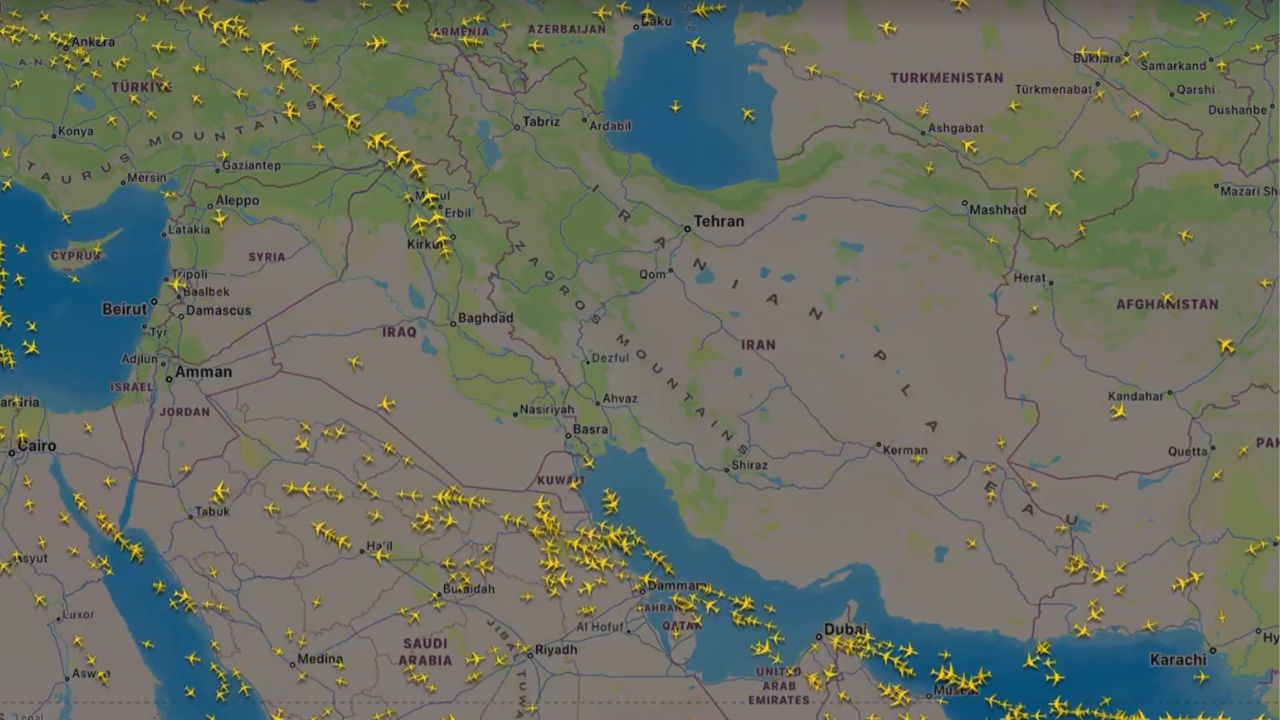
The operational stability of the Middle Eastern "Super-Connector" model—built on the rapid transit of millions through Dubai (DXB) and Doha (DOH)—relies on a fragile equilibrium of regional airspace availability and carrier-specific crew duty cycles. When Emirates or Qatar Airways initiate mass cancellations, it is rarely a localized failure of equipment. Instead, it represents a systemic "pressure release" triggered by the closing of specific high-altitude corridors or the saturation of ground handling capacity. Current flight suspensions across these hubs indicate a breakdown in the Triad of Hub Reliability: geopolitical stability, atmospheric predictability, and crew legality.
The Geometry of Airspace Compression
Aviation in the Middle East does not operate in a vacuum. It functions within a highly restricted "corridor economy." Unlike the sprawling, multi-directional airspace of the United States, the routes connecting Europe and Asia through the Gulf are narrow. When regional conflicts or military escalations occur, large swaths of Iranian, Iraqi, or Lebanese airspace become "no-fly zones" or "high-risk zones" (Levels 1 through 4 on the risk scale).
The immediate result is Airspace Compression. When a primary corridor closes, the remaining traffic must divert into adjacent sectors. This creates a geometric bottleneck:
- Fuel Penalty: Diversions around prohibited zones can add 45 to 90 minutes of flight time. For an ultra-long-haul flight already pushing the limits of a Boeing 777-300ER’s fuel tanks, this can necessitate an unscheduled technical stop, breaking the hub-and-spoke efficiency.
- Sector Saturation: Air traffic controllers in neutral territories (such as Saudi Arabia or Turkey) face a sudden 300% increase in volume. To maintain safety intervals, they implement "flow control," forcing aircraft to remain on the ground at their origin.
- The Slot Cascades: A 20-minute delay in a departure from London Heathrow to Dubai might seem minor, but it causes the passenger to miss a 90-minute connection window to Mumbai. When 400 passengers miss that window, the hub reaches physical capacity.
The Duty Clock The Hidden Constraint of Cancellations
Public announcements often cite "operational reasons" for cancellations, a euphemism for the exhaustion of Crew Duty Limitations (CDL). Aviation regulators strictly dictate the maximum number of hours a pilot or cabin crew member can remain on duty.
In a disruption scenario, the duty clock becomes the primary antagonist. If an Emirates flight is delayed on the tarmac for four hours due to airspace congestion, the crew may "time out" before they even take off. Because these carriers operate out of centralized hubs, there is no "reserve pool" of pilots sitting in outstations like Paris or Singapore. If a crew reaches their legal limit in a foreign city, the return flight must be cancelled. This creates a "ghost leg" where an aircraft is physically present but legally grounded, leading to the multi-day backlogs currently observed.
Quantifying the Ripple Effect The 1-to-4 Ratio
For every single flight cancelled by a major Gulf carrier, the operational recovery time is approximately four times the duration of the initial disruption. This Recovery Ratio is driven by the high load factors (often exceeding 85%) typical of Emirates and Qatar Airways.
- Inventory Scarcity: If a flight carrying 400 passengers is cancelled, and subsequent flights are 90% full, the airline can only re-seat 40 passengers per flight. It takes ten subsequent flights to clear the backlog from one cancellation.
- Baggage Decoupling: In mass disruption events, the physical sorting systems at DXB or DOH become overwhelmed. The priority shifts from moving bags to moving people. This results in "Short Shipped" luggage, where the passenger reaches the destination, but the baggage remains stuck in a mountain of unsorted containers at the hub.
- Hotel Floor Capacity: Dubai and Doha have high hotel densities, but they are not infinite. During a mass cancellation event involving 10,000+ stranded passengers, the "Involuntary Denied Boarding" (IDB) protocols exhaust local 4-star and 5-star inventory within six hours, forcing passengers into terminal lounges—a visual signifier of systemic failure.
Strategic Divergence Between Emirates and Qatar Airways
While the headlines group these carriers together, their vulnerability profiles differ based on their fleet composition and geographical positioning.
Emirates: The A380 Bottleneck
Emirates’ reliance on the Airbus A380 is a double-edged sword. While it offers massive capacity, it limits flexibility. Only specific gates and runways can accommodate the "Super." When a major route is disrupted, Emirates cannot easily swap a cancelled A380 for two smaller aircraft because they simply do not maintain a large fleet of narrow-body planes. This makes their cancellations "lumpy"—large, concentrated blocks of 500+ passengers being displaced at once.
Qatar Airways: The Narrow-Body Pivot
Qatar Airways maintains a more diverse fleet, including the Airbus A320 family. This allows them to maintain "thin" routes even during periods of restricted airspace. However, Qatar’s geographical position forces it to navigate more complex geopolitical "choke points." Their logic for cancellation is often more proactive (preventative) than Emirates, as they seek to avoid the reputational damage of long-term strandings in the cabin.
The Economic Logic of Cargo vs. Passengers
In periods of high disruption, airlines must make a "Yield Choice." High-value cargo—electronics, pharmaceuticals, and perishables—often takes priority over discounted economy-class passengers. If an aircraft must carry extra fuel to navigate a long diversion, it must shed weight. The first things to be removed are "non-revenue" items and, occasionally, the checked baggage of passengers. In extreme cases, the airline may cap the passenger load at 70% to ensure the aircraft is light enough to carry the fuel required for a 12-hour detour that was originally an 8-hour flight.
Passenger Mitigation Strategy
Travelers caught in this systemic gridlock must move beyond the standard "wait for an email" approach. The internal logic of airline rebooking software prioritizes passengers based on:
- Fare Class: 'Y' class (Full fare economy) and Business/First are rebooked by automated scripts first.
- Loyalty Tier: High-tier frequent flyers are flagged for manual intervention by gate agents.
- Connection Complexity: Passengers with three or more legs are often deprioritized because the probability of them missing a later connection is too high, making them a "bad investment" for the current seat inventory.
To circumvent this, the tactical play is Self-Rerouting. Rather than waiting for a direct flight to open up, passengers should identify "Lateral Hubs"—cities like Istanbul (IST), Muscat (MCT), or Riyadh (RUH)—and request to be rebooked on partner airlines to these locations. This moves the passenger out of the "Eye of the Storm" (DXB/DOH) and into a secondary market with more available "last-mile" seats.
The Insurance Gap
Standard travel insurance policies often contain "Act of War" or "Civil Unrest" exclusion clauses. If a cancellation list is the result of regional military escalation, many insurers will deny claims for hotel reimbursements. It is critical to obtain a "Written Statement of Reason" from the carrier. If the airline cites "Operational Constraints" or "Technical Issues" rather than "Geopolitical Instability," the path to a successful insurance claim remains open.
The current wave of cancellations is not a temporary glitch; it is the manifestation of the Middle Eastern hub model hitting its ceiling in an unstable environment. Until airspace corridors are widened or regional tensions de-escalate, the "Super-Connector" will continue to function as a high-performance engine that is prone to seizing when the external pressure exceeds its design tolerances.
Monitor the FlightRadar24 or ADS-B Exchange feeds for the specific flight number 24 hours prior to departure. If the inbound aircraft (the "hull") is diverted or delayed by more than 180 minutes, the probability of a cancellation for the outbound leg exceeds 70%. At this threshold, initiate a "Plan B" booking on a non-Gulf carrier through a northern corridor (e.g., via Helsinki or Tashkent) to ensure arrival.