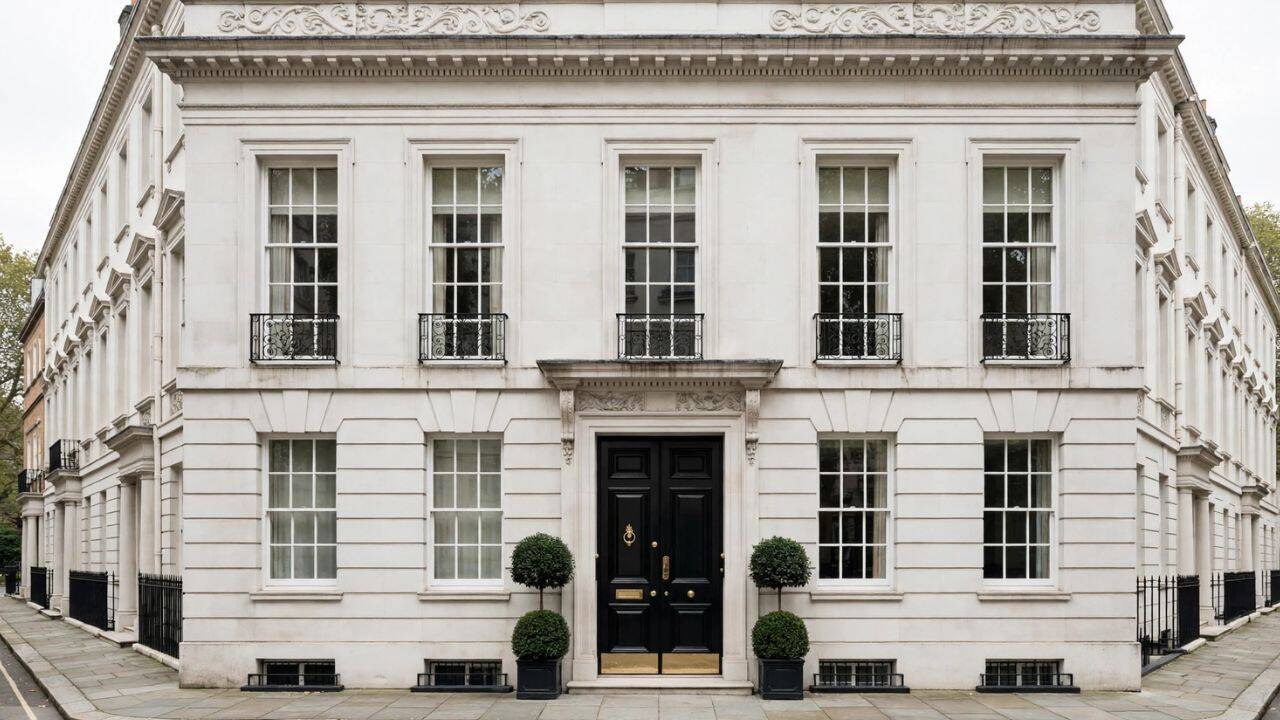
You don't need to be a music historian to feel the pull of Green Street in Mayfair. A flat right beneath the only residence all four Beatles ever shared just hit the market for £4.5 million, and the real estate press is predictably losing its mind over the rock-and-roll connection.
Here's the catch. If you're looking at a £4.5 million price tag in central London, the Beatles connection is actually the least important number on the spreadsheet.
The listing at 57 Green Street sits directly below Flat L, the third-floor apartment where John Lennon, Paul McCartney, George Harrison, and Ringo Starr lived together in the autumn of 1963. Real estate agents love a celebrity hook because it gets clicks from people who couldn't afford the service charge. But if you actually buy property in W1K, you aren't paying for ghosts of Beatlemania. You're paying for prime Mayfair square footage, period architecture, and a postcode that holds its value when everything else tanks.
Let's break down what you're really getting for £4.5 million on Green Street, why the Beatles angle is both true and slightly exaggerated, and what savvy London buyers actually look at before making an offer on a flat like this.
The Real Story Behind 57 Green Street and the Beatles
Most headlines make it sound like the Fab Four spent years hosting wild parties in this building. They didn't.
In the autumn of 1963, Beatlemania was exploding across Britain. The band's manager, Brian Epstein, needed to move the four of them out of their separate hotel rooms and into one secure spot where they wouldn't be mobbed every time they stepped outside for a newspaper. He leased Flat L on the third floor of 57 Green Street.
It was the only time John, Paul, George, and Ringo ever lived under the same roof.
Before Green Street, they bounced between modest digs in Liverpool and cramped London hotels like the President Hotel in Bloomsbury. After Green Street, they were rich enough to buy their own separate homes—John and Ringo moved out to the Surrey stockbroker belt, Paul moved in with Jane Asher's family on Wimpole Street, and George got his own place.
Their stay at 57 Green Street lasted only a few months, roughly from September to late 1963. Yet those few months were electric. Inside that third-floor flat, Lennon and McCartney worked on early drafts of tracks that would define their breakout era, including "I Want to Hold Your Hand." Fans quickly figured out where they were staying, camping out on the pavement below and shouting up at the windows until the police had to clear the street.
The flat currently on the market for £4.5 million isn't Flat L itself. It's the apartment directly underneath it.
That distinction matters. A lot. When a property has direct provenance—meaning a historic figure actually slept, wrote, or lived inside those specific walls—you can sometimes slap a 10% to 15% "trophy premium" onto the asking price. When you're one floor down, you get a great dinner party story and zero official blue plaque on your front door.
Why £4.5 Million Is Actually Standard for Mayfair
If you don't track Prime Central London (PCL) real estate, £4.5 million sounds like an absurd sum driven entirely by music trivia. It isn't.
Take the Beatles out of the equation completely, and a well-proportioned, lateral apartment in a red-brick Edwardian mansion block on Green Street still commands between £3,000 and £4,200 per square foot. Depending on the exact square footage, condition, and lease length, £4.5 million puts this flat right in the middle of normal Mayfair pricing.
Green Street runs parallel to Oxford Street, tucked quietly between Park Lane and North Audley Street. You're a two-minute walk from Hyde Park. You're around the corner from Mount Street's boutiques and restaurants like Scott's and George. For international buyers, pied-à-terre hunters, and domestic downsizers, this specific pocket of W1K is about as blue-chip as London gets.
Here's what actually drives the valuation on a property like this:
- The Grosvenor Estate factor. Much of Mayfair is owned by the Grosvenor Estate, and they maintain strict architectural and environmental standards across the neighborhood. Streets are clean, tree-lined, and fiercely protected from tacky commercial creep.
- Mansion block proportions. Unlike narrow Georgian townhouses where you're constantly climbing steep, creaky stairs, red-brick Edwardian blocks like 57 Green Street offer wide lateral living spaces, high ceilings, and proper porterage.
- Scarcity of good stock. People hold onto prime Mayfair flats for decades. When a clean, unencumbered apartment comes up on a quiet residential street rather than a noisy main thoroughfare, it moves.
Honestly, if the listing agent hadn't mentioned the Beatles at all, the asking price wouldn't look much different. The music history is just free PR.
What You Need to Check Before Buying a Period Flat in W1K
If you're seriously considering a multi-million-pound apartment in a building like 57 Green Street, don't let the romantic history distract you from the brutal mechanics of London leasehold property. I've seen buyers fall in love with a Mayfair address and completely miss five-figure annual liabilities hidden in the management pack.
Lease Length and Enfranchisement Costs
In England and Wales, almost all flats are sold as leaseholds rather than freeholds. If the lease on a £4.5 million flat has dropped below 85 years, extending it will cost you a small fortune—and once a lease dips under 80 years, "marriage value" kicks in, making the extension dramatically more expensive.
Always verify the exact unexpired term on day one. Even with recent UK leasehold reform legislation gradually reshaping how extensions are calculated, you never want to inherit an unextended short lease on a Prime Central London asset without factoring the exact statutory cost into your bid.
Service Charges and Reserve Funds
Edwardian mansion blocks look gorgeous from the street, with their ornate brickwork, stone dressings, and communal entrances. Maintaining them is relentlessly expensive.
A building with a resident porter, lift maintenance, communal heating, and strict conservation rules on exterior repairs can easily carry annual service charges between £12,000 and £25,000+. Worse, if the building hasn't maintained a healthy sinking fund, you could get hit with a sudden Section 20 major works notice for roof repairs or façade restoration, landing you with a £50,000 bill six months after completion.
Listed Building Restrictions and Neighbours
Check whether the building is Grade II listed or sits within the Mayfair Conservation Area. Both apply to large swathes of Green Street. If you plan to knock down internal walls, upgrade single-glazed sash windows, or install modern air conditioning, you'll face strict planning hurdles from Westminster City Council and the freeholder.
And remember that Beatles connection? While fans aren't camping outside 57 Green Street like they did in 1963, London walking tours still stop on the pavement outside to point up at the third floor. If you hate the idea of tourists occasionally taking photos of your front entrance, test the street noise on a Saturday afternoon before you exchange contracts.
Does Celebrity History Ever Add Real Resale Value?
Property portals love running stories about homes where famous musicians, actors, or politicians once lived. They do it because readers click on them. In the real world, celebrity provenance is a notoriously fickle asset class.
When Jimi Hendrix's former flat at 23 Brook Street—just a few blocks away from Green Street—became part of the Handel & Hendrix museum, it worked because the space was preserved as a cultural landmark. When standard residential flats hit the open market with a "celebrity lived next door" angle, sophisticated buyers rarely pay extra for it.
In fact, overt celebrity history can occasionally work against a sale. Ultra-high-net-worth buyers in Mayfair usually crave absolute anonymity. They want to walk through their front door without feeling like they live inside a tourist attraction.
That's why the smartest way to view this £4.5 million Green Street listing is purely on its fundamentals. Look at the ceiling heights. Measure the natural light in the reception room. Check the remaining years on the lease, scrutinize the last three years of service charge accounts, and compare the price per square foot against recent Land Registry sold prices on Green Street, Lees Place, and Park Street.
If the numbers stack up against comparable Mayfair stock, buy it for the location and the architecture—and treat the fact that John and Paul wrote songs right above your bedroom ceiling as a nice bonus.