Silence.
That is the first thing you notice when a wall comes down—not the roar of the explosion, not the shriek of twisting rebar, not even the frantic shouting of neighbors running toward the smoke, but the sudden, suffocating vacuum where ordinary life used to hum.
For years, I have watched conflicts reduce human geography into cold wire dispatches. A town becomes a coordinate. A building becomes a target. A family becomes a fraction in a morning briefing. When news broke that Russian strikes targeting a school in Komyshuvakha had pushed the death toll to thirty-three, the headlines moved with the brisk efficiency of modern journalism. Thirty-three dead. A town in the Zaporizhzhia region. Another line in a live-blog feed that refreshes every ten minutes before scrolling out of sight.
Numbers have a way of numbing us. They insulate the mind from the specific weight of a single pair of shoes left by a doorway.
To understand what thirty-three actually means in a settlement like Komyshuvakha—a community sitting perilously close to the shifting front lines of southern Ukraine—you have to step away from the map and walk into the dust. You have to look at what a rural schoolhouse represents when the rest of the world is coming apart at the seams.
The Architecture of a Safe Haven
In small towns across eastern and southern Ukraine, a school is never just a place where children memorize multiplication tables or conjugate verbs. Built mostly during the mid-twentieth century with thick brick walls and deep concrete basements, these buildings serve as the civic spine of the community. When artillery begins to rumble on the horizon, residents do not look toward sleek modern glass towers; they look toward the heavy masonry of the local gymnasium.
Consider a hypothetical morning in such a town before the siren wails. Let us call her Olena—a composite of the countless teachers, mothers, and grandmothers who keep small-town Ukraine functioning under siege. In a town where jobs have vanished and supply trucks hesitate to drive down cratered roads, Olena does not walk to the school to teach literature. She walks there because the basement holds pallets of bottled water, boxes of canned meat, and sacks of flour. She goes there because the building has a generator, a working kettle, and the faint, lingering smell of floor wax and chalk that reminds everyone of a time when their biggest worry was a winter cold.
When bombs strike a school in a front-line settlement, they are not merely destroying classrooms. They are collapsing the town's nervous system.
Think of a community under prolonged bombardment like a human body exposed to freezing temperatures. To survive, the body pulls warmth away from the extremities and concentrates it in the vital organs. In a war zone, the schoolhouse is that vital organ. People gather there to charge phones so they can tell distant relatives they are still alive. Elderly residents who cannot flee—because they have nowhere to go, or because leaving behind forty years of soil and memory feels like a different kind of death—sit on wooden benches in the corridors just to hear another human voice.
Thirty-Three Universes
When the toll climbs from a handful of initial casualties to thirty-three, the arithmetic changes. In a metropolis of three million, thirty-three deaths is a tragedy that ripples through neighborhoods. In a settlement of a few thousand souls, thirty-three deaths is an earthquake that alters the DNA of the entire town.
Every person pulled from the rubble in Komyshuvakha carried an entire ecosystem of dependencies.
Take the hypothetical figure of Mykola, a retired mechanic in his late sixties—the kind of man every Ukrainian village relies on when a water pump fails or a cellar door jams. In wartime, men like Mykola become irreplaceable infrastructure. If he is among the thirty-three, who fixes the neighbor's roof after the next shockwave? Or picture a young mother who stopped by the building for twenty minutes to pick up hygiene kits for her toddler, caught in the exact wrong square meter of concrete when the strike landed.
We often ask why civilians remain in towns like Komyshuvakha when the front line creeps within range of heavy munitions. From a comfortable distance, staying looks like stubbornness. Up close, the calculus is painfully human. Evacuating means stepping into an unknown city with two suitcases, zero income, and the quiet terror of becoming a burden to strangers. Staying means sleeping in your own bed, tending your own garden, and trusting that the thick brick walls of the local school will hold if the sky falls.
That trust is precisely what makes attacks on civilian shelters so devastating. It turns a sanctuary into a trap.
The Mechanics of Erasure
I remember standing once outside a shelled community center in eastern Europe, staring at a single intact chalkboard hanging precariously from a shattered second-floor wall. On it, someone had written the date in neat cursive, followed by a list of names for bread distribution. The contrast between that tidy handwriting and the jagged crater below it stays with you forever. It forces you to confront a harsh truth about modern attrition warfare: the destruction of civilian infrastructure is rarely an accidental byproduct.
When artillery or aerial munitions hit a school far from active trench combat, the tactical value on a military map is negligible. No armored column is halted by collapsing a gymnasium roof. No supply highway is severed by burying thirty-three residents beneath concrete slabs.
Instead, the effect is psychological and demographic.
By striking the places where people gather for aid, education, or shelter, the bombardment sends an unmistakable message to every surviving family within twenty kilometers: Nowhere is neutral. Nothing is protected. If the school is gone, the clinic feels exposed. If the clinic is unsafe, the post office becomes a gamble. Slowly, methodically, a town is hollowed out—not necessarily because every house is flattened, but because the shared spaces that make communal survival possible are systematically erased.
Historians who study twentieth-century conflicts recognize this pattern immediately. From Guernica to Grozny, from Sarajevo to Aleppo, the targeting of schools, hospitals, and markets serves to fracture social cohesion. Once people are too terrified to gather in groups of ten or twenty, mutual aid breaks down. Neighbors retreat into isolated cellars. Fear replaces solidarity.
What the Rubble Leaves Behind
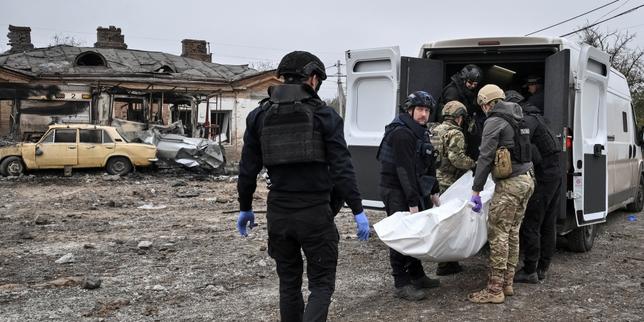
Rescue operations in towns like Komyshuvakha do not look like the high-tech, coordinated recoveries seen in wealthy capitals. There are no fleets of specialized acoustic sensors or massive cranes arriving within minutes. Instead, there are local firefighters working alongside men in dusty tracksuits, using crowbars, shovels, and bare hands to shift slabs of reinforced concrete while drones buzz overhead, threatening a second strike on the very people digging out the first victims.
The rise in the death toll to thirty-three reflects that agonizing timeline. In the first hours after a strike, the figures are always artificially low—representing only those found near the surface or pulled from the edges of the blast. The true cost emerges slowly, over days of grueling excavation, as heavy machinery finally clears the collapsed upper floors to reach the basement spaces where people had gone specifically to stay safe.
And what happens after the last body is recovered and the official tally stops rising?
The statistics freeze at thirty-three, ready to be archived in reports by international observers and war-crimes investigators. Yet for Komyshuvakha, the damage continues to compound in silence. The children who survived lose not only their classrooms, but their peers, their teachers, and the basic rhythm of growing up. Psychologists who work with displaced youth note that losing a school during wartime creates a double dislocation: the physical loss of a building and the cognitive loss of a future. Without a classroom, time stops moving forward; every day becomes an endless loop of waiting for the next sirens.
I will admit something that rarely makes it into crisp news dispatches: looking at this pattern year after year leaves you grappling with a quiet dread. You begin to wonder whether the world is growing accustomed to the unacceptable—whether the sight of a ruined schoolhouse has become so familiar on our screens that it no longer triggers outrage, only a brief, weary sigh before we swipe to the next headline.
International humanitarian law draws a bright, thick red line around schools and civilian shelters. On paper, those protections are absolute. On the ground in Zaporizhzhia, paper stops nothing. The gap between the treaties signed in Geneva and the dust settling over Komyshuvakha feels wider than ever, and pretending otherwise would be dishonest.
The Weight of a Single Desk
Still, to reduce Komyshuvakha to a story of pure victimhood is to miss the stubborn resilience that keeps these towns breathing even after the worst days.
In almost every Ukrainian settlement where a school has been destroyed, something remarkable happens within weeks. Teachers set up makeshift lessons over spotty mobile connections from neighboring villages. Volunteers haul generators to undamaged basements a few streets away to restart aid distribution. Neighbors pool whatever timber and plastic sheeting they can salvage to patch blown-out windows before the frost sets in. They refuse to let the mapmaker have the final word on whether their community exists.
Yet resilience cannot bring back thirty-three lives. It cannot un-collapse a ceiling or erase the memory of dust choking the air in a darkened stairwell.
Tonight, in a shattered hallway in Komyshuvakha, beneath tons of broken brick and twisted steel, a child's notebook lies buried in the dark—its ruled pages still open to a half-finished sentence that no one will ever grade.