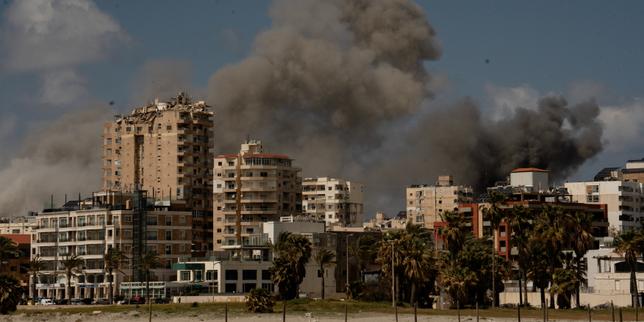
The sound of a tea kettle whistling in a South Beirut kitchen is usually a signal of routine. It means the workday is over, or perhaps it’s just beginning. But for Mariam, a sixty-year-old grandmother whose life has been measured in the rebuilding of the same three walls, the whistle was swallowed by a roar that felt less like an explosion and more like the earth itself screaming.
When the sky over Lebanon turns the color of bruised iron, the air changes. It thickens with the scent of pulverized limestone and burnt rubber. This isn't just the "dry fact" of a military operation or a strategic maneuver described in a press briefing. It is the smell of a childhood bedroom being erased. It is the sound of a neighbor’s frantic calling, not for help, but for a name that will never answer again.
Lebanon is currently a country where the currency is grief and the primary export is displacement. The recent wave of massive aerial bombardments has pushed the nation past a breaking point it has reached many times before, yet this time, the floor has dropped even lower. Thousands are dead. Tens of thousands are moving. The roads are choked with cars carrying mattresses strapped to roofs, a visual shorthand for a people who have learned that the only thing you truly own is what you can carry.
The Geometry of a Shadow
War is often discussed in terms of "targets" and "assets." On a map, a strike is a clean red dot. On the ground, that dot is a three-story apartment building where a wedding dress was being hemmed. It is a pharmacy where the last of the insulin was stored. It is a street corner where men played backgammon every Tuesday for forty years.
Consider the logic of "vengeance" that echoes through the rubble. Many Lebanese citizens, standing amidst the ruins of their livelihoods, describe these attacks not as surgical strikes against an armed group, but as a collective punishment for a war they did not choose. When a power perceives a loss—strategic, moral, or psychological—the reflex is often to project strength through sheer, overwhelming volume.
The weight of the explosives dropped on Lebanon in recent weeks defies easy visualization. Imagine every brick in a suburban neighborhood being turned into a projectile simultaneously. That is the physical reality. The psychological reality is more insidious. It is the "invisible stake" of the conflict: the permanent dissolution of the sense of home. Once a ceiling has collapsed on you, you never truly trust a roof again. Even in the silence, you are listening for the hum of a drone.
The Anatomy of Displacement
To understand the scale, you have to look at the highway. The road from the south to Beirut is a slow-motion river of desperation. People are not just fleeing bombs; they are fleeing the erasure of their history.
One hypothetical family—let’s call them the Al-Zaids—represents the millions. They left their home with three minutes of warning. They didn't grab the photo albums. They grabbed the bread, the water, and the grandmother’s blood pressure medication. They are now living in a public school classroom with four other families. There is one bathroom for sixty people.
This is where the "dry facts" of casualty counts fail to capture the truth. A "casualty" is a person who survived but lost their mind to the stress. A "casualty" is the child who has stopped speaking entirely because the sound of the jets was too loud for his ears to process. The statistics tell us how many hearts stopped beating, but they don't tell us how many hearts are breaking in real-time.
The political justifications offered by the Israeli military focus on the degradation of Hezbollah’s infrastructure. But in the densely packed geography of Lebanon, infrastructure is human. A rocket launcher tucked into a valley is a military fact; the forest fire that results, destroying ancient olive groves that have fed a village since the Ottoman Empire, is a human tragedy. You can rebuild a bunker. You cannot rebuild a five-hundred-year-old tree.
The Language of the Fallen
There is a specific kind of silence that follows a massive bombardment. It isn’t peaceful. It is heavy, vibrating with the echoes of what was just there. In the wake of the most recent strikes, the hospitals in Tyre and Sidon have become theaters of the absurd. Doctors, exhausted beyond the point of tears, perform surgeries by the light of mobile phones because the grid is a memory.
They tell stories of "the lost." These are the bodies brought in that no one claims because the entire family was in the same room when the missile hit. There is no one left to identify them. No one to bury them. No one to remember the way they liked their coffee.
The argument from the south is that these strikes are born of frustration. The narrative on the streets of Beirut is that after months of inconclusive skirmishes, the shift to "massive" bombing is an admission of failure—a desperate attempt to win through rubble what could not be won through strategy. Whether or not this is militarily true is almost irrelevant to the person digging through a pile of gray dust for a pair of shoes. To them, the motive is felt as pure, unadulterated spite.
The Invisible Stakes
What is actually at risk here? It isn’t just a border or a cache of weapons. It is the very concept of a future for the Eastern Mediterranean. Every bomb dropped is a seed of resentment that will grow for decades.
We often talk about "cycles of violence" as if they are weather patterns, inevitable and beyond our control. But these cycles are fueled by the specific, agonizing loss of dignity. When a man has to watch his children sleep on a sidewalk because his house was leveled to "send a message," that message is received, but it isn't the one the sender intended. It doesn't breed a desire for peace; it breeds a cold, hard shell around the soul.
The world watches these events through a glass screen, scrolling past images of smoke plumes. We see the "how" of the war—the technology, the precision, the tonnage. We rarely look at the "who."
Who is the girl sitting on a suitcase at the edge of the road? She is the future of a nation. If her only memory of her tenth year is the smell of cordite and the sight of her father’s tears, what kind of world will she build when she is twenty?
The Echo in the Rubble
The international community issues statements. They use words like "restraint" and "escalation." These words are like bandages on a severed limb. They don’t stop the bleeding. They don't give a mother back the daughter who was buried under the pantry.
The reality is that Lebanon is being carved by the tools of modern warfare, but the wounds are ancient. They are the wounds of a people who have been told, time and again, that their lives are secondary to a "higher" strategic goal. When you are the one under the rubble, there is no goal high enough to justify the weight of the stone.
The morning after a massive strike, the sun rises over the Mediterranean just as it always has. It illuminates the jagged edges of what used to be a city. It catches the glint of broken glass on the pavement. The dust hasn't settled; it has just become part of the air everyone is breathing.
Mariam, the grandmother who heard the kettle whistle, stands in the middle of a street that no longer exists. She doesn't have a rifle. She doesn't have a political affiliation. She has a handful of dirt from the place where her kitchen used to be. She isn't crying anymore. The time for tears has passed, replaced by a silence so profound that it should terrify anyone who still believes that war can ever be "won."
She looks at the sky, waiting for the whistle to return.