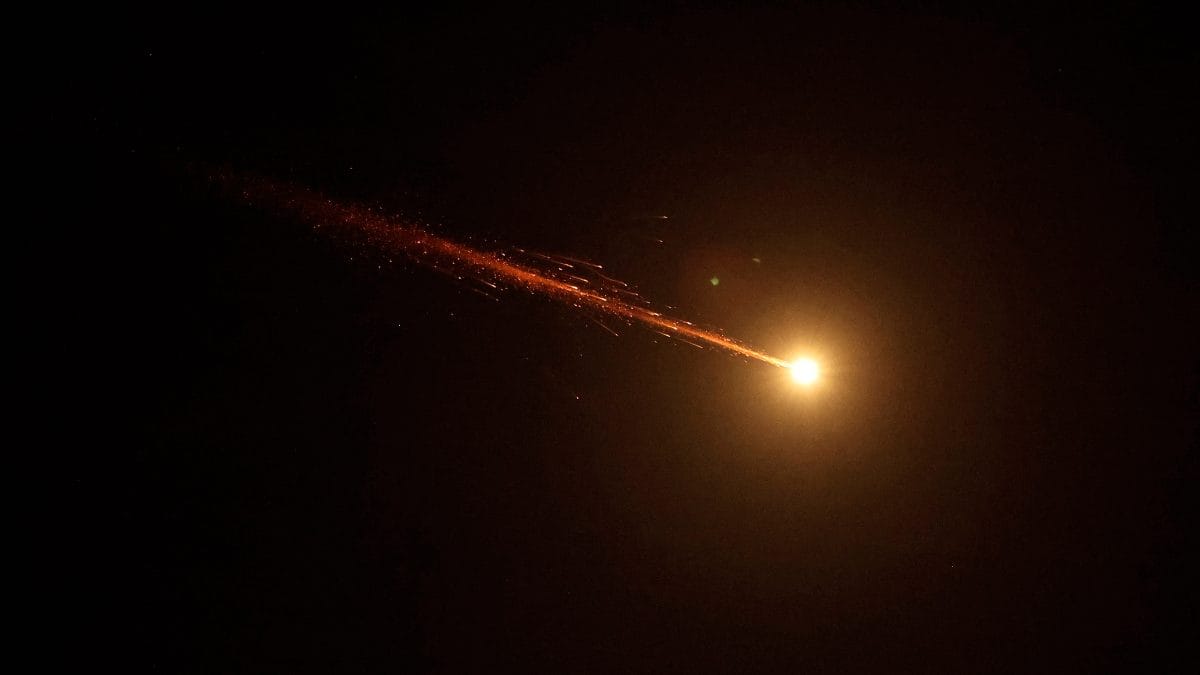
The sound of a modern city at night is a predictable hum of air conditioning units and distant traffic. In Abu Dhabi, that hum is usually gold-plated and serene. But when the sky breaks, it doesn't sound like thunder. It sounds like the tearing of heavy silk, followed by a concussive thump that rattles the teeth in your skull.
We watch the videos on our phones—pixelated streaks of light chasing other streaks of light. We call them "intercepts." It is a clean, clinical word. It suggests a problem solved. A threat neutralized. We see the flash in the atmosphere and feel a sense of distant relief because the missile didn't hit its target.
But gravity is an absolute law.
What goes up must come down. When a billion-dollar defensive battery meets a ballistic threat in the clouds, the result isn't disappearance. It is fragmentation. The missile is transformed from a single, tracking nightmare into ten thousand jagged, screaming pieces of hot tungsten and steel. These pieces do not vanish. They rain.
The Man Who Was Just Looking for Home
Consider a man named Naveed. This is a name for the thousands of Pakistani nationals who keep the gears of the Gulf turning. He isn't a general. He isn't a politician. He doesn't have a seat at the table in Tehran, Tel Aviv, or Washington.
Naveed spent his day moving boxes, or perhaps driving a taxi, or wiring money back to a village in Punjab where the exchange rate is the difference between a sister’s wedding and a family’s debt. He was likely tired. The air in the Emirates at night is thick and salty. He might have been standing on a balcony, or walking to a corner grocery to buy a cold drink, looking up because the sirens were doing something they weren't supposed to do.
He was killed by falling debris.
Think about the cosmic unfairness of that sentence. He survived the journey across the Arabian Sea. He survived the heat of the construction sites. He survived the loneliness of the migrant life. Only to be struck down by the literal "success" of a weapon system designed to save lives. He is the invisible math of modern warfare.
The Illusion of the Shield
We have lived for decades under the assumption that technology has made war precise. We use words like "surgical" and "targeted." We talk about the Iron Dome, the Patriot missiles, and the THAAD systems as if they are invisible umbrellas that make the rain stop.
They aren't umbrellas. They are shotguns.
When an interceptor missile engages a target, it uses a "kinetic kill" or a fragmentation warhead. The goal is to hit a bullet with a bullet. If you are successful, you have prevented a massive explosion at a high-value target—a power plant, a palace, a military base. But you have created a secondary event: a localized storm of shrapnel.
The geography of a conflict is often measured in maps and borders, but the true geography is vertical. The conflict between Israel and Iran, stretching across the proxy lands of Yemen, Lebanon, and Iraq, has turned the sky into a transit corridor for heavy metal. The people living underneath that corridor—the shopkeepers in Amman, the laborers in Abu Dhabi, the families in Baghdad—are living in a lottery they never bought a ticket for.
The Weight of Metal
To understand the stakes, you have to understand the physics of a "falling object." A piece of debris the size of a brick, falling from the edge of the atmosphere, reaches terminal velocity quickly. It becomes a kinetic slug. It doesn't matter if it was part of a "bad" missile or a "good" interceptor. To the roof of a car or the shoulder of a man, the politics of the metal are irrelevant.
The death of a Pakistani national in Abu Dhabi is a signal. It tells us that the "regional conflict" is no longer something you can watch on the news and remain detached from. The ripple effects are physical. They are lethal.
We often focus on the "Big Three"—the US, Israel, and Iran. We analyze the rhetoric. We count the centrifuges. We measure the oil prices. But the actual friction of this war is felt by the people who are just trying to exist in the spaces in between.
A Shadow Over the Gulf
The Gulf states have spent thirty years building a shimmering reality of glass and light. They have marketed themselves as the neutral ground, the crossroads of the world, the safe harbor. But you cannot buy safety from a ballistic trajectory.
When the news cycle moves on to the next escalation, the body of the man in Abu Dhabi stays. His family in Pakistan receives a phone call that makes no sense. How could he be dead? There was no bomb. He wasn't at the front line. The front line is now everywhere. It is the sidewalk. It is the parking lot. It is the space right above your head.
Modern defense is a series of trade-offs. We trade a catastrophic hit for a series of smaller, unpredictable strikes. We celebrate the "100% interception rate" while ignoring the fact that the sky is now full of falling knives. It is a terrifying form of progress.
We have become so good at stopping the end of the world that we have forgotten how to stop the small, quiet deaths that happen in the process. We watch the lights in the sky and we cheer for the sparks, unaware that every spark eventually has to land.
Naveed wasn't a soldier. He was a witness. He was the person who proved that in the game of regional hegemony, the house always wins, but the bystanders always pay the tab.
The sky over the Middle East is no longer just a place for stars and airplanes. It is a pressurized chamber. It is a ceiling that feels lower every day. And as the debris continues to fall, we are forced to realize that no matter how high we build our towers, we are still standing in the open, waiting for the metal to find us.
The hum of the air conditioning in Abu Dhabi continues. The traffic flows. The lights stay on. But there is a hole in the silence now, a reminder that the war isn't just coming—it is already dropping from the clouds, one jagged piece at a time.