Ash does not fall like snow. Snow drifts, dances, surrenders to the slightest draft. Ash drops heavy, greasy, and terminal, carrying the distinct, ancient smell of an entire ecosystem unspooled into carbon.
Stand at the edge of the Kalmthoutse Heide in northern Belgium, and the air still tastes like old campfires that refuse to die. For days, the horizon has not belonged to the sky. It belongs to smoke. A persistent, bruised haze hangs over the peatlands, a visible ghost of a historic fire refusing to yield to the thousands of liters of water poured over its chest. For a more detailed analysis into this area, we recommend: this related article.
Firefighters call it encercler définitivement. Encircle definitively. A military phrase for a biological nightmare.
To understand what is happening beneath your boots here, you have to forget everything you know about standard urban fires. This is not a house fire gasping for oxygen behind drywall. This is an underground furnace. The ground beneath the natural park is thick with peat, a dense, spongy accumulation of partially decayed organic matter built over millennia. Peat does not just burn on the surface; it holds fire in its lungs, smoldering in the dark, chewing through ancient roots and buried timber weeks after the red flames have supposedly been put to sleep. For additional background on this development, in-depth analysis is available on NBC News.
Imagine walking across a meadow that looks entirely peaceful, the grass green enough to fool the eye, only for your boot to sink into soil hot enough to melt rubber. That is the reality facing the crews right now.
Jean, a veteran firefighter with twenty-five years on the force, rubs a thumb across his soot-stained forehead, leaving a dark smudge that looks like war paint. His voice is gravel and exhaustion.
"We think we win," he says, staring out over a charred stretch of heather where wisps of white smoke still snake out of rabbit holes. "We drown a sector. We pack our hoses. We go home for an hour. And then the wind shifts, the peat breathes, and a new tongue of fire licks up through the roots fifty meters behind our backs. It is a living thing. It plays with us."
That is the hidden terror of the Kalmthoutse Heide blaze. It is not an event with a clean beginning and a tidy end. It is a siege.
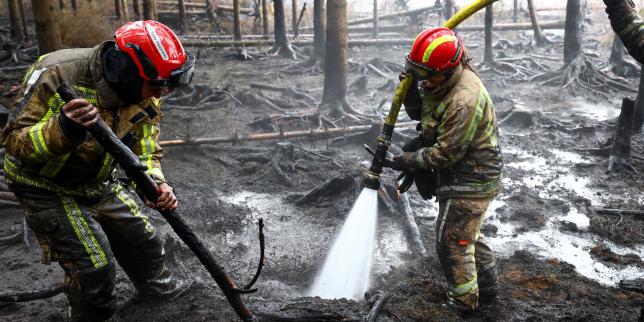
The strategy deployed by the emergency services is an exercise in total geometric exhaustion. To encircle definitively means creating an unbroken ring of defense, digging firebreaks through sand and stubborn scrub, drowning every square inch of suspected hotspot with water hauled in by specialized all-terrain tankers. It requires absolute precision. If a single pocket of smoldering peat is left untouched beneath the surface, the next dry afternoon will turn it into an open wound.
History hangs heavy over this landscape. The park is a sanctuary, a fragile pocket of biodiversity tucked into a densely populated country, home to rare birds, crawling reptiles, and plants that grow nowhere else in the region. When the park burns, a piece of the collective memory of the low countries turns to charcoal. Generations of families have walked these sandy paths on Sunday afternoons, breathing in the scent of pine and damp earth. Now, those same paths look like a battlefield sequence from a historical drama, complete with heavy machinery churning up mud and ash, and tired crews sharing lukewarm coffee from battered thermoses in the grey dawn.
We forget how fragile our green spaces are until they are threatened with erasure. We look at a national park as a permanent fixture, an immutable backdrop to our modern lives, like a mountain range or an ocean. But places like the Kalmthoutse Heide are fragile treaties between water, earth, and human stewardship. When the climate dries the topsoil and turns the peat into tinder, that treaty is broken.
The work is agonizingly slow. There is no glory in it. No cinematic explosions, no dramatic rescues from crumbling rooftops. Just men and women in heavy, sweat-soaked gear, hacking at the earth with shovels, monitoring thermal imaging cameras, and reading the direction of the wind like sailors navigating a hurricane. They are fighting a war against an enemy that hides under their own feet.
As the sun dips below the charred silhouette of the pine trees, painting the smoke a bruised violet, the hum of water pumps returns to the valley. The battle lines are drawn again in the dark.
Somewhere beneath the surface, a single spark waits for tomorrow. And above it, the ring closes.