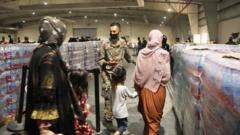
Five years after the frantic fall of Kabul, a stretch of desert in Qatar remains a purgatory for thousands of Afghans who were promised a path to the West. They are the leftovers of Operation Allies Refuge, tucked away in Camp As Sayliyah, a high-security facility where the heat is oppressive and the silence from Washington is deafening. These are not just refugees; they are the former interpreters, intelligence assets, and elite commandos who risked everything for a twenty-year American experiment. Now, they are caught in a bureaucratic bottleneck that looks less like a processing delay and more like a deliberate strategy of containment.
The initial narrative surrounding the 2021 evacuation was one of heroism and logistical triumph. However, the reality on the ground in Doha reveals a darker side of the withdrawal. The U.S. government has effectively outsourced its moral obligations to a third-party host, creating a legal gray zone where "security vetting" serves as a catch-all excuse for indefinite detention. While those with perfect paperwork and high-profile connections moved on to Virginia or Texas years ago, those remaining in the camp are the complicated cases. They are the ones with a missing signature on a decade-old contract or a distant relative with the wrong political affiliations.
The Architecture of Indefinite Waiting
Camp As Sayliyah functions as a gilded cage. While the physical needs of the inhabitants—food, water, and basic medical care—are met by the Qatari government and U.S. contractors, the psychological toll is immense. The camp is managed with military precision, yet it lacks the one thing a soldier or a refugee needs to survive: a timeline.
The vetting process is a black box. Many residents have completed their initial interviews and biometric scans, only to wait years for a follow-up. When inquiries are made through the few available legal channels, the response is almost always a variation of "administrative processing." This phrase has become a death knell for hope. It implies that the file is not denied, but it is not moving. In the world of high-stakes immigration, a non-answer is often more damaging than a rejection because it prevents the applicant from seeking asylum elsewhere or making a life in a different country.
The "betrayal" these evacuees feel is not a result of a sudden policy shift. It is the result of a system designed for a trickle that was suddenly forced to handle a flood. The U.S. State Department and the Department of Homeland Security (DHS) have different thresholds for risk. If a former Afghan special forces member was forced to interact with the Taliban during the collapse to save his family, that interaction might appear as a "red flag" in a DHS database. The nuance of the battlefield is lost in the sterile offices of a vetting center in Virginia.
The Strategic Cost of Abandonment
The situation in Qatar is not just a humanitarian failure; it is a massive intelligence and strategic blunder. In the shadow wars of the future, the U.S. will rely on local partners. Those partners are watching how the Afghan allies are being treated today.
The Trust Deficit
- Recruitment Barriers: Future assets will demand more than just a promise of a visa. They will want escrowed guarantees, knowing that a "SIV" (Special Immigrant Visa) is currently a lottery ticket with terrible odds.
- Operational Security: Desperate people in limbo are vulnerable. By leaving highly trained military personnel in a camp for five years, the U.S. is creating a ripe environment for foreign intelligence services to recruit disgruntled former allies.
- Moral Weight: The veteran community in the United States, particularly those who served in the "Green Berets" or CIA paramilitary units, feels a deep sense of personal shame over the abandonment of their counterparts. This has led to a fractured relationship between the rank-and-file military and the political leadership.
The financial cost is also staggering. Maintaining thousands of people in a high-security facility in Qatar is not cheap. The American taxpayer is essentially funding a permanent holding center because the political will to resolve these cases—either by granting entry or finding a third-country solution—does not exist. It is cheaper, politically speaking, to keep the problem in the desert than to risk the optics of a vetting failure on American soil.
The Security Vetting Myth
Official statements often lean on the "rigorous security screening" as the primary reason for the delay. This is a half-truth that masks a deeper dysfunction. The vetting is slow because the data sources are gone. When the U.S. military left Bagram Airfield, they lost access to the ground-level intelligence that could verify a person’s story. Now, adjudicators are trying to verify 2012 events using 2026 technology, without any boots on the ground in Kabul to check references.
This creates a "guilty until proven innocent" environment. If an interpreter worked for a unit that didn't keep perfect records, or if their American supervisor has since retired and cannot be found, the applicant is stuck. There is no mechanism for an Afghan at Camp As Sayliyah to challenge a "security hold." They are not in U.S. territory, so they have no right to due process. They are not in Qatar as traditional refugees, so they fall outside the standard UNHCR protections. They are, quite literally, nowhere.
Legal Limbo and the Humanitarian Vacuum
Inside the camp, the demographic is shifting. What started as a group of individual soldiers and interpreters has turned into families with children who have spent their entire formative years behind a wire fence. These children are not in school in any traditional sense. They are learning English from YouTube and waiting for a flight that never comes.
The mental health crisis within the camp is a ticking time bomb. There have been reported hunger strikes and suicide attempts. When you take people who have survived the trauma of war and place them in a high-pressure environment with no autonomy, the psyche begins to fracture. The "betrayal" isn't just about the visa; it’s about the dehumanization. They are treated as data points to be scrubbed, not as people who saved American lives.
The Realities of the Pipeline
| Stage of Process | Estimated Time (Pre-2021) | Current Estimated Time (Qatar) |
|---|---|---|
| Initial Screening | 3 Months | 12-18 Months |
| Security Review | 6 Months | 36+ Months (Indefinite) |
| Medical Clearance | 1 Month | 6 Months |
| Final Flight Prep | 2 Weeks | Unknown |
The table above illustrates the systemic slowdown. It isn't just a lack of staff; it's a lack of priority. In the current political climate, there is no "reward" for a politician to advocate for more Afghan refugees.
The Third Country Shell Game
Recently, there have been efforts to move some residents to third countries like Albania, Kosovo, or Rwanda. While this provides an exit from the desert, it often feels like another betrayal to the evacuees. They were promised America. Moving them to a country where they have no cultural ties, no language skills, and no support system is a way for the U.S. to "clear the books" without honoring the original commitment.
These third-country agreements are often opaque. They involve financial incentives provided by the U.S. to host nations, essentially paying them to take a problem off Washington's hands. For the Afghan commando who was told he would find safety in the U.S. after years of fighting the Taliban, being told he is now moving to a rural village in the Balkans is a bitter pill. It confirms his suspicion that he was never an ally, but merely a temporary tool.
The bureaucratic inertia is compounded by the fact that many of the original files from the evacuation were lost or poorly digitized during the chaos at Hamid Karzai International Airport. We are seeing cases where individuals have been interviewed four or five times by different agencies, only to be asked the same questions. Each interview is a new opportunity for a minor discrepancy to derail their lives. If a man says he was at a specific checkpoint in 2014 during one interview, and says 2015 in another—perhaps due to the passage of time or the use of a different calendar—he is flagged for "inconsistent testimony."
A Policy of Exhaustion
It is hard to escape the conclusion that the U.S. government is practicing a policy of exhaustion. The hope is that if the wait is long enough and the conditions are monotonous enough, people will simply choose to leave. But leave for where? Returning to Afghanistan is a death sentence for most of these people. The Taliban have not forgotten who worked for the "invaders."
This is a crisis of accountability. No one in the current administration wants to be the person who signed off on a visa for someone who later poses a risk, but no one wants to be the person who officially tells a war hero he isn't welcome. So, the decision is to make no decision.
The silence from the international community is equally striking. Because Qatar is a key strategic ally and the facility is a military-adjacent zone, NGOs have limited access. There are no cameras in Camp As Sayliyah. There are no daily press briefings. The world has moved on to other conflicts, other refugees, and other headlines. The Afghans in Doha are a relic of a war that the West is desperate to forget.
The only path forward that avoids a permanent human rights stain is a surge in adjudicative resources—a dedicated task force with the authority to waive minor technicalities in favor of the "preponderance of evidence." If a veteran can vouch for an interpreter, that should carry more weight than an incomplete HR file from a defunct contractor. Until the vetting process acknowledges the messy reality of the Afghan conflict, the camp in Qatar will remain a monument to a promise broken in the desert.
Pressure must be applied to the State Department to provide a clear, transparent status update for every head of household in the facility. If the U.S. intends to reject them, it must do so and allow them to seek resettlement through international channels. Keeping them in a state of permanent "processing" is a psychological torture that no ally deserves.
Check the current status of the Afghan Adjustment Act and contact your representatives to demand its passage with specific provisions for those held in overseas transit centers.