The Strait of Hormuz functions as a binary switch for global energy markets, yet for the local artisanal fishing industry in the United Arab Emirates, it represents a deteriorating cost-benefit equation. While macro-analysis focuses on the daily transit of 21 million barrels of oil, the micro-economic reality for coastal communities involves a tightening squeeze between rising operational risks and shrinking accessible biological reserves. This misalignment of maritime security priorities and local economic sustainability has created a systemic failure in the traditional primary sector of the Persian Gulf.
The Triple Constraint of Modern Gulf Fisheries
The viability of commercial fishing in the UAE is currently dictated by three intersecting pressures that individual boat captains cannot mitigate through traditional seamanship.
1. The Perimeter of Exclusion
Security protocols initiated by regional naval forces—including the UAE Coast Guard and international task forces—have effectively shrink-wrapped the available fishing grounds. To prevent asymmetric threats and unauthorized vessel approaches to critical infrastructure or tankers, "exclusion zones" have expanded. These zones are often high-productivity areas where coral reefs or seabed topography naturally aggregate fish populations. When a dhow is forced to move five miles further offshore to bypass a restricted military corridor, the fuel consumption increases by approximately 15-22% depending on the vessel’s engine efficiency and load.
2. The Insurance and Risk Premium
As geopolitical friction between regional powers escalates, the classification of the Persian Gulf as a high-risk area by maritime insurers has indirect but tangible downstream effects. While small-scale artisanal fishers may not carry the same complex P&I (Protection and Indemnity) insurance as a VLCC (Very Large Crude Carrier), the overall cost of doing business in a militarized zone rises. Maintenance costs for GPS and AIS (Automatic Identification System) hardware become mandatory rather than optional, as non-broadcasting vessels are increasingly treated as potential hostile actors by automated defense systems.
3. Biological Displacement and Thermal Stress
Beyond the human conflict, the ecology of the Gulf is under structural duress. The Persian Gulf is one of the world’s warmest sea bodies. As industrial desalination plants—essential for the UAE’s urban survival—discharge high-salinity brine back into the shallows, fish populations migrate to deeper, cooler waters. These deeper waters often coincide with the international shipping lanes or disputed territorial boundaries where fishing is either physically dangerous or legally prohibited.
The Mechanics of Kinetic Friction
The primary driver of the current crisis is not a single "war" but a state of permanent kinetic friction. This is defined by the high frequency of low-intensity maritime encounters.
The Identification Bottleneck
Traditional fishing dhows often lack the sophisticated electronic signatures of modern yachts or commercial freighters. In a high-tension environment, the time-to-identify (TTI) for a naval commander is compressed. This results in frequent "interdiction delays" where fishing vessels are stopped, boarded, or turned back. For a business model that relies on the freshness of highly perishable inventory (Scomberomorus commerson or Narrow-barred Spanish mackerel), a four-hour delay for security clearance can reduce the market value of a catch by 30% due to degradation in cold-chain integrity.
Navigational Sabotage and GPS Interference
Electronic warfare (EW) is a constant, invisible variable in the Strait. Reports of GPS spoofing and signal jamming aimed at disrupting military drones or missiles frequently catch civilian fishers in the crossfire. A navigator losing accurate positioning in a region littered with offshore oil rigs and subsea pipelines faces more than just a lost day of work; they face catastrophic hull damage or arrest for accidental border transgression.
The Economic Disparity of the Maritime Commons
The UAE’s transition to a post-oil economy has prioritized high-value sectors: tourism, finance, and logistics. This creates an internal resource conflict where the "Maritime Commons"—the shared space of the sea—is managed for the benefit of the highest-revenue occupants.
- Shipping Priority: A single container ship or LNG tanker generates thousands of times more GDP per square meter of sea-space occupied than a fishing dhow.
- Recreational Encroachment: Large-scale coastal developments (islands and marinas) prioritize leisure over labor, pushing traditional landing sites further from urban centers and increasing the "commute" time for the fleet.
This prioritization creates a "Shadow Cost" for the fishing industry. The fishermen are not just victims of Iranian-Western tensions; they are victims of a spatial hierarchy that views their presence as a logistical variable to be managed rather than an industry to be preserved.
Quantifying the Catch Decline
While precise longitudinal data on every dhow is proprietary or fragmented, the trend lines are clear when observing the Abu Dhabi and Sharjah fish markets. The volume of "local" catch has seen a steady downward trajectory, replaced by imports from Oman or further afield via air freight.
The Replacement Effect
When local supply chains break, the market does not wait. It optimizes. High-end UAE restaurants and supermarkets have shifted their procurement strategies toward more stable, albeit more expensive, international suppliers. This creates a permanent loss of market share for local fishers. Even if the geopolitical tensions subsided tomorrow, the "Return to Market" would be blocked by established institutional contracts with global seafood distributors.
Labor Flight and the Skills Gap
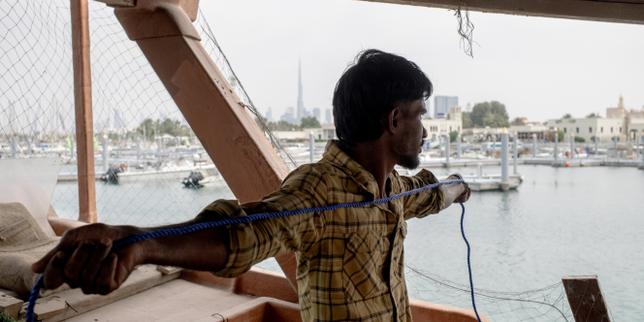
The majority of the labor on UAE fishing vessels consists of expatriate workers from South Asia. As the profit margins per voyage shrink—due to the fuel and time costs mentioned previously—the wage-earning potential for these crews collapses. This leads to a brain drain of experienced maritime labor. Replacing a crew that understands the specific tidal nuances of the Gulf with inexperienced labor increases the risk of maritime accidents, further driving up the insurance and regulatory burden on the vessel owner.
The Failed Logic of Subsidies
Direct government intervention has historically focused on fuel subsidies or equipment grants. However, these are "Linear Solutions" to a "Systemic Problem." A fuel subsidy does not help a fisherman who is barred from entering a 10-mile radius around a new gas platform. It does not provide clarity when GPS signals are jammed.
The structural problem is Spatial Access, not Resource Scarcity. The fish are present, but they are geographically locked behind a barrier of security protocols and industrial infrastructure.
Re-Engineering the Maritime Strategy
To stabilize the artisanal sector, the strategy must move beyond simple financial aid and toward integrated maritime management.
Corridor Optimization
The establishment of "Blue Corridors" specifically for fishing vessels, protected from the churn of heavy commercial shipping and clearly defined in naval ROEs (Rules of Engagement), would reduce interdiction delays. This requires a level of inter-agency cooperation between the Ministry of Climate Change and Environment and the Naval Forces that currently exists only on paper.
Technological Hardening
Equipping the traditional fleet with encrypted, military-grade transponders that are immune to standard commercial spoofing would decrease the "Threat Profile" of the vessels. This moves the fishing fleet from being a "noise" variable in security radars to a "known" entity, reducing the friction of security stops.
On-Shore Value Addition
Since the volume of catch is likely to remain constrained by security and biology, the focus must shift to value-per-kilogram. Developing specialized processing facilities at the landing sites that can flash-freeze or vacuum-pack catch for the high-end export or luxury domestic market would allow fishers to maintain revenue even with lower volumes.
The long-term outlook for UAE fisheries is not a return to the 20th-century status quo. The Strait of Hormuz will remain a contested space as long as it remains the world's primary energy artery. For the fishing industry, the only path forward is a radical technical and operational pivot. Owners must consolidate smaller fleets into larger, more technologically capable entities that can navigate the regulatory and electronic complexities of a modern theater of conflict. Small-scale, independent operators who lack the capital to upgrade their navigational and preservation systems will inevitably be phased out, not by a lack of fish, but by the overwhelming cost of the geography they occupy.