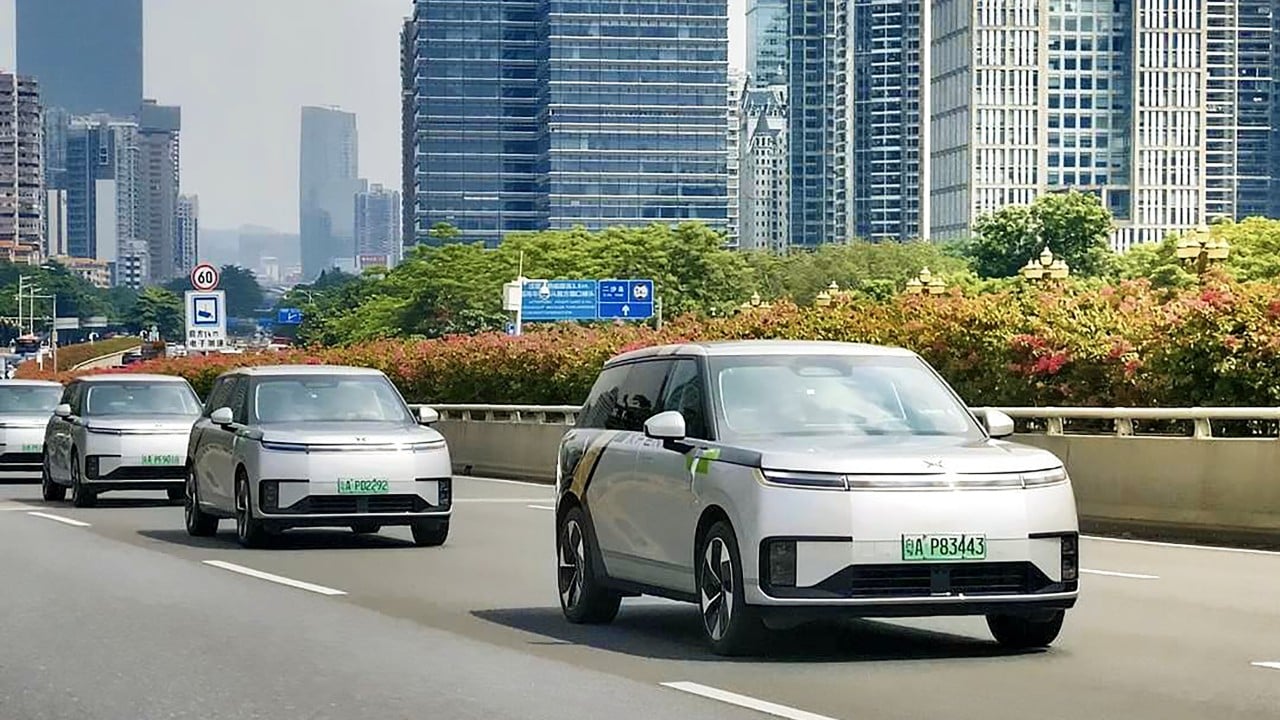
Rain changes the geometry of a Shanghai intersection at midnight. Streetlights smear across wet asphalt like spilled oil, turning familiar lane markings into shimmering illusions, while electric scooters dart out from blind alleys with the fearless unpredictability of moths. For decades, navigating this controlled chaos required a very specific kind of human muscle memory—the subtle feathering of a brake pedal, the split-second eye contact with a delivery rider, the quiet intuition that tells a driver a parked van is about to swing its door open.
Now, imagine sitting in the back seat of a sedan rolling through that exact intersection. The front seats are empty. The steering wheel turns on its own, making micro-adjustments so smooth and deliberate they feel almost eerie. If you liked this post, you might want to look at: this related article.
That hypothetical ride is no longer a distant science-fiction daydream, nor is it confined to closed test tracks in the desert. With Beijing’s decision to grant autonomous driving permits to both a Volkswagen joint venture and the Chinese electric vehicle maker Xpeng, the race to replace human reflexes with silicon intuition has entered its most consequential phase yet. On paper, a regulatory permit sounds like dry bureaucratic housekeeping. In reality, it is a starting gun fired in a crowded room.
Why Legacy Giants Are Suddenly Chasing Startups
To understand why a permit in China matters so much to an automaker headquartered in Wolfsburg, Germany, you have to understand how completely the automotive world has been turned upside down over the last five years. For another look on this story, check out the latest coverage from The Next Web.
For more than a century, building a great car was an exercise in mechanical perfection. Volkswagen built an empire on precision engineering—the satisfying, heavy thud of a closing door, the predictable torque of an internal combustion engine, the tactile feedback of a well-tuned chassis. When you bought a German car, you were buying generations of metallurgical and mechanical mastery.
Then the car stopped being a machine and became a rolling supercomputer.
In China, the world’s largest automotive market, buyers stopped asking about horsepower and started asking about software. A new generation of drivers began treating the cabin less like a cockpit and more like a living room on wheels. Suddenly, legacy giants found themselves outmaneuvered by agile domestic challengers like Xpeng, Nio, and Li Auto—companies born in the smartphone era that viewed hardware merely as a shell for artificial intelligence.
Volkswagen’s response was a massive strategic pivot, pouring billions of dollars into local partnerships, software hubs, and a high-profile alliance with Xpeng itself. By securing autonomous testing and operational permits alongside Xpeng, Volkswagen’s joint venture is doing something that would have seemed unthinkable a decade ago. It is admitting that the future of German engineering runs through Chinese streets, Chinese data, and Chinese regulatory approval.
The Invisible Fuel of the Autonomy Race
People often ask what actually separates one self-driving system from another. Is it better cameras? More expensive lidar sensors? Faster microchips?
The honest answer is much simpler, and far harder to replicate. It is mileage.
Think of an autonomous driving algorithm like a newly licensed teenager. You can hand that teenager the thickest, most comprehensive driver’s manual ever written. They can memorize every traffic law, every stopping distance formula, and every right-of-way rule. Yet the first time they encounter a construction worker waving an orange flag in the middle of a flooded roundabout, the manual becomes useless. Experience is the only teacher that counts.
In artificial intelligence, experience is measured in edge cases—those rare, bizarre, one-in-a-million traffic scenarios that no engineer could ever program in advance. A mattress falling off the roof of a pickup truck. A flock of geese blocking an expressway ramp. A sudden dust storm reducing visibility to ten feet.
China’s megacities are, without exaggeration, the richest edge-case factories on Earth.
When regulators grant permits to companies like Xpeng and Volkswagen’s joint venture, they are handing over the keys to a living laboratory of hundreds of millions of daily commuters. Every mile driven under these permits feeds billions of data points back into neural networks. The cars watch, learn, hesitate, and adapt. Every near-miss in Guangzhou makes a vehicle smarter in Beijing. Every awkward merge in Hefei refines the decision-making matrix for thousands of other cars overnight.
This is the quiet truth behind the headlines. A permit is not merely permission to drive; it is permission to learn at a scale no Western test fleet can easily match.
Two Philosophies on the Same Wet Road
Watch how Xpeng and Volkswagen approach this challenge, and you see two wildly different corporate DNA strands colliding in real time.
Xpeng has long positioned itself as the audacious software native. Led by executives who cut their teeth in mobile internet and tech, the company bet early on end-to-end artificial intelligence—systems that rely less on rigid, human-written rules and more on deep learning models trained to mimic human perception and decision-making. To understand Xpeng’s philosophy, picture an artist painting from intuition rather than following a numbered grid. Their XNGP (Navigation Guided Pilot) system was built to ditch high-definition maps, relying instead on real-time vision and onboard computing to read the road as a human eye would.
Volkswagen, by contrast, carries the weight—and the responsibility—of a global mass-market titan. When you sell millions of vehicles to families around the world, moving fast and breaking things is not an option. A single high-profile failure can erode decades of hard-won trust. For Volkswagen’s joint ventures, entering the autonomous permit arena is about marrying industrial scale and safety validation with the breakneck speed of Chinese AI development.
Consider what happens next as these two philosophies converge.
If Xpeng’s software agility merges seamlessly with Volkswagen’s manufacturing might, the resulting vehicles won't just be experimental robotaxis confined to geofenced districts. They will be affordable, mass-produced consumer cars capable of driving themselves from a suburban driveway to a downtown office garage. The technology stops being a luxury novelty for tech enthusiasts and becomes a standard utility, as unremarkable as anti-lock brakes or power steering.
The Human Element We Rarely Talk About
I still remember the first time I rode in a Level 4 autonomous vehicle in dense urban traffic. Before the doors locked, I felt a surge of pure, irrational bravado. I work in technology. I understand sensor fusion, neural networks, and redundant braking architectures. I knew the math.
Then the car pulled away from the curb, and my reptilian brain took over.
My right foot pressed hard against the empty floorboard every time a bus drifted toward our lane. My shoulders knotted up near my ears. When the vehicle paused patiently for three full seconds at an unprotected left turn—waiting for a gap in oncoming traffic that felt impossibly tight—I caught myself holding my breath, utterly convinced we were about to be T-boned.
The car executed the turn cleanly. Smoothly. Without a flicker of drama.
That visceral gap between intellectual trust and emotional surrender is the real battleground of autonomous driving. Engineers love to talk about disengagement rates—the number of miles a car can travel before a human safety driver has to intervene. Regulators love to talk about permit tiers, Level 2-plus versus Level 3 and Level 4 classifications, and liability frameworks.
Yet none of those metrics capture the quiet psychological shift required of the person sitting inside the cabin.
For over a century, driving has been synonymous with agency. Getting behind the wheel meant freedom, control, and independence. Handing that control over to an invisible algorithm requires a leap of faith that feels unnatural, even scary. When things go wrong—and in the messy, unpredictable reality of public roads, things inevitably will—the public rarely forgives a machine the way it forgives a tired human driver.
A human driver who causes a fender-bender is an unfortunate statistic. An autonomous car that makes a mistake becomes international news.
Why Beijing Is Moving Faster Than Washington or Brussels
Look across the Pacific or over to Europe, and the contrast in regulatory temperament becomes impossible to ignore.
In the United States, autonomous driving has been a story of brilliant technical leaps paired with agonizing regulatory fragmentation. A company might secure approval to operate robotaxis in San Francisco or Phoenix, only to face a patchwork of conflicting state laws, skeptical city councils, and fierce public backlash the moment a vehicle blocks a fire truck or stalls in traffic. Progress moves in lurches—two steps forward, one high-profile investigation back.
Europe, true to its historical caution, has prioritized strict harmonization and liability clarity, which protects consumers but often slows real-world deployment to a crawl.
China has taken a fundamentally different path. Beijing views intelligent connected vehicles not merely as a consumer trend, but as a core pillar of national industrial strategy—the logical next chapter after dominating global electric vehicle manufacturing and battery supply chains. By creating structured pilot zones across major cities and systematically issuing testing and operational permits to both domestic champions like Xpeng and committed foreign partners like Volkswagen, Chinese regulators are actively building the runway while the plane is taking off.
Does this approach carry risks? Undoubtedly. Putting advanced autonomous systems onto crowded public streets accelerates learning, yet it also compresses the margin for error. Regulators are walking a tightrope between fostering domestic innovation and ensuring public safety on streets shared by millions of pedestrians, cyclists, and traditional drivers.
Still, the strategic logic is unmistakable. Whoever sets the standards for autonomous mobility in the world’s largest auto market will hold enormous sway over how those standards are exported to the rest of the globe.
The Stakes Beneath the Surface
Strip away the corporate press releases and the regulatory jargon, and what remains is a profound question about who will own the future of human movement.
For traditional automakers, the danger is clear. If they fail to master autonomous software, they risk becoming the automotive equivalent of hardware assemblers—building beautiful, comfortable metal boxes while tech companies capture all the high-margin software revenue, customer data, and brand loyalty. Volkswagen’s aggressive push in China is a survival instinct dressed up as a joint venture. They know they cannot afford to sit on the sidelines while domestic rivals rewrite the rules of the road.
For companies like Xpeng, the challenge is the exact mirror image. Having the smartest code means very little if you cannot survive the brutal price wars currently tearing through the Chinese EV market. Expanding autonomous capabilities—and monetizing them through software subscriptions, licensing deals, and partnerships with global giants—is how a younger automaker turns technological brilliance into long-term financial durability.
And for the rest of us? The people who simply want to get to work, pick up groceries, or get home safely on a rainy Tuesday night?
The transformation will arrive not with a thunderclap, but in quiet increments. First, the highway commute becomes effortless, the car holding its lane and pacing traffic while your shoulders finally drop away from your ears. Next, the chaotic urban streets begin to yield, those shimmering midnight intersections decoded by sensors that never blink, never get distracted by a text message, and never lose their temper in gridlock.
Somewhere in a test fleet tonight, a car with no hands on the wheel is approaching a slick, crowded crosswalk in the rain. Its cameras are piercing the glare. Its processors are weighing a thousand probabilities in the span of a heartbeat. Slowly, deliberately, the brake lights glow red, bringing two tons of steel to a gentle halt inches before the painted white line—while the ghost behind the wheel waits patiently for a stranger to cross the street.