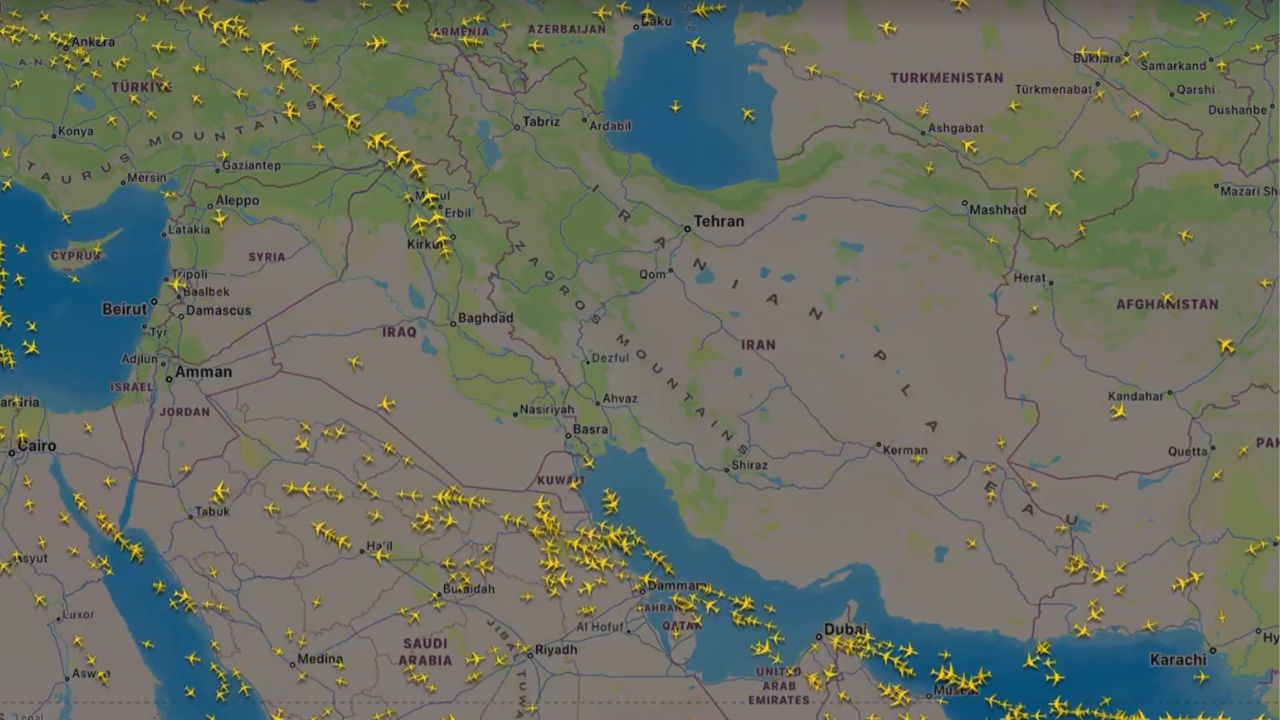
The headlines are screaming about "chaos" again. Every time a kinetic exchange occurs between Iran and Israel, the legacy media resets its narrative clock to zero. They paint a picture of a global aviation network on the brink of collapse, with "stranded passengers" and "disrupted supply chains" serving as the cheap emotional hooks.
They are wrong.
The standard reporting on Middle Eastern airspace closures is built on a fundamental misunderstanding of how modern logistics and risk mitigation actually function. They treat a rerouted flight from Dubai to London as a systemic failure. In reality, it is a demonstration of the most sophisticated, resilient, and redundant machine ever built by humans.
Stop looking at the flight board at Heathrow and start looking at the math of modern risk.
The Myth of the Fragile Sky
The "lazy consensus" argues that the Middle East is the indispensable "bridge" between East and West, and that any friction in this corridor threatens the global economy. This is a 1970s perspective applied to a 2026 reality.
Aviation isn't a glass vase; it is a fluid. When you block a pipe, the pressure redistributes.
When Iran’s airspace shuts down, or Jordan closes its doors for six hours, the industry doesn't panic. It executes a pre-planned, algorithmic shift. We saw this during the initial volleys of the conflict. Within minutes, flight paths shifted to the northern corridor over Azerbaijan or south toward the Red Sea and Saudi Arabia.
The cost? A few tons of extra fuel and ninety minutes of flight time. For a billion-dollar airline, that isn't a "disruption." It’s an operational rounding error.
The Safety Industrial Complex is Working
People ask: "Is it safe to fly over a war zone?"
The premise of the question is flawed. You aren't flying over a war zone. You are flying around it, because the international NOTAM (Notice to Air Missions) system is the most effective gatekeeper in history. Since the tragedy of MH17, the appetite for risk in civilian boardrooms has hit absolute zero.
Airlines aren't being "forced" to cancel flights; they are proactively electing to preserve their most valuable assets—the airframes and the brand. When Lufthansa or Qantas suspends service to Tehran, they aren't losing. They are optimizing. They are moving those hulls to more profitable, less volatile routes.
Conflict doesn't destroy demand; it merely relocates it.
The Fuel Surcharge Scams
Let’s talk about the "battle scars" of the industry. I have seen carriers use these 48-hour geopolitical "crises" as a smoke screen to hike fares and keep them there long after the missiles have been intercepted and the runways cleared.
The competitor's narrative suggests that airlines are victims of geopolitical instability. In truth, volatility is a gift to the revenue management department.
- Yield Management: Chaos allows for "dynamic pricing" on steroids.
- Fuel Hedging: Most majors are hedged months in advance. A spike in oil prices over a weekend doesn't actually cost them more in the immediate term, but it gives them the perfect excuse to tell you why your ticket to Bali just doubled in price.
- Capacity Constraints: Canceling flights allows airlines to consolidate passengers onto fewer planes, driving up load factors and stripping out the cost of half-empty long-haul segments.
If you believe the "disruption" is hurting the bottom line of the big three Gulf carriers, you aren't paying attention to the ledger.
The Redundancy of the "Hub" Model
The Western press loves to obsess over the "vulnerability" of Dubai (DXB), Doha (DOH), and Abu Dhabi (AUH). They claim that if the "bridge" is broken, the world stops spinning.
This ignores the massive expansion of ultra-long-range (ULR) travel. We are no longer tethered to the 6,000-mile limit that made the Middle East a mandatory stopover. With the $A350-1000$ and the $787-9$, we can bypass the entire region if necessary.
The "Middle East Hub" is now a choice, not a geographic necessity.
Imagine a scenario where the Strait of Hormuz becomes a permanent no-fly zone. Does the world end? No. You fly over the North Pole. You fly across the Pacific. You pay for the extra kerosene. The infrastructure exists. The pilots are trained. The seats will still be full.
The Truth About "Stranded" Passengers
Most of the "stranded passenger" stories you read are fiction designed to garner clicks. Under modern regulations like EU261 or its equivalents, airlines are remarkably efficient at re-accommodating travelers.
The real friction isn't the war; it’s the bureaucracy of the ground handlers. If you’re stuck in an airport, it isn't because Iran launched a drone. It’s because the airline didn't want to pay for a hotel voucher until they absolutely had to.
Stop blaming the geopolitics for the customer service failures of a legacy carrier.
Stop Monitoring the News and Start Monitoring the NOTAMs
If you want to know if the world is actually falling apart, stop watching the news anchors who can't point to Isfahan on a map. Watch the technical data.
- NOTAMs (Notices to Air Missions): If these are specific and time-bound, the system is working.
- Kerosene Spot Prices: If the surge is under 15%, it’s noise.
- Insurance Premiums: The "war risk" premiums for hull insurance are the only honest metric of danger. If the underwriters are still signing off on flights to Amman and Tel Aviv, the "danger" is being managed.
The current "attack on Iran" isn't a disruption of the system. It is the system functioning at its highest level of adaptability. The air moves, the planes turn, and the profit continues.
The sky isn't falling. It's just taking a slightly longer route.
Don't book your next flight based on the fear-mongering of a 24-hour news cycle. Book it based on the reality that an airline’s fear of a lawsuit is significantly greater than their fear of a regional skirmish.
You aren't in danger. You're just late. Deal with it.