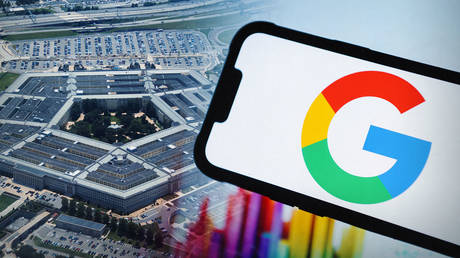
Google just walked back into the line of fire. After years of trying to play the role of the "don't be evil" tech giant that keeps its hands clean of military combat, the company is doubling down on its partnership with the Department of Defense. This isn't just about moving files to the cloud or fixing an email server. This is about artificial intelligence.
The latest reports confirm that Google has secured a significant deal with the Pentagon to provide AI-driven capabilities. It’s a move that feels like a massive pivot from the internal revolts of 2018. If you remember, back then, thousands of Google employees signed a petition against Project Maven. They didn't want their code helping drones identify targets. It was a PR nightmare. Google eventually pulled out. They even wrote a set of "AI Principles" to prove they were the good guys.
But times change. The world feels more dangerous now. The tech industry's moral high ground is getting smaller as the need for national security tech grows. Google’s new involvement suggests those 2018 principles might have been more like suggestions.
Why the Pentagon wants Google so badly
The military doesn't just want Silicon Valley’s money. It wants its brains. Traditional defense contractors like Raytheon or Lockheed Martin are great at building missiles and jets. They aren't always the best at deep learning or neural networks. Google is.
Google’s AI can process data at a scale that makes human analysts look like they’re using an abacus. In a modern conflict, the side that identifies a threat five seconds faster wins. The Pentagon realizes that if they don't use these tools, their adversaries will. It's a classic arms race, just with algorithms instead of gunpowder.
The deal likely focuses on "situational awareness." That sounds like boring corporate speak, but it means using AI to scan thousands of hours of satellite imagery or drone footage to find things that shouldn't be there. It's about pattern recognition. It's about finding the needle in the haystack before the haystack moves.
The end of the Silicon Valley neutrality myth
For a long time, tech companies tried to act like they were above the fray. They were global citizens. They served the world, not just the Pentagon. That era is dead.
Look at the current geopolitical climate. Between the competition with China and the conflicts in Europe and the Middle East, the U.S. government is leaning hard on big tech. They’ve basically told Google, Microsoft, and Amazon that being a "neutral platform" isn't an option anymore. You're either helping the home team or you're getting out of the way.
Microsoft and Amazon have been doing this for years. They fought a multi-billion dollar war over the JEDI cloud contract. Google was the holdout. They were the ones who cared about employee sentiment. Now? It looks like the lure of massive government contracts and the pressure to be a "patriotic" company outweighed the fear of another office walkout.
What happened to the AI Principles
Google’s own rules say they won't build AI for weapons. They won't build tech that causes "overall harm." So, how do they justify this?
They usually frame it as "non-combat" support. They'll say the AI is for logistics, or healthcare for veterans, or cybersecurity. It’s a grey area. If an AI helps a truck get to the front lines faster, is that a weapon? If it helps a commander make a decision based on data, is that "harm"?
I’ve seen this play out before in other industries. You start with the most innocent use case possible to get your foot in the door. Once the infrastructure is built, the line between "logistics" and "targeting" gets very blurry. Honestly, it’s a distinction without a difference in the eyes of a soldier on the ground.
Internal pushback is coming
You can bet the folks at Google’s Mountain View campus aren't all happy about this. The culture there is built on a certain level of idealism. When you hire the smartest people in the world and tell them they’re making the world better, they tend to notice when you start working with the Department of Defense.
Expect more leaked memos. Expect some high-profile resignations. But don't expect Google to cancel the contract. The leadership has likely decided that the revenue and the strategic importance of being a defense partner are too big to ignore. They’re willing to weather a few weeks of bad headlines for a decade of government checks.
The real risk is the black box
The biggest problem with AI in the military isn't just "killer robots." It’s the lack of transparency. When a human makes a mistake in combat, there's a paper trail. There’s a chain of command. When an AI makes a mistake—due to biased data or a "hallucination"—who is responsible?
If Google’s AI misidentifies a civilian vehicle as a threat, does the blame lie with the programmer in California or the operator in the field? We don't have answers for this yet. We're building the plane while we're flying it. That’s terrifying when the plane is armed.
Actionable steps for the tech-conscious
If you're an investor, a developer, or just someone who cares about where this is going, you can't just ignore it.
- Watch the contract language. Whenever these deals are announced, look for what they don't say. Look for terms like "dual-use" or "decision support."
- Track the AI Act. Governments are trying to regulate AI. Keep an eye on whether military AI gets a "blank check" exemption from these rules.
- Pressure for transparency. If you own stock in these companies, ask about the ethical guardrails. Not the PR-friendly ones, the real ones.
The Google-Pentagon partnership is a signal. It tells us that the "tech utopia" is over and the "tech arsenal" is here. You don't have to like it, but you do have to understand it. This deal is just the beginning of a much deeper integration between the code that runs our lives and the tech that runs our wars.
Check the quarterly reports. Watch the board reshuffles. The shift is happening right now.