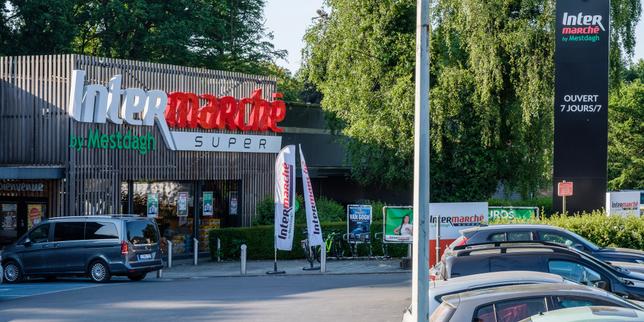
The lights in a supermarket never actually turn off; they just dim to a ghostly hum, illuminating rows of colorful boxes that promise a better life, a faster dinner, or a cleaner home. But for a handful of independent shopkeepers in Belgium, those lights are starting to feel like the glare of an interrogation room. They are the franchisees of Intermarché, men and women who bought into a dream of Gallic efficiency and Musketeer-style solidarity, only to find themselves staring at ledgers that bleed red.
Think of Marc. He isn't real, but he is the composite of every nervous owner currently pacing their stockroom in the quiet hours of a Tuesday morning. Marc spent twenty years building a local grocery business. When Intermarché aggressive expanded into the Belgian market—notably through the massive acquisition of the Mestdagh group—Marc saw a lifeline. He saw the power of a multinational. He saw "Les Mousquetaires" and their promise of collective strength.
He signed the papers. He changed the signs. He put on the uniform.
Now, Marc sits in a small office tucked behind the dairy section, looking at a supply chain that feels less like a partnership and more like a chokehold. The shelves are stocked, but the margins are razor-thin. The "Mestdagh transition" was supposed to be a triumph of integration. Instead, it has become a case study in how a corporate giant can underestimate the friction of local reality.
The Weight of the Logo
Business reporting often treats mergers like a game of Tetris, where blocks simply click into place. But in the real world, these blocks are made of people, unions, and decades of ingrained culture. When Intermarché swallowed the Mestdagh stores, they didn't just buy floor space; they inherited a complex web of labor agreements and a workforce that viewed the "franchise" model with deep suspicion.
In Belgium, the shift from integrated management—where the company owns everything—to a franchise model is often seen as a way to sidestep heavy labor costs. For the unions, it is a declaration of war. For the franchisee, it is a tightrope walk. You are given the brand and the products, but you also inherit the debt and the social tension.
The numbers coming out of the Belgian sector aren't just dry data points. They represent a systemic struggle. Several franchisees are currently in "grave difficulty," a polite corporate euphemism for the fact that they are drowning. Some have already seen their stores taken back over by the central group because the independent owners simply couldn't make the math work.
Why? Because a supermarket is a living, breathing organism. If the cost of goods from the central warehouse rises by 5%, but the local competition—the Colruyts and Delhaizes of the world—is engaged in a race to the bottom on price, the franchisee is the one who gets crushed in the middle. They are the shock absorbers for a corporate engine that is revving too high.
The Invisible Margin
Consider the logistics of a single crate of oranges. In a perfectly optimized world, that crate moves from a Spanish grove to a Belgian shelf with the grace of a ballet dancer. But under the current strain, the choreography is falling apart.
Franchisees have complained about supply issues, about being forced to take inventory they didn't ask for, and about a pricing structure that seems designed to benefit the parent company's global balance sheet rather than the local shop's survival. It is a classic power imbalance. The "Mousquetaire" spirit—one for all and all for one—starts to feel a lot like all for one, and the "one" isn't the guy working seventy hours a week to manage the checkout lines.
The problem is compounded by the Belgian consumer's psyche. In a country where the cost of living has squeezed wallets to the breaking point, loyalty to a brand is a luxury few can afford. If Intermarché cannot offer the lowest price because its internal costs are too high, the customer walks across the street.
The franchisee watches them go.
They watch the automatic doors slide shut, knowing that every lost customer is a step closer to a bankruptcy filing or a forced "re-integration" back into the corporate fold. It is a slow-motion crisis. It doesn't happen with a bang; it happens with a slightly emptier produce section and a manager who stops sleeping through the night.
A Culture Clash in the Cold Chain
There is a fundamental difference between a manager and an owner. A manager follows the manual. An owner feels the vibrations of the floor. Intermarché’s model relies on the "adherent" system, where store owners also participate in the high-level management of the group. It is a unique, democratic approach to retail that worked wonders in France for decades.
But Belgium is not France.
The Belgian retail landscape is a dense, hyper-competitive jungle. The integration of the Mestdagh stores brought in a workforce that was used to a different set of rules. Forcing the "Mousquetaire" DNA onto a system that was already struggling resulted in a biological rejection.
The central group in France might see a successful expansion on their year-end slides. They see more dots on the map. But zoom in on those dots, and you see the stress fractures. You see owners who feel they were sold a map to a treasure chest, only to find the chest is empty and the map is written in a language they don't fully speak.
The tension is palpable in the regional meetings. These aren't just discussions about "synergy" or "logistical optimization." These are heated confrontations about survival. When a franchisee points out that their energy bills have tripled while their margins have halved, a corporate directive about "brand consistency" feels like being told to worry about the color of the deck chairs on the Titanic.
The Fragility of the Neighborhood Hub
We often forget that a supermarket is more than a place to buy milk. In many Belgian towns, it is the last remaining anchor of the community. It’s where the elderly lady at the end of the block has her only conversation of the day. It’s where the local teenagers get their first jobs.
When a franchisee fails, that anchor is ripped up.
If Intermarché continues to see its Belgian partners struggle, the "Mousquetaire" model itself faces a crisis of credibility. If the independent owner cannot thrive, the system reverts to a standard corporate monolith—a soulless machine that cares more about the stock price in Paris than the quality of the bread in Charleroi.
The struggle currently unfolding in the Belgian aisles is a warning. It is a reminder that you cannot scale human ambition with a spreadsheet. You cannot buy loyalty; you have to earn it through shared risk. Right now, the risk feels entirely lopsided.
Marc, our hypothetical owner, stands at the front of his store as the evening rush begins. He sees his neighbors, his friends, and his staff. He wants to believe in the brand on his shirt. He wants to believe that the giants in the boardroom have his back. But as he looks at the rising costs and the thinning crowds, he realizes that a name is just a name.
A sign can be changed in a day.
Building a life’s work takes decades. Losing it takes only a few bad quarters and a partner who stopped listening. The lights in the store hum on, indifferent to the struggle, casting long shadows across the floor where the dream of the Musketeers is quietly being tested to its breaking point.