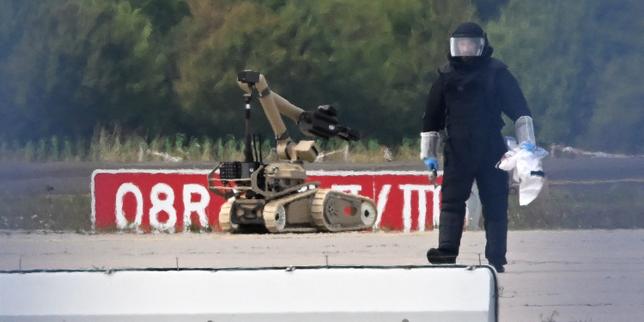
The explosive-laden drone rested quietly on the tarmac of Leipzig/Halle Airport just feet away from a Ukrainian cargo aircraft. It was August 4, and only a sheer stroke of mechanical failure prevented a catastrophic explosion that would have rewritten the security architecture of Western Europe. Weeks later, the German government formally pointed its finger at Moscow, stripping away any remaining diplomatic illusions about the boundaries of modern hybrid warfare. European Union officials labeled the failed strike for what it fundamentally represents: state-sponsored terrorism on Western soil.
This was not a rogue operation carried out by isolated actors. Investigative findings presented by Berlin point directly to a coordinated plot orchestrated by Russian intelligence services, utilizing low-level proxy operatives recruited to mask state responsibility. The target was deliberate. Leipzig/Halle Airport functions as an essential civilian freight center and a primary logistical backbone for NATO military hardware destined for Ukraine. Destroying a Ukrainian Antonov transport plane on German pavement was designed to send a chilling message to Berlin and Brussels. The message was simple. No infrastructure in Europe is safe from infiltration, and political support for Kyiv carries an immediate physical cost.
European foreign policy leaders faced an uncomfortable reality upon receiving the intelligence dossiers. Decades of post-Cold War security assumptions have dissolved into a new normal defined by deniable sabotage, cyber intrusions, and targeted kinetic attacks. Interior Minister Alexander Dobrindt noted that the components, the configuration of the hexogen explosives, and the detonator design matched patterns identified across multiple thwarted operations throughout the continent. The tradecraft bore the fingerprints of specialized military engineering units operating under deep cover. Yet, the Western response remains trapped in a bureaucratic loop.
Diplomats scrambled to draft countermeasures while acknowledging the severe limitations of traditional deterrence against an adversary willing to operate below the threshold of conventional war. Germany announced the immediate closure of the sprawling Russian consulate general in Bonn, a sprawling facility historically tied to Soviet-era intelligence networks. Leases for cultural institutions functioning as propaganda and coordination fronts in Berlin face termination. Stricter visa vetting procedures and tighter border controls for Russian nationals are finally rolling out, long after security analysts warned that intelligence operatives easily exploit open European borders using tourist credentials from third countries.
Yet these punitive steps look increasingly like historical relics applied to a modern crisis. Closing a consulate building does little to disrupt decentralized cell structures utilizing commercial drones bought off the shelf and modified with military-grade explosives. The European Commission pushes forward with yet another package of economic sanctions targeting shadow fleet oil tankers and industrial supply chains, hoping financial pressure will alter the Kremlin's strategic calculus. That hope ignores foundational principles of state behavior during existential conflicts. Economic penalties rarely stop covert sabotage operations that cost relatively little to execute and yield high psychological dividends for authoritarian regimes.
The broader security landscape reveals a systemic vulnerability that goes far beyond a single foiled drone attack in Saxony. Within a span of forty-eight hours surrounding the Berlin announcement, critical infrastructure across Europe faced parallel shocks, including mysterious power grid disruptions and suspicious fires at logistics hubs. Security agencies across Poland, the Baltic states, and Germany are overwhelmed by an escalating volume of low-signature incidents. Each individual event is managed as a localized criminal investigation, while the collective pattern points to a continuous, institutionalized campaign of destabilization designed to exhaust Western political will.
Western capitals remain paralyzed by the fear of escalation. Invoking collective military responses risks dragging nuclear-armed adversaries into an open confrontation, a threshold NATO explicitly seeks to avoid. This hesitation creates a strategic vacuum. When state-sponsored sabotage carries no proportionate kinetic consequence, the aggressor calculates that the risk of experimentation is near zero. The Leipzig drone incident exposed the fragile gap between rhetorical solidarity and effective deterrence.
Europe stands at a dangerous historical crossroads where conventional diplomacy no longer functions as a shield. The illusion that economic integration and open societies could insulate the continent from great power conflict has shattered on a concrete runway in eastern Germany. As intelligence services race to map out remaining sleeper cells and trace the financial pipelines funding these proxy networks, the underlying structural weakness remains unaddressed. Until Western democracies develop a credible framework to impose immediate, severe costs for hybrid aggression, the drone on the tarmac will not be an aberration. It will be the opening chapter of a prolonged war of attrition fought quietly in the shadows of civilian airports and critical supply lines.