For decades, condensed-matter physics has relied on a comforting illusion. We assumed that when collective electronic states recover inside an ultra-cold lattice, they do so with uniform predictability. A team of physicists led by Nuh Gedik at the Massachusetts Institute of Technology just shattered that assumption. By firing ultrafast laser pulses into a rare-earth crystal called erbium tritelluride, these researchers watched electrons rebuild themselves from absolute chaos. What they found was not a singular, orderly march back to equilibrium, but a fractured structural rebellion where one electronic phase behaves like steady vapor while another freezes outward like jagged ice crystals.
Understanding this mechanism requires stepping past the surface-level hype and looking directly at what happens when matter is forced out of equilibrium at minus 230 degrees Celsius.
The Atomic Checkerboard and the Cryogenic Trap
To grasp the weight of this observation, look closely at the material itself. Erbium tritelluride naturally hosts what physicists call charge density waves, or CDWs. These are not electrical currents streaming through a wire. Instead, they represent a spontaneous reorganization of spatial charge, where electron density ripples across the atomic lattice in alternating crests and troughs.
When cooled to roughly minus 8 degrees Celsius, the material forms a dominant charge density wave running in a single direction. Cool it further down to minus 113 degrees Celsius, and a second, perpendicular wave emerges. Together, they lock into an atomic-scale checkerboard of overlapping quantum orders.
To observe how these competing phases negotiate their coexistence, the MIT group cooled thin crystal samples down to minus 230 degrees Celsius. At this extreme thermal floor, both waves coexist natively. Then, the researchers introduced a violent disruption: an initial laser pulse designed to shake the system and melt the checkerboard entirely. A second, high-energy probe pulse systematically kicked electrons out of the material at staggered intervals, allowing the team to reconstruct snapshots of the recovery process.
Two Populations, Two Entirely Different Rules
The resulting data exposed a profound divergence in how quantum materials heal. The dominant charge density wave followed textbook physics. Regardless of how aggressively the initial laser pulse scrambled the system, this primary phase crept back smoothly, evenly, and uniformly across the entire sample simultaneously. It acted as a classic second-order phase transition, mirroring the steady way a magnet loses its magnetic pull as thermal energy rises.
Then came the anomaly. The subdominant, perpendicular wave ignored every standard rule of electronic recovery.
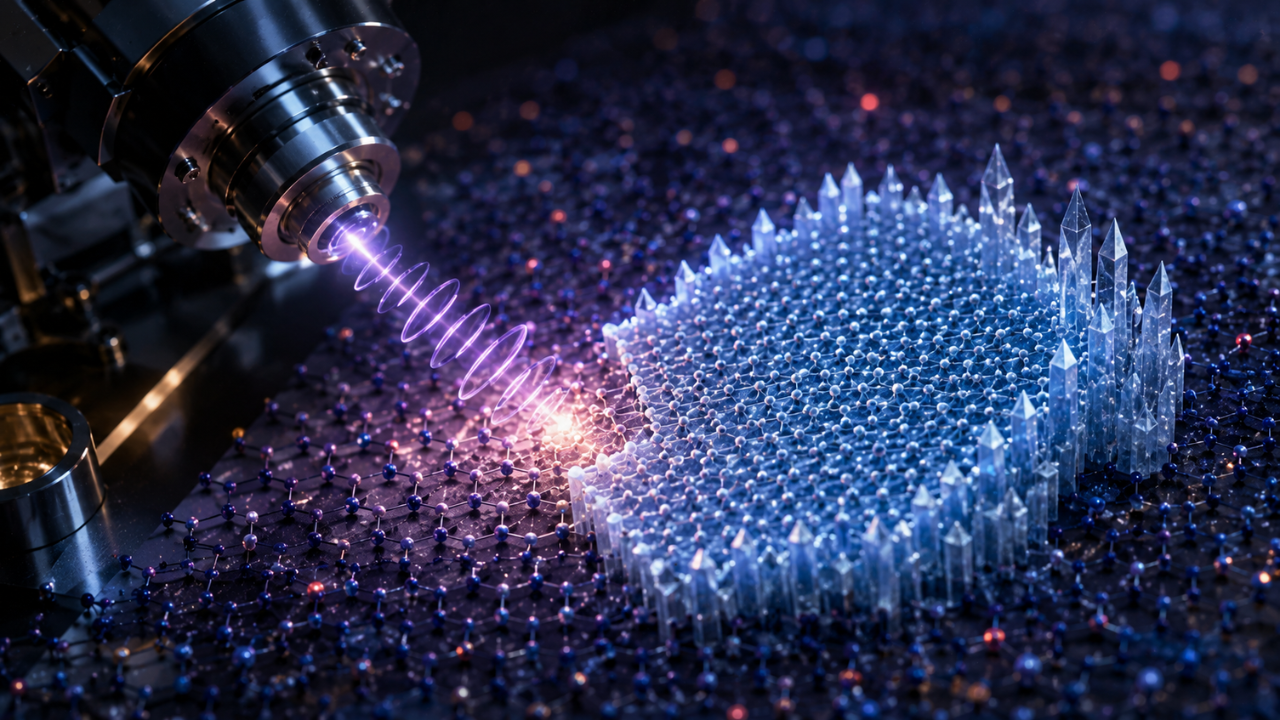
Instead of spreading uniformly across the crystal matrix, this secondary phase nucleated. It formed in isolated, scattered pockets that slowly expanded outward, colliding and merging until they reclaimed the lattice. This is a first-order phase transition. It is the exact physical mechanism liquid water uses when foreign seeds prompt it to crystallize into solid ice.
For years, theorists debated whether this subdominant wave formed through uniform field suppression or localized nucleation. By capturing the recovery in real time, the MIT experiment settled the debate. Electrons in competing phases do not share a single developmental language.
Why This Changes the Hunt for Next-Generation Electronics
Skeptics often dismiss these ultra-cold quantum dynamics as academic exercises far removed from practical utility. That perspective misses the broader trajectory of material science. Charge density waves serve as a clean, manageable laboratory stand-in for more complicated collective phenomena, most notably superconductivity.
Superconductivity relies on electrons pairing up and moving through a substrate with absolute zero resistance. Yet, achieving and controlling that state requires understanding how distinct electronic orders cooperate, compete, and share a single physical space without destroying one another. When multiple phases coexist, their boundaries dictate whether a material conducts efficiently or breaks down entirely.
By proving that coexisting electronic states can use fundamentally disparate assembly lines—one spreading as an unbroken field, the other growing via localized crystal seeds—this research provides engineers with a new framework for manipulating quantum phases. If we intend to design functional materials that eventually supersede silicon, we must learn to engineer these microscopic phase boundaries deliberately rather than treating them as unpredictable background noise. The ice-like freezing of electrons inside erbium tritelluride proves that quantum order is far more structurally diverse than our models previously admitted.
The equations on our whiteboards are finally catching up to the stubborn, beautiful complexity of the physical substrate].