Power rarely surrenders quietly. When street-level momentum collides with institutional inertia, something has to break. Last week, that fracture point arrived in New Delhi when the union education minister tendered his resignation. This unprecedented political exit followed months of relentless pressure from a decentralized student collective known colloquially as the Cockroach movement.
For years, standardized testing corruption, administrative bloat, and systemic employment anxieties have hollowed out the ambitions of millions of young citizens. This article breaks down the mechanics behind the movement, the structural failures that fueled it, and why traditional political playbooks failed to contain a generation refusing to be silenced.
The Anatomy of a Grassroots Uprising
Traditional political resistance relies on hierarchies. Leaders emerge, committees form, and manifestos get drafted in smoke-filled backrooms. The Cockroach movement rejected every single one of these conventions by design.
Named pejoratively by critics who claimed the protesters were impossible to exterminate, the collective embraced the moniker. They adapted the survival tactics of insects to digital and physical organizing. There was no single president to arrest. No central headquarters to raid. When authorities shut down one social media hashtag, ten others spawned across regional platforms within minutes.
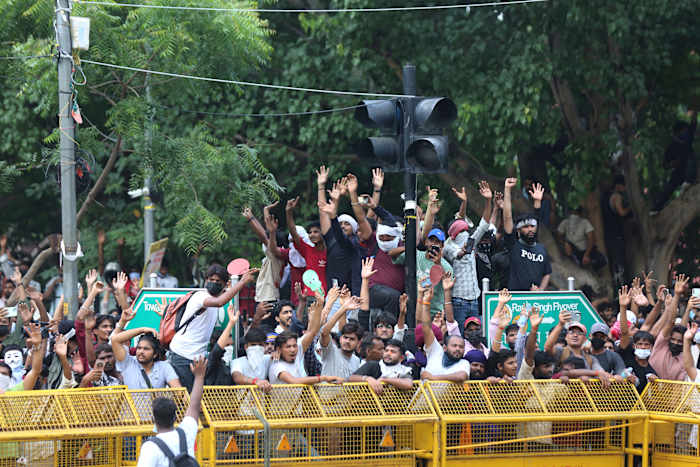
Examinations leaked with alarming regularity. Millions of candidates spent years preparing for civil service or university entrance tests, only to watch slots get sold to the highest bidder or canceled due to institutional incompetence. The resulting fury transcended regional, linguistic, and economic divisions. Rural mechanics sat shoulder-to-shoulder with urban coders on blocked railway tracks.
+-------------------------------------------------------------+
|               THE DYNAMICS OF DECENTRALIZED PROTEST         |
|                                                             |
|   [Leaked Exams] ---> [Mass Frustration] ---> [Flash Mobs]  |
|                                                     |       |
|   [Zero Leaders] <--- [Digital Swarms] <------------+       |
|         |                                                   |
|         v                                                   |
|   [Political Capitulation]                                  |
+-------------------------------------------------------------+
Why the Old Guard Missed the Warning Signs
Cabinets are insulated by design. Bureaucrats enjoy air-conditioned offices far removed from the sweltering coaching centers of Kota or Patna. Decade after decade, leadership treated youth unemployment as a statistical inconvenience rather than an existential crisis.
Economists pointed to gross domestic product growth numbers on paper. Students looked at their empty bank accounts and stagnant career prospects in reality. The disconnect widened into an unbridgeable chasm.
When the education ministry dismissed early protests as localized disruptions orchestrated by opposition parties, they committed a fatal miscalculation. They failed to realize that this generation does not trust legacy institutions. Trust is zero-sum, and the state had spent decades squandering its reserves.
The Economics of Despair
To understand why a resignation happened now, look at the mathematics of modern opportunity.
- The Supply-Demand Mismatch: Millions compete for a few thousand government positions annually.
- The Coaching Mafia: An unregulated multi-billion-dollar private tutoring complex preys on parental anxiety.
- The Integrity Deficit: Constant paper leaks turn meritocracy into a cruel lottery.
When education ceases to be an elevator for social mobility and transforms into a debt trap, social contracts rupture. The minister's departure is merely a symptom of a deeper governance failure.
The Digital Infrastructure of Resistance
Governments used to control the narrative by controlling the broadcast towers. That monopoly evaporated.
Youth organizers bypassed mainstream news networks entirely. They utilized end-to-end encrypted messaging channels to coordinate flash demonstrations, share legal aid resources, and document police overreach in real-time. Every baton charge was recorded, uploaded, and amplified globally within seconds.
The state found itself fighting a ghost. Traditional censorship mechanisms—designed for newspaper offices and television studios—proved entirely useless against a fluid, peer-to-peer network operating across multiple languages and jurisdictions.
What Happens Next in the Corridors of Power
A resignation does not fix a broken system. The underlying structural rot remains untouched by the exit of a single politician.
New leadership inherits an angry electorate that expects immediate systemic overhaul, not empty promises or cosmetic committee formations. If the administration fails to sanitize the testing agencies, decentralize academic evaluation, and create legitimate economic avenues for youth, the next wave of dissent will not stop at a ministerial resignation.
The cockroaches survived the spray. Now they are inside the kitchen.