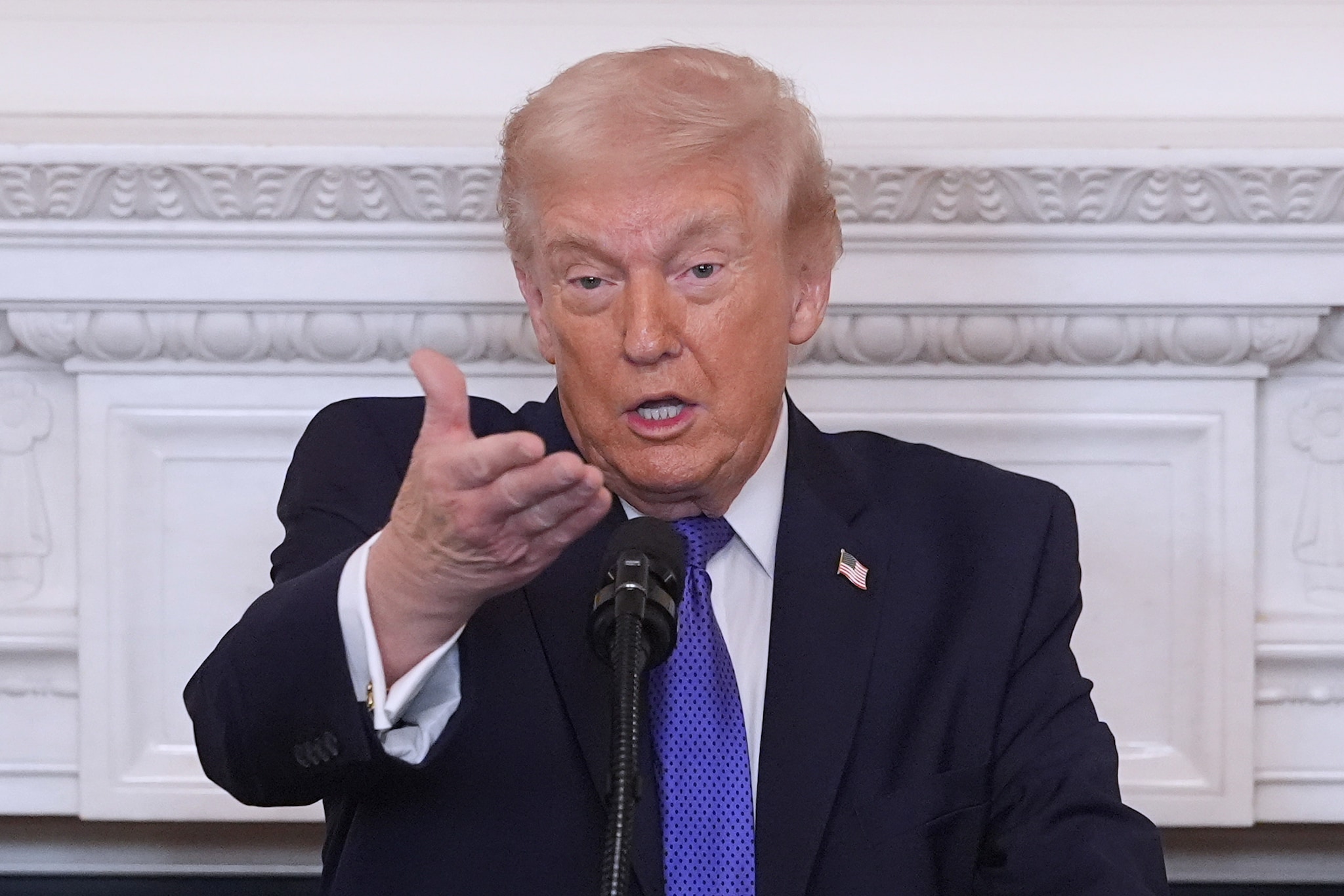
The ink on a diplomatic cable is never just ink. It is the weight of millions of lives, the stillness of a city at night, and the fragile hope that a handshake in a gold-trimmed room actually means something to a mother in Tehran or a student in Washington. When Donald Trump stood before the world to announce that Iran had agreed to "no nuclear weapons," the air in the briefing room didn't just carry words. It carried the ghost of a conflict that has simmered for forty years.
We often treat geopolitics like a chess match played with cold, wooden pieces. We look at the maps, the enrichment percentages, and the range of ballistic missiles as if they are abstract data points. They aren't. Every percentage point of uranium enrichment is a tightening of a global knot. Every tweet and every press conference is a vibration sent down a wire that connects a farmer in the Midwest to a shopkeeper in a Persian bazaar.
Consider a hypothetical watchmaker in a small workshop. His name is irrelevant, but his precision is everything. To him, the world is a series of gears that must mesh perfectly to keep time. If one tooth breaks, the entire mechanism fails. Diplomacy operates on the same terrifyingly thin margin. For years, the gears between the West and Iran have been grinding, throwing off sparks, and threatening to seize up entirely.
The core of the recent announcement isn't about the technical specifications of a centrifuge. It is about the admission of a shared reality. By stating that Iran had agreed to forgo the pursuit of a nuclear arsenal, the administration wasn't just reporting a policy shift; they were claiming a momentary lull in a storm that has been brewing since 1979.
The stakes are invisible until they aren't.
You don't feel the tension of a nuclear-armed Middle East when you are buying groceries or driving to work. It exists in the background, a low-frequency hum that most of us have learned to tune out. But for the people tasked with monitoring the "breakout time"—the duration it would take for a nation to produce enough fissile material for a bomb—that hum is a deafening roar.
When the news broke that talks were continuing under the premise of a non-nuclear Iran, that roar dipped into a whisper.
Critics often point to the volatility of these declarations. They argue that a verbal agreement is a house built on sand. They aren't wrong. Trust in the international arena isn't a feeling; it is a ledger of verified actions. Yet, there is a human element to the "art of the deal" that transcends the ledger. It is the ego of leaders, the desperation of sanctioned economies, and the simple, primal desire to avoid a catastrophic fire.
History doesn't move in a straight line. It stutters. It loops.
Take a moment to look at the numbers, not as statistics, but as a measure of pressure. Sanctions are often described as "surgical," but for a family trying to buy imported medicine or a small business owner watching their currency evaporate, they feel like a blunt instrument. The pressure of these economic constraints is what pushes a government to the table. It is a slow, grinding squeeze that forces a choice: the pride of a weapon or the survival of the marketplace.
The announcement suggested that the squeeze might be working, or at least, that the pressure had reached a point where the conversation had to change.
"No nuclear weapons."
It’s a simple phrase. Four words. But beneath them lies a labyrinth of verification protocols, satellite imagery, and the silent work of inspectors who spend their lives in the bowels of concrete facilities, checking seals and counting canisters. These people are the real characters in this story. They are the ones who bridge the gap between a politician’s boast and the physical reality of a laboratory.
The skepticism that follows such a bold claim is healthy. It is the armor we wear to protect ourselves from disappointment. We have seen treaties torn up before. We have seen "red lines" crossed and "final warnings" ignored. The human brain is wired to recognize patterns, and the pattern of the last several decades has been one of escalation followed by a brief, gasping retreat.
But there is something different about the current friction. It feels more personal. It is driven by a style of diplomacy that favors the spectacle over the slow, bureaucratic crawl of traditional statecraft. This is high-stakes poker played on a global stage, where the "all-in" isn't just chips—it's the stability of the global oil market and the safety of entire zip codes.
If we look past the podium and the cameras, what remains?
We find a world that is exhausted by the threat of "what if." We find a generation of people who have grown up with the shadow of a mushroom cloud as a metaphorical backdrop to their entire lives. For them, the nuance of whether a deal is a "Memorandum of Understanding" or a "Joint Comprehensive Plan of Action" matters far less than the simple assurance that the horizon won't turn to fire.
The path forward is never a paved highway. It is a narrow mountain trail, slick with the ice of past grievances. One side demands total capitulation; the other demands respect and the lifting of the knee from their neck. Finding a middle ground isn't just a political feat; it’s a psychological one. It requires both parties to believe that they are winning, or at least, that they are losing less than they would if they walked away.
Negotiations are ongoing. That phrase is the heartbeat of the story.
As long as the talking continues, the shooting doesn't start. The silence of a laboratory is better than the sound of an air-raid siren. We live in the space between those two sounds.
The "core facts" of the President’s statement are easy to find, but the truth of the situation is felt in the gut. It is the realization that we are all tethered to the same volatile cord. When a leader says a door has opened, we all lean in to see if there is light on the other side, even if we suspect it might just be another mirror.
The invisible stakes are the lives we lead while these giants argue. It is the birthday party that happens because a war didn't start. It is the investment made in a new business because the world felt, for one Tuesday afternoon, slightly more stable than it did on Monday.
We are witnesses to a long, grinding evolution of power. The era of cold wars and proxy battles hasn't ended; it has simply changed its vocabulary. We talk of "maximum pressure" and "strategic patience," but we are really talking about the same thing humans have talked about since we first gathered around a fire: how to keep the person across from us from picking up a stone.
The watchmaker in his shop understands that even the most complex machine is just a collection of simple parts working toward a single goal. In the machinery of global peace, the goal is survival. The parts are the men and women sitting in rooms in Geneva, Vienna, or Washington, trying to find a sequence of words that everyone can live with.
Sometimes, they find those words. Sometimes, they just buy more time.
The sun sets over the Potomac and the Alborz mountains regardless of what is said at a press conference. The people beneath those skies continue their lives, mostly unaware of how close the gears came to snapping. They go to sleep trusting that the world will be there in the morning, a trust that is built on the fragile, shifting foundation of a few sentences uttered by a man at a microphone.
There is no finality in this. There is only the continuation. The talks proceed. The centrifuges may slow or they may spin, but for a brief moment, the narrative was one of restraint. In a world that often feels like it is accelerating toward a cliff, any mention of a brake is a story worth telling.
It is the story of the line we refuse to cross, held together by nothing more than the hope that the person on the other side wants to see tomorrow just as much as we do.