The High-Stakes Choreography of 240,000 Miles
Imagine standing in a pitch-black room, holding a needle. Across the hallway, through a series of open doors, another person is holding a single thread. You cannot see them. You can only hear the faint, crackling instructions of a third person over a radio, telling you to move a millimeter to the left, then a fraction of a degree up. Now, imagine you are both traveling at thousands of miles per hour.
That is the reality of docking in deep space. It is a violent, silent ballet where the smallest miscalculation doesn't just result in a missed connection—it results in a catastrophe that can be seen from Earth.
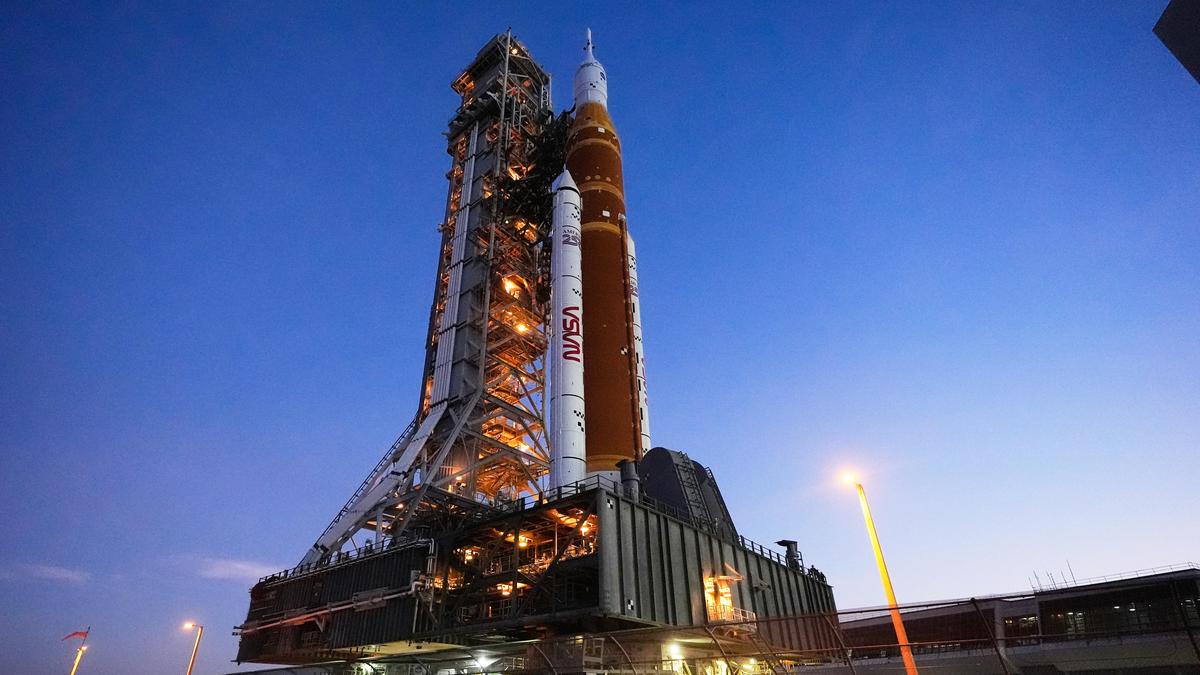
NASA recently looked at the blueprints for its return to the Moon and realized the margin for error was too thin. The Artemis program, the spiritual and literal successor to the Apollo missions of the 1960s, is no longer just a series of "flags and footprints" events. It is a massive, multi-billion-dollar construction project in the sky. To ensure the safety of the men and women stepping into the void, the agency has overhauled its flight manifest. They aren't just changing dates; they are inserting a ghost mission to prove we can actually stick the landing.
The Fragile Architecture of Artemis
The original plan for Artemis III—the mission intended to put boots back on lunar soil—was an exercise in extreme confidence. It required the Orion capsule, carrying the crew, to meet a massive Starship HLS (Human Landing System) in lunar orbit. They would click together like Lego bricks, the astronauts would crawl through the hatch, and then descend to the surface.
But space is rarely that cooperative.
When engineers at Johnson Space Center ran the numbers, the complexity of that first "handshake" in the lunar vicinity started to look like a gamble. We haven't docked two massive, crewed vehicles around the Moon in over fifty years. The physics haven't changed, but the equipment has. The Orion is a marvel of modern computing, but the Starship is a tower of stainless steel the size of a skyscraper.
The new strategy involves a dedicated docking test mission. This isn't a delay in the traditional sense; it’s a realization that you don't test your parachute for the first time after you've jumped out of the plane. NASA decided that before a crew ever enters that lunar lander, the two ships must prove they can find each other, talk to each other, and lock together in the cold vacuum of space without a single hiccup.
A Lesson Bought in Liquid Oxygen
Why the sudden caution? To understand the stakes, you have to look at the "invisible" side of space travel: the fuel.
Unlike the Apollo missions, which carried all their fuel with them in one go, the Artemis architecture relies on a "filling station" model. To get something as heavy as the Starship to the Moon, SpaceX has to launch multiple "tanker" flights to Earth orbit just to top off the tanks before the long trek. Every one of those launches is a point of failure. Every docking maneuver is a moment where a thruster could stick or a sensor could go blind.
Consider a hypothetical engineer named Sarah. She sits in a clean room in Houston, staring at telemetry data that looks like a heartbeat. Her job is to ensure that when the Orion approaches the Starship, the relative velocity is low enough that they don't crush each other, but high enough that the latches engage.
If Sarah sees a deviation of even one percent in the approach angle, the mission is aborted. If they abort at the Moon, there is no easy way home. By adding a preliminary docking test in Earth orbit, NASA is giving Sarah and her team a "practice swing." They will launch a Starship and an Orion-like simulator to see how these two giants interact. They will push them, pull them, and see if the software can handle the literal weight of the moment.
The Ghost of Apollo and the Reality of Now
There is a tendency to look back at 1969 with a sense of "if we did it then, why is it so hard now?"
The answer lies in the destination. Apollo was a sprint to the finish line. Artemis is the beginning of a marathon. We aren't going to the Moon to stay for a weekend; we are going to build a base at the South Pole, where the shadows are long and the ice is hidden in craters that haven't seen sunlight in a billion years.
The South Pole is a treacherous neighborhood. The terrain is rugged, and the lighting is deceptive. To land there, the docking must be perfect because the fuel margins are razor-thin. If the crew spends too much time trying to link up in orbit, they lose the window to go down to the surface.
NASA's overhaul of the manifest also shifts the timeline for the Gateway—a small space station that will eventually orbit the Moon. By prioritizing the docking test and the initial landings, they are admitting that the "house" (the Gateway) can wait, but the "car" (the lander) must be bulletproof.
The Human Cost of Precision
We often talk about these missions in terms of billions of dollars or "launch windows." We rarely talk about the silence in the room when a docking sequence begins.
When those two crafts are drifting toward each other, the astronauts inside the Orion are looking through a small window or at a screen. They are strapped into seats, feeling the subtle vibrations of the RCS thrusters—the tiny puffs of gas that steer the ship. They are trusting millions of lines of code written by people they will never meet.
The decision to add a test mission is an act of humility. It is an admission that despite our fancy simulations and our powerful rockets, the vacuum of space is still the ultimate arber of truth. It doesn't care about political deadlines or budget cycles. It only cares about physics.
By shifting the Artemis III objectives and inserting this new milestone, the agency is protecting the people inside the suits. It’s a move that recognizes that the most valuable cargo on any rocket isn't the scientific instruments or the lunar rovers—it’s the three or four human beings who want to come home and tell their children what the Earth looks like from the bottom of the Moon.
The Long Road to the South Pole
The manifest change means the lunar landing might slip further into the decade. For those of us watching from the ground, impatient for that "giant leap" moment, it can feel like a setback. But for the people at the tip of the spear, it feels like a breather.
They are now looking at a path that includes:
- Artemis II: A crewed loop around the Moon, proving the life support systems can keep humans alive for ten days in deep space.
- The Docking Test: A high-stakes rehearsal in Earth orbit to ensure the "handshake" works.
- Artemis III: The actual descent to the lunar South Pole.
This sequence is logical. It is methodical. It is the way you build a bridge—one pylon at a time, testing the weight-bearing capacity of each before you lay the road.
As we look toward the 2020s, the Moon is no longer a distant silver coin in the sky. It is a construction site. The cranes are being built, the foundations are being poured, and the workers are practicing their trades. The invisible tether between Earth and its satellite is being pulled taut, and for the first time in a generation, we are making sure we know how to hold on.
The next time you look up at a crescent moon, realize that somewhere in a lab or a simulator, a pilot is practicing that millimeter-perfect move. They are learning how to bridge the gap between two ships in the dark. They are making sure that when the time comes to finally step out into the grey dust of the South Pole, the door behind them is locked tight to the ship that will bring them back.
The thread is moving toward the needle. We are just making sure our hands are steady.