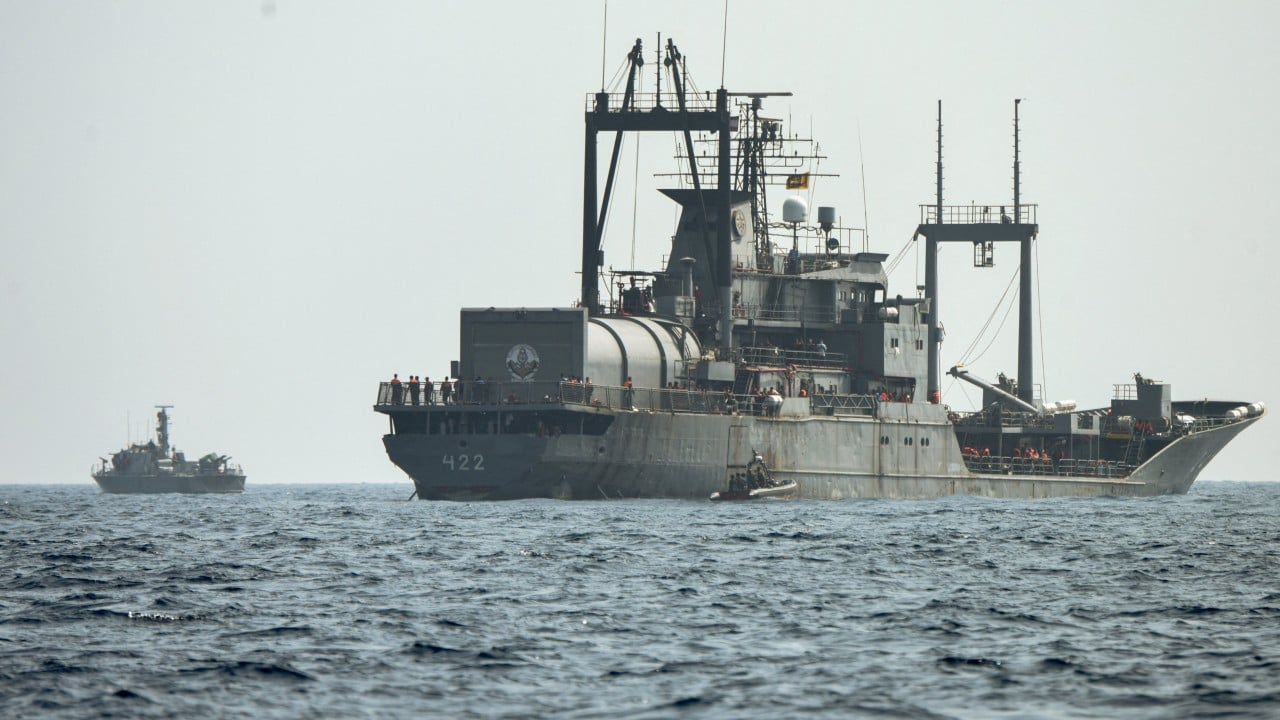
The Persian Gulf just got a lot quieter, at least for a moment. You’ve probably seen the grainy footage by now. A massive, lumbering vessel—a converted commercial cargo ship the Iranian Revolutionary Guard Corps (IRGC) tried to pass off as a high-tech "drone mothership"—erupted into a fireball. The US military didn't just disable it. They erased it. This wasn't some accidental collision or a technical glitch. It was a calculated, overwhelming display of force against a vessel that represented Iran’s latest attempt at asymmetric naval warfare.
The ship in question, the Behshad, or one of its "Frankenstein" siblings, was never built for the heat of a real naval engagement. It was a merchant hull draped in the ornaments of war. It carried tracked launchers, shipping containers packed with suicide drones, and enough surveillance gear to act as a floating nerve center for Houthi rebels. But when the US decided the provocation had gone too far, the "mothership" proved to be nothing more than a giant, slow-moving target.
Why the Frankenstein Strategy Failed So Fast
Iran loves a bargain. Building a clean-sheet destroyer or a dedicated aircraft carrier costs billions and takes decades. They don't have that kind of time or money. Instead, the IRGC Navy takes old bulk carriers—ships designed to carry grain or iron ore—and welds flight decks onto them. They bolt on anti-aircraft guns and hide missiles inside standard 20-foot ISO containers. On paper, it’s clever. You get a massive platform for a fraction of the cost.
In practice? It's a death trap.
These ships lack the structural "honeycombing" of a true warship. They don't have advanced damage control systems or the ability to absorb a hit from a modern torpedo or cruise missile. When the US struck, the Behshad didn't just take damage. It structurally failed. You can’t turn a civilian cargo ship into a frontline combatant just by adding some camo paint and a few drone rails. The internal layout remains a wide-open cavern. One well-placed strike creates a secondary explosion that clears the entire hull.
The Myth of the Drone Swarm
We’ve heard the hype for years. The idea is that Iran could launch hundreds of low-cost drones from these ships to overwhelm a billion-dollar US destroyer. It’s the "death by a thousand cuts" theory. People talk about it like it's an unstoppable force. It isn't.
During the recent engagement, the US Navy demonstrated that Aegis combat systems and electronic warfare suites are more than capable of picking these "mosquitoes" out of the sky. The drones Iran uses, while effective against defenseless tankers, are relatively slow. They follow predictable flight paths. If the mothership can't get within a certain range without being detected—and it can't, because it's the size of a skyscraper—the drones never get the chance to swarm.
The US didn't wait for the drones to launch. They went for the source. By taking out the platform, the US Navy neutralized hundreds of potential threats in a single blast. It’s a reminder that while drones are changing the face of war, the logistics of launching them remain a massive vulnerability. If your "aircraft carrier" is just a modified freighter, you're bringing a knife to a railgun fight.
Intelligence Is the Real Weapon Here
You might wonder how the US knew exactly when and where to strike. It wasn't just luck. The Behshad and its sister ship, the Saviz, have been under a microscope for years. These vessels often sit in the Red Sea or the Gulf of Aden for months, pretending to be "anti-piracy" stations. In reality, they provide targeting data to Houthi rebels in Yemen.
US intelligence tracked every radio ping, every drone offload, and every suspicious movement. When the order came down to "blow it up," the military knew exactly which bulkheads to target to ensure the ship went down. They didn't just want to scare the IRGC. They wanted to send a message to Tehran: we see everything you're doing, and your "stealthy" conversions are transparent to us.
The IRGC tried to use these ships as "gray zone" tools—vessels that sit in a legal limbo between civilian and military. They thought the US wouldn't dare touch them for fear of escalation. They were wrong. The rules of engagement shifted the moment these ships started actively assisting in attacks on international shipping.
The Cost of Asymmetric Hubris
Tehran is likely reeling from the loss, not just because of the ship itself, but because of the PR disaster. They spent a year bragging about this "Frankenstein" fleet. They produced slick propaganda videos showing drones buzzing off the deck. It was supposed to be the great equalizer. Instead, it became a very expensive pile of scrap metal on the ocean floor.
The reality of modern naval power is harsh. You can't shortcut your way to a blue-water navy. You can't "life-hack" a cargo ship into a carrier. The US Navy operates at a level of integration that Iran simply cannot match. From satellite surveillance to underwater acoustics, the environment is rigged in favor of the established power.
Iran’s strategy of using these ships as "floating bases" is now effectively dead. Any ship they put out there with a drone rail on it is now a confirmed target. They’ve lost the element of surprise, and they’ve lost the protection of the "civilian" label.
What This Means for Global Shipping
If you're a commercial captain, this is good news. These Iranian motherships were the eyes and ears for the pirates and rebels harassing the Suez Canal routes. Removing them breaks the kill chain. Without the real-time data provided by the Behshad, Houthi missile strikes become much less accurate. They’re essentially firing blind into the dark.
But don't expect Iran to just quit. They'll likely try to hide their tech on even smaller vessels—fishing dhows or speedboats. The "Frankenstein" ship era might be over, but the drone threat is just moving to a different, smaller stage. The US and its allies have to stay aggressive. You can't just play defense against drones; you have to kill the archer, not just the arrows.
The destruction of this vessel wasn't just a "dramatic moment." It was a necessary correction. It proved that the "innovative" Iranian naval strategy was actually a house of cards. When the wind blew, the house fell.
For anyone tracking regional security, the next step is clear. Monitor the remaining "civilian" Iranian vessels in the region. If they start behaving like the Behshad, they need to meet the same fate. Don't wait for them to launch. The precedent is set. If it looks like a mothership and acts like a mothership, it’s a target. Period.