The room was entirely empty of his own creation. When the pioneering painter of The Splash died peacefully at his London home on June 11, 2026, a month shy of his eighty-ninth birthday, he left behind properties in England, France, and the United States. He also left behind an estimated thirty-five thousand artworks created across seven spectacular decades. Yet inside his personal residences, not a single one of those canvases hung on the walls. He did not own the work of his peers, either. The flat surfaces of his private world had been deliberately scrubbed clean of the massive financial value he generated.
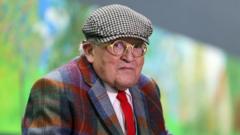
Then came the funeral. For an artist whose peroxide-blonde mop, heavy-rimmed round glasses, and defiant clashing tweeds made him one of the most instantly recognizable human beings on earth, the world expected a grand, crowded send-off. Instead, by his own fierce mandate, exactly two people walked behind his coffin: his partner, Jean-Pierre Goncalves de Lima, and his great-nephew, Richard. King Charles paid tribute from a distance. The Prime Minister issued a statement. But the actual burial happened in absolute, unbroken silence.
"I do not care for a fuss," Hockney once said, cutting through the noise with the flat Yorkshire cadence he never lost. "I don't value prizes of any sort. I value my friends."
Now, the public is being invited to step into the vast, glittering vacuum left behind by a man who spent his life teaching us how to look at the world, while systematically ensuring we couldn't look at him when he left it. His publicist, Erica Bolton, clarified the grand design of his departure. The funeral is over. The privacy of the grieving has been secured. What happens next is a global, multi-year invitation for the rest of us to say goodbye, starting with an open free exhibition at the Serpentine in London running until late August, followed by a monumental sequence of global memorials stretching from the streets of Paris to the hills of Los Angeles, and peak retrospectives at Tate Britain and Tate Modern in 2027.
But to understand why these public tributes matter, you have to understand the silent war Hockney waged against the commodification of his own soul.
The billion-pound ghost
Consider a hypothetical art collector standing in the crowded aisles of Art Basel. Let us call her Sarah. Sarah has millions to spend, and following the news of June 11, her instincts tell her to hunt down a Hockney. Death usually causes art to spike in value; it freezes the supply chain. The artist can no longer paint, so the existing canvases become finite, sacred relics.
Sarah expects to find a secondary market flooded with pieces preserved by the estate to pay for inheritance taxes or enrich distant relatives. Instead, she hits a brick wall.
Hockney pulled off a final, massive redistribution of visual wealth. His estate confirmed that the vast majority of his remaining personal collection—thousands of works collectively valued at well over one billion pounds—will not go to auction houses or private billionaire bunkers. They are being systematically given away to public foundations and regional museums across the globe.
This was not a sudden burst of deathbed generosity. It was a calculated, lifelong philosophy. Hockney spent his career fighting the idea that art belongs in a vault. By sending his personal archives directly to public institutions, he ensured that a teenager in Yorkshire or a working-class kid in East London can walk into a gallery and see his brushstrokes for free, without needing a Sotheby’s paddle.
The upcoming memorial services are structured with the same democratic intent. They are tracking the geography of his heart. The spring 2027 service at Westminster Abbey—where his magnificent, stained-glass Queen’s Window already bathes the ancient stone in vibrant hawthorn pinks and yellow wildflowers—will be open to the public. It will be followed by gatherings in the landscapes that defined him: the rolling wolds of Yorkshire, the cafe-lined avenues of Paris, and the sun-bleached asphalt of Southern California.
The radical act of noticing
We live in an era where looking has become a passive, digitized transaction. We scroll. We glance. We double-tap. We forget.
Hockney’s entire existence was an aggressive, joyous rebellion against this collective blindness. When he arrived in Los Angeles in the 1960s, locals saw a boring, sprawling desert of concrete and cheap motels. Hockney looked at the same suburban sprawl and saw an incandescent paradise of turquoise water, shifting pink shadows, and sharp, cinematic light. He took the ordinary backyard swimming pool and transformed it into an emblem of modern desire.
Later in life, when the art world assumed he would grow old gracefully and stick to oils, he bought an iPad. He began drawing on the screen with his thick fingers, capturing the dawn rising over the Normandy countryside or the sudden burst of spring in a vase of domestic lilies. He would text these digital drawings to his friends first thing in the morning. He wanted them to have fresh flowers before they even got out of bed.
He understood that an artist’s true job isn't to create an expensive commodity to be traded by hedge funds. The job is to notice harder.
Think about the way you see a tree in winter. You know it is a tree; your brain labels it "tree" and you move on. Hockney would sit in a customized car in the pouring British rain, staring at a single patch of Yorkshire woods for hours, mapping how the purple depth of a shadow changed between three in the afternoon and ten past three. He proved that nothing is boring if you look at it long enough.
The empty house
There is a beautiful, aching paradox in the news of his public memorials. The world is being invited to gather by the thousands to celebrate his life, yet the man himself fled the stage through the back door with only two people watching.
He gave everything away before he closed his eyes. The art went to the public. The money went to the foundations. The houses were left empty of his own imagery. He didn't need to live surrounded by his own genius because his genius was never about the physical canvas anyway. It was about the active, ongoing rush of the human gaze.
When you attend the exhibitions at the Serpentine this summer, or stand under the stained glass of Westminster Abbey next spring, you are not looking at a tomb. You are looking at a lens. He left the work behind in the public square so that we could continue the work for him.
Look at the sky today. Notice the exact, strange shade of blue shifting against the clouds. Somewhere, behind those iconic round spectacles, David Hockney is still smiling, thrilled that he finally got you to pay attention.