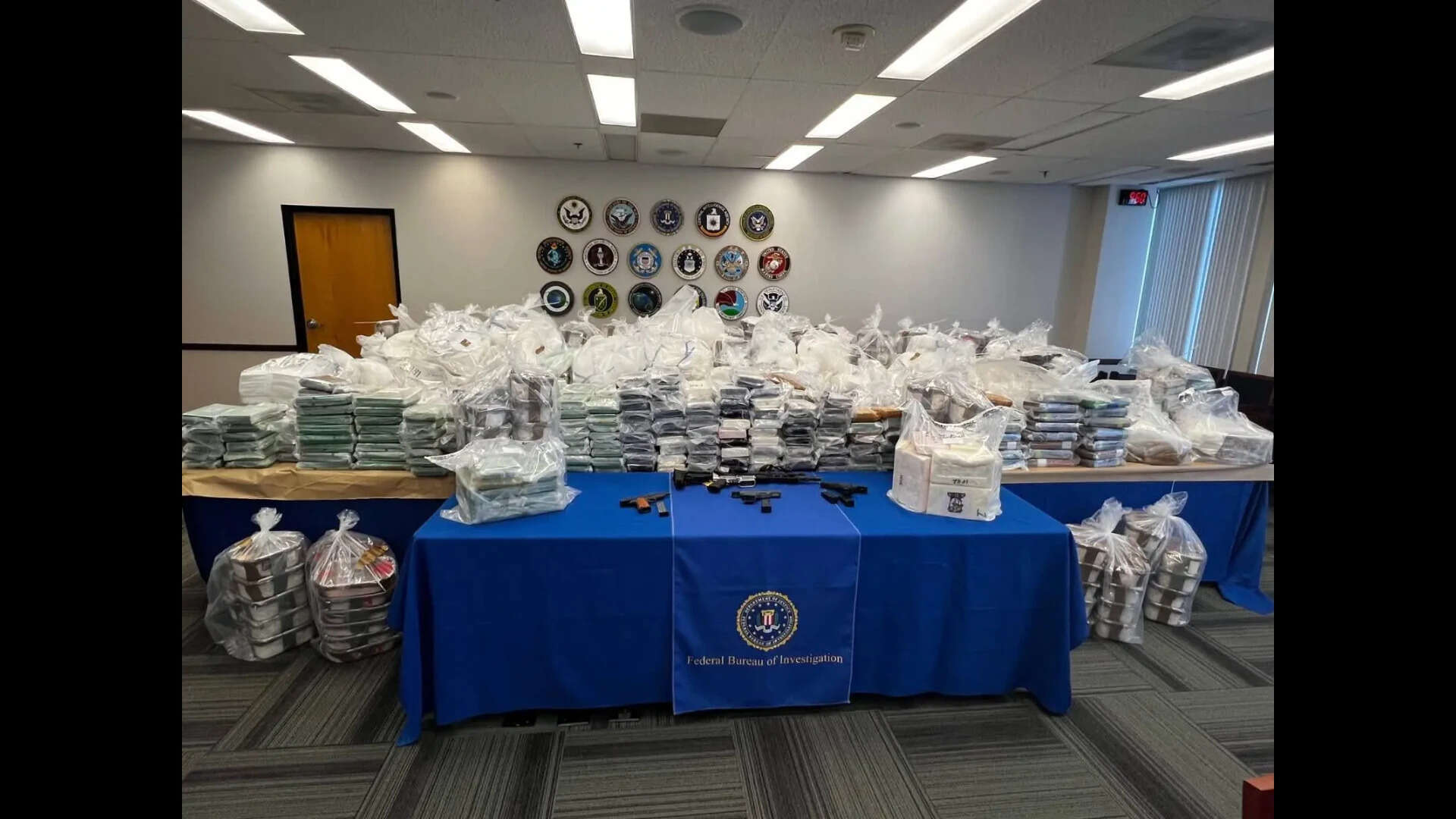
The recent guilty plea of Guramrit Sidhu in a United States federal court exposes more than a criminal enterprise; it reveals a sophisticated logistics model designed to exploit the friction between international borders and the scalability of North American supply chains. Between January and February 2021, Sidhu coordinated the movement of approximately $17 million worth of methamphetamine and cocaine. The efficiency of this operation—moving nearly 750 kilograms of controlled substances in a 30-day window—indicates a shift from traditional "smuggling" toward a high-volume, industrialized distribution framework.
Analyzing the Sidhu case requires a move away from the sensationalism of "kingpins" and toward an understanding of the Three Pillars of Illicit Supply Chain Velocity: infrastructure procurement, risk distribution, and capital recycling.
The Infrastructure of Bulk Distribution
The Sidhu network operated on the principle of nested logistics. To move 500 kilograms of methamphetamine and over 200 kilograms of cocaine across the Canada-US border, the organization required a reliable physical layer that mimicked legitimate commercial freight.
- Vehicle Specialization: The use of commercial semi-trucks provided the primary camouflage. Unlike passenger vehicles, which face higher scrutiny for behavioral anomalies, commercial freight is processed through a system that prioritizes throughput. The network leveraged the sheer volume of "just-in-time" manufacturing shipments between the US and Canada to hide its inventory in plain sight.
- Storage and Staging: The seizure of nearly half a million dollars in cash and specialized equipment during the investigation points to the necessity of staging areas. These locations serve as "decoupling points" where bulk shipments are broken down or aggregated to minimize the time any single driver spends with a high-value load.
- Geographic Arbitrage: The operation targeted specific border crossings where the infrastructure supported rapid heavy-vehicle processing. By selecting routes with the highest density of commercial traffic, the network lowered the statistical probability of an individual inspection (The Dilution Effect).
The Cost Function of Risk Management
In legitimate business, risk is managed through insurance and legal contracts. In the Sidhu model, risk is managed through compartmentalization and deniability. The $17 million valuation of the seized goods represents the "at-risk capital" of the organization, but the operational risk was distributed across several tiers of human capital.
- The Orchestration Layer: Occupied by Sidhu, this layer manages the information flow. He did not physically touch the product but functioned as the "Logistics Lead," coordinating the timing of pickups and deliveries via encrypted communication. This separation of the decision-maker from the physical asset is a fundamental requirement for scaling illicit operations.
- The Logistics Layer: This includes the commercial truck drivers and warehouse operators. In the Sidhu case, the drivers were the primary point of failure for the organization. The legal system views these individuals as the "physical link" to the crime, while the organization views them as "consumable assets."
- The Financial Layer: The recovery of $430,000 in cash suggests a high-velocity cash-to-asset conversion cycle. The organization faced a constant bottleneck: the physical volume of cash generated by $17 million in sales is significantly more difficult to transport than the drugs themselves.
The Mechanism of Value Creation
The $17 million figure is not a static number; it is a reflection of the Border Risk Premium. Methamphetamine and cocaine are significantly more expensive in Canada than in the United States due to the difficulty of crossing the 49th parallel.
The Sidhu network was essentially an arbitrage firm. It bought (or acquired) product in the US—a high-supply, lower-price environment—and sought to sell it in Canada—a lower-supply, high-price environment. The profit margin is derived from the network's ability to successfully "subsidize" the risk of seizure. When a shipment is seized, the loss is recorded as a sunk cost of doing business. The fact that the network attempted to move $17 million in a single month suggests their previous "success rate" was high enough to justify the massive capital exposure.
This lead-time compression—moving that volume in only four weeks—indicates a "blitzscale" strategy. The goal was to maximize revenue before law enforcement could complete the "OODA Loop" (Observe, Orient, Decide, Act). By the time the investigation crystallized, the network had already attempted to move enough volume to sustain multiple years of operational overhead.
Structural Failures in Network Security
The collapse of the Sidhu operation illustrates the Centralization Trap. While the network used modern logistics, it remained vulnerable at the point of human coordination.
- Communication Vulnerability: Despite the use of encrypted platforms, the "metadata" of coordination—timing, locations, and frequency—creates a pattern. Law enforcement uses link analysis to map these nodes. Once a single driver is compromised, the "digital breadcrumbs" lead directly back to the orchestration layer.
- The Weight of Success: As the volume of a network grows, its physical footprint becomes impossible to hide. Moving 700+ kilograms requires a level of physical labor and vehicle movement that creates "noise" in an environment designed for quiet, efficient commerce.
The Sidhu case proves that the primary constraint on transnational drug trafficking is no longer "access" to product, but the "efficiency" of the logistics chain. As law enforcement shifts toward data-driven interdiction, criminal organizations are forced to choose between slower, safer movements or the high-risk, high-reward model Sidhu attempted.
For the legal and enforcement sectors, the focus must shift from seizing product to disrupting the logistics-as-a-service providers. Removing the coordinator (Sidhu) is more impactful than seizing the 700kg of product, as it destroys the "intellectual property" of the route and the trust-based network required to facilitate such high-value transfers.
The strategic play for future interdiction lies in the "Financial-Logistics Nexus." Law enforcement should prioritize the mapping of "shadow" trucking companies and freight forwarders that provide the legitimate front for these operations. By increasing the cost of "logistics procurement," the risk premium of the border will eventually exceed the potential profit of the arbitrage, forcing the collapse of high-velocity models like the one Sidhu engineered.