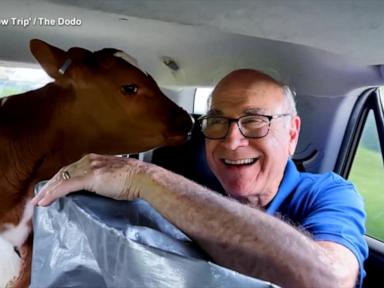
The air in the cab of a pickup truck smells different when you are hauling hope. It’s a mix of stale coffee, old upholstery, and the sharp, metallic tang of anxiety. For most people, a road trip means a change of scenery or a vacation. For a father and daughter from a small corner of the world where the pulse of the land still matters, it meant something entirely different. It meant twelve hundred miles of asphalt between a death sentence and a second chance.
Two calves. Recently making news in related news: The Twenty Five Acre Gamble That Went Up in Smoke.
To a ledger at a commercial dairy, they are rounding errors. To a steakhouse, they are future inventory. But to a young girl looking into the liquid depth of a calf's eyes, they are sentient beings with a right to breathe the morning mist. This wasn't a journey of logic. It was a journey of the heart.
The Weight of a Life
We live in a culture of the disposable. We toss out phones because the battery flickers. We abandon relationships when they get difficult. So when someone decides to spend their own money, their own time, and their own sanity to transport two farm animals across state lines, the world tends to look at them with a sideways glance. Why bother? More information regarding the matter are covered by Cosmopolitan.
The father didn't ask "why." He saw his daughter’s face. He saw the way she didn't see livestock, but lives. He understood that teaching a child that life is worth the effort—even when that life doesn't "produce" anything—is perhaps the most vital lesson a parent can ever offer. They weren't just saving calves; they were preserving his daughter's empathy in a world that tries to iron it out of us by the time we hit twenty.
The logistics were a nightmare. You don't just put a calf in the backseat and drive. There are trailers to hitch, health certificates to secure, and the constant, nagging fear of a breakdown in the middle of a literal nowhere.
Mile Marker 402
The hum of the tires against the pavement becomes a heartbeat after the first eight hours. You start to notice things. The way the light hits the grain elevators at dusk. The way the wind shakes the trailer, a reminder of the fragile cargo behind you.
Inside the trailer, the calves—small, wobbly, and utterly confused—huddled together. They didn't know they were being "rescued." They only knew the vibration of the road and the occasional sound of a familiar voice checking on them at a gas station.
Think about the sheer physical toll. Driving a heavy load requires a different kind of focus. Every brake tap is calculated. Every turn is wide and slow. The father’s hands were likely cramped around the wheel, his eyes scanning for deer, for potholes, for any threat to the cargo. Beside him, the daughter stayed awake, her phone likely dead or forgotten, her mind tethered to the animals in the rearview mirror.
This is where the human element eclipses the facts. A news report can tell you they drove from point A to point B. It cannot tell you about the quiet conversation at 3:00 AM in a fluorescent-lit parking lot, where a father realizes his daughter is becoming the kind of person who stands up for the small and the silent.
The Invisible Stakes
If they had failed, if the truck had given out or the calves had succumbed to the stress of travel, the world would have kept spinning. No stock market would have crashed. No headlines would have mourned.
But a spark in a young girl would have gone out.
That is the hidden cost of "not bothering." When we decide something is too much trouble, we chip away at our own humanity. We tell ourselves that unless a gesture is grand or profitable, it isn't worth the sweat. This duo disagreed. They chose the sweat. They chose the long, boring stretches of highway. They chose the smell of manure and the cost of diesel.
The calves represented a rejection of the industrial mindset. In the massive machinery of modern agriculture, these two were destined for a short, unremarkable end. By pulling them out of that cycle, the father and daughter performed an act of rebellion. It was a quiet, dusty, exhaust-fumed mutiny against the inevitable.
The Arrival
There is a specific kind of silence that happens when you finally turn the engine off at your destination. It’s a silence that rings in your ears. When they finally backed that trailer up to the gates of the sanctuary, the air was different. It wasn't the air of the road anymore. It was the air of home.
The ramp dropped. The calves stepped out, their hooves hitting solid ground that wasn't moving for the first time in days. They shook themselves. They sniffed the grass. They looked around at a horizon that didn't involve steel bars or concrete floors.
The daughter stood there, watching them. The fatigue of the road, the bags under her eyes, the dirt under her fingernails—it all vanished in that moment. You could see the realization hit: they did it. They actually did it.
The father watched her. He wasn't looking at the calves anymore. He was looking at his daughter, seeing a version of her that was stronger, more capable, and infinitely more compassionate than the girl who had started the trip.
We often think of heroes as people who run into burning buildings or lead armies. But sometimes, a hero is just a guy with a driver’s license and a daughter who refuses to let a light go out. They didn't save the world that day. They didn't even save a species. But for two living, breathing souls, the world changed forever. And for the two humans in the cab of that truck, the world became a place where mercy is still worth the drive.
The dust settled on the gravel driveway. The truck ticked as the engine cooled. In the pasture, two calves began to graze, unaware that they had just been the center of a two-thousand-mile miracle. The girl reached out and touched the fence, a simple wooden barrier that now marked the border between a hard past and a soft future.


